


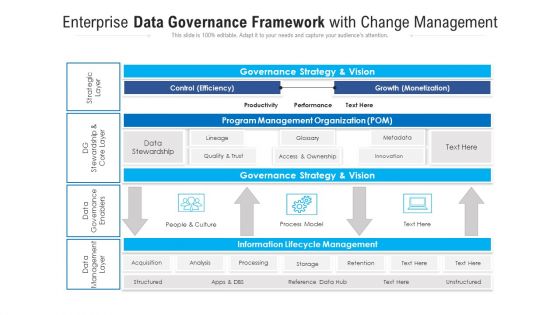
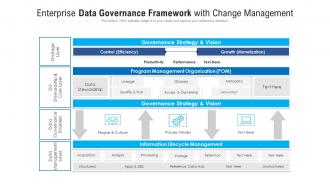
Enterprise data governance framework with change management





Try Before you Buy Download Free Sample Product
 Impress Your
 Audience
 100%
100% Editable
 Save Hours
 of Time


Our Enterprise Data Governance Framework With Change Management are topically designed to provide an attractive backdrop to any subject. Use them to look like a presentation pro.
People who downloaded this PowerPoint presentation also viewed the following :
Enterprise data governance framework with change management with all 2 slides:
Use our Enterprise Data Governance Framework With Change Management to effectively help you save your valuable time. They are readymade to fit into any presentation structure.
FAQs for Enterprise data governance framework
Honestly, you need four key things to make this work. First is data stewardship - basically assigning clear owners to different data areas. Then policies and standards for handling everything. Quality management comes next to keep accuracy in check. And compliance frameworks, obviously. The tech infrastructure piece is huge too - that's where most companies totally blow it. But real talk, stewardship matters most because without actual owners, your policies become meaningless suggestions. I'd start by figuring out who should own what data domains first, then build everything else around those relationships. Makes the whole process way smoother.
Look, data governance is basically your roadmap for actually following GDPR and CCPA rules instead of crossing your fingers. You'll need solid processes for classifying data, setting retention policies, and controlling access - regulators expect all that stuff. It also spells out who does what when things go sideways (which they will). Without it, you're screwed when handling data requests or breach notifications. Honestly, proving you have legit reasons for processing personal info becomes a nightmare. First step? Map out what data you've got and where it's hiding - everything builds from there.
So data stewards are like your go-to people who actually make governance work in real life. They're the ones implementing policies, checking data quality, handling access requests - all the stuff that matters daily. Usually they're subject matter experts who get both the technical side and business needs. Honestly, I've seen too many companies skip this part and wonder why their governance fails. Short sentences work here. These stewards bridge IT and business users, which is harder than it sounds. Without them, you just have nice policies gathering dust. Get yours identified early and give them proper authority to do their job.
Here's how I'd tackle data governance maturity - check five main areas: policy development, data quality, who's accountable for what, your tech setup, and whether people actually buy into it. Most companies totally overestimate where they are (classic move). Rate yourself 1-5 in each area. Do you have clear data owners? Written processes that people follow, not just ignore? Real measurable results? The cultural piece is honestly the hardest part. Be super honest about gaps - like, painfully honest. Then pick your top priorities and start there. Don't try fixing everything at once.
Start with a good data catalog - think of it as your master inventory. Quality monitoring tools come next to catch problems early. Metadata management tracks where stuff comes from and what it means. The catalog setup is honestly a pain at first, but trust me on this one. You'll also need access controls and classification for security (compliance teams love that stuff). Workflow automation handles approvals and keeps policies running. My advice? Begin with your most critical datasets, then gradually expand. Don't try to catalog everything at once or you'll burn out.
Honestly, start with like 3-5 metrics that actually matter to your original goals. Data quality scores are obvious ones. Compliance audit results too. I'd also track how long people wait to get data they requested - that one's huge for adoption. The soft stuff matters more than you'd think though. Survey your users about whether they trust what they're seeing. Are people still making random Excel files instead of using official data? That's a red flag right there. Oh, and track incidents or breaches going down over time. Review everything quarterly so you don't lose momentum.
Honestly? Leadership buy-in is always the nightmare part. Different departments hoard their data like it's gold or something - nobody wants to share because of those stupid turf wars. Then you've got the whole mess of figuring out who's actually responsible for what data. Legacy systems make everything worse since they weren't designed for this stuff. Oh, and defining clear roles? Good luck with that one. Start with just one important dataset though. Prove it works, then slowly expand. Way less overwhelming that approach.
Honestly, it's all about what regulators care about in your industry. Healthcare is brutal - HIPAA makes everything about patient privacy and who can access what. Meanwhile finance deals with SOX and PCI stuff, so they're obsessed with tracking every transaction and catching fraud. Both industries have crazy strict rules, but the focus is totally different. Healthcare worries more about consent and keeping data locked down. Finance? They want real-time monitoring of everything. I mean, both will get you in massive trouble if you mess up, but the actual day-to-day work looks pretty different depending on which beast you're dealing with.
Honestly, get everyone involved from day one - data owners, IT folks, business users, the whole crew. Don't make it feel like you're handing down commandments from corporate. Nobody wants another boring compliance meeting. Instead, run actual working sessions where people talk about real problems they're dealing with. Show some quick wins early on, like fixing those annoying data quality headaches that've been driving everyone nuts for months. That stuff matters way more than perfect documentation. Oh, and ditch the tech jargon when you're talking to business people. They care about results, not governance frameworks.
Honestly, ML is a game-changer for data governance stuff. You can train it to automatically spot sensitive data and flag quality problems without doing everything by hand. The automated tagging alone will save you hours - I'm talking about cataloging assets, tracking data lineage, all that tedious work. Real-time monitoring catches weird access patterns too, which is pretty clutch. My advice? Don't try to automate everything at once though. Start with something simple like data classification and build from there. Way less overwhelming that way.
Track four main things: completeness (missing fields), accuracy (does it match reality), consistency (same data looks identical everywhere), and how fresh your info is. Validity metrics matter too - basically checking if data follows your rules. Oh, and duplicates are honestly the worst because they screw up everything later. I'd set up automated dashboards for all this stuff so you catch problems early. Alerts help when things go sideways. Start simple though - don't try to measure everything at once or you'll burn out.
So first things first - figure out what data you actually have and how sensitive it is. Group your users based on what they need for their jobs, then only give them access to those specific things. Honestly, most companies mess this up by trying to add security after everything's already built. You want to build privacy protections right into your processes from the start. Be upfront about what you're collecting and why - people appreciate transparency. Oh, and don't forget to review who has access to what every few months. People change roles and you'll end up with weird permissions everywhere.
Dude, bad data governance turns every business decision into a total guessing game. You can't trust what you're looking at, so you're making calls with garbage information - kinda like using a GPS that's three years out of date. Your team ends up second-guessing every single report. Decisions drag on forever while everyone's scrambling to find the "real" numbers, and by then you've already missed half the good opportunities. Honestly, the whole thing's exhausting. Start simple though - figure out who owns what data and set up some basic quality checks. Build from there once that's actually working.
Honestly, culture is like 70% of whether your data governance thing will work or not. When your company's already moving toward being more open and collaborative, people actually want to share data and be accountable. But those old-school departments that hoard everything? They'll fight you constantly. I'd say time it right - wait for when there's already momentum happening. Get your leadership to actually do what they're asking everyone else to do (shocking concept, I know). Find those people in each department who are already bought in and let them spread the word. Way more effective than top-down mandates.
Definitely check out those AI governance tools - they'll handle all that tedious compliance stuff you hate doing manually. Privacy laws are popping up everywhere now, not just Europe, so you're dealing with way more scope. Real-time data lineage is finally becoming standard (thank god, because batch processing is such a pain). Companies want to democratize data but also lock down sensitive info - it's this weird balancing act. Oh, and don't wait to evaluate automated platforms. Trust me, you don't want to be scrambling later when things get crazy busy.
No Reviews