

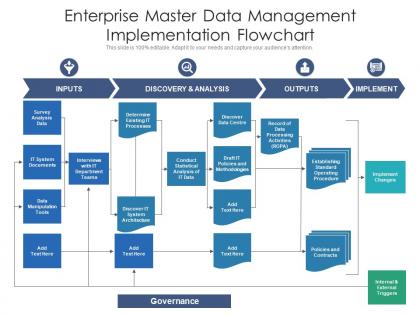
Enterprise master data management implementation flowchart




Try Before you Buy Download Free Sample Product
 Impress Your
 Audience
 100%
100% Editable
 Save Hours
 of Time


Our Enterprise Master Data Management Implementation Flowchart are topically designed to provide an attractive backdrop to any subject. Use them to look like a presentation pro.
People who downloaded this PowerPoint presentation also viewed the following :
Enterprise master data management implementation flowchart with all 2 slides:
Use our Enterprise Master Data Management Implementation Flowchart to effectively help you save your valuable time. They are readymade to fit into any presentation structure.
FAQs for Enterprise master data
So basically you get super clean data across everything - no more arguing between departments about whose numbers are right. Your compliance people will actually thank you for once since reporting becomes way easier. I've seen companies slash their data mess by 70% which is honestly wild. Customer experience gets better too since their info matches everywhere they interact with you. Oh and you'll waste way less time fixing duplicate records and conflicting stuff. Start with whatever data matters most to your business first. That's where you'll see results fast and can justify the whole thing to leadership.
So MDM basically becomes your single source of truth for customer data - no more duplicate records floating around everywhere. It standardizes formats and catches inconsistencies before they mess up your whole system. Honestly, it's like having a really picky editor cleaning up all your data constantly. You won't deal with those annoying "wait, which address is the real one?" moments anymore since there's just one master record feeding all your other systems. I'd probably start with your most important data first though, then build out from there. Way less headache that way.
Honestly, the data mess will hit you first - duplicates and missing info everywhere. Your team's gonna hate any new processes that slow them down, trust me on that one. Legacy systems? Good luck getting those to cooperate with anything modern. I'd say start small with a pilot project and map out your data early. Don't skimp on training either - spend way more time on it than you think you need. Oh, and that whole governance thing takes forever, so factor that in from day one.
Get everyone in the room from the start - IT for the tech stuff, data governance to set standards, and business users who actually know what data matters. Legal/compliance will save your butt with regulations (seriously, don't add privacy controls as an afterthought). You'll need executive sponsors too since these projects eat budget. Oh, and map out who owns what data first - that alone can be a nightmare. Once you know the key players, drag them into planning sessions. Short version: involve everyone or watch it fail spectacularly later.
So you gotta track both the techy stuff and business results. Start with data quality - fewer duplicates, better completion rates, that kind of thing. Business-wise, look at faster product launches or happier customers. ROI calculations are honestly a pain but worth doing - just compare what you spent vs what you're saving now. Monthly dashboards work great for monitoring everything. Oh, and actually ask your team if the system's helping them or just creating more work. That last part tells you way more than most metrics do.
For enterprise MDM, I'd go with AWS or Azure as your base - their APIs are solid. Pair that with Informatica or Talend for integration stuff. SQL Server or Oracle handle the database side well enough. Honestly? Those vendor meetings will kill your soul, but don't get too caught up in fancy features. Your data stewardship and how clean your source systems are matter way more than whatever shiny tool the sales guy is pushing. Oh, and definitely audit what you've got now before you start shopping around - saves you from buying stuff you don't actually need.
So data governance is what makes MDM actually functional - skip it and you're building a pretty disaster. You need someone owning each piece of data, plus clear rules for cleaning and validating everything. Without good stewardship roles, your master data just becomes junk over time. Business rules are huge too - they handle conflicts when different systems disagree about the same info. Honestly, I'd find your data owners first since they're the ones who'll define those rules and keep things from going sideways. Quality standards matter, but the people part is what really makes or breaks it.
Honestly, MDM is a lifesaver for compliance stuff like GDPR and HIPAA. You get all the encryption controls, data retention policies, and audit trails that make auditors happy. Remote wipe is clutch when someone inevitably loses their phone. The BYOD thing is probably the biggest win though - you can totally separate work data from personal stuff. My advice? Don't make the same mistake we did and try adding MDM after rolling out devices. Set up your compliance policies first, then deploy everything. Trust me, it'll save you so many headaches later.
Start with unified data models and get cross-functional governance teams actually talking to each other. Standard APIs help too, but honestly? A centralized data catalog is where I'd put my money first - stops teams from reinventing the wheel constantly. Pick your 2-3 worst problem areas and fix those before going crazy with everything else. Half the battle is organizational anyway since departments love their little kingdoms. Don't overthink it - prove it works on a small scale, then expand from there. Way easier than trying to fix everything at once.
Start with mapping out what you've got - do a full inventory of your legacy systems and how data moves between them. Don't try replacing everything at once, that's just asking for trouble. Instead, build APIs or middleware to connect your existing stuff to the new MDM hub. Pick your most critical data first and set up solid governance rules from the start. Go one system at a time - integrate, check data quality, then move on. Honestly, I'd start with whatever's lowest risk but gives you the biggest win as a pilot. Way less stressful that way.
Start with your golden records and work backwards - trust me on this one. Define those parent-child relationships between entities before you dump everything in. Granular attribute definitions are key, but don't overthink it (made that mistake once). Build for current state AND historical tracking from the start. Retrofitting later? Total nightmare. Oh, and get your business users involved early in the modeling process. They spot weird edge cases IT misses every time. Document as you go too - not when you're scrambling later trying to remember why you made certain choices.
Look, MDM basically gives you one clean version of all your customer data instead of having it scattered everywhere. No more awkward situations where your sales team has no clue what promises support made last week. Your marketing stops sending those cringy irrelevant emails too - you know the ones. When everything flows between systems properly, you can actually respond fast and anticipate what customers need. Honestly makes such a difference for building real relationships. I'd start by figuring out where your customer touchpoints are now and spotting those annoying data silos that mess up the whole experience.
MDM is what makes your analytics actually trustworthy. Think garbage in, garbage out - if your master data is messy, your insights will be too. It standardizes stuff like customer records and product info across systems so you don't get weird duplicates messing up your dashboards. I've seen people pull reports with three different spellings of the same company name, which is just embarrassing. Your data quality directly impacts everything downstream. Start with whatever master data matters most for your specific analytics, then clean that up first. Don't try to boil the ocean right away.
Honestly, start with proper training right away - people won't use what they don't get. Do hands-on sessions showing real benefits, not boring policy stuff. Your IT team better be available for support too. Nothing tanks adoption faster than frustrated users stuck without help. I've watched so many rollouts crash because leadership thought everyone would just figure it out themselves (spoiler: they won't). Get champions in each department to help teammates and give feedback. Oh, and connect MDM to actual business wins so it doesn't feel like another security headache to deal with.
So the big things to watch right now are zero-trust security, AI-powered device management, and UEM platforms that handle everything from phones to IoT stuff. Cloud-native MDM is pretty much the standard at this point - honestly, on-prem feels ancient now. Privacy regs are forcing better data governance features too. Hybrid work means way more personal device management. The coolest shift? Predictive analytics that catch problems before they blow up. You should definitely check if your current setup can handle remote-first teams, especially if you're stuck with legacy systems that don't play nice.
-
Graphics are very appealing to eyes.
-
Really like the color and design of the presentation.
-
Wonderful templates design to use in business meetings.
-
Great designs, Easily Editable.
-
Designs have enough space to add content.