


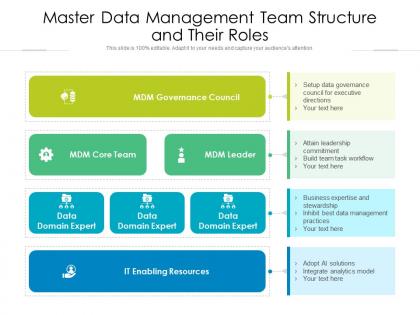
Master data management team structure and their roles




Try Before you Buy Download Free Sample Product
 Impress Your
 Audience
 100%
100% Editable
 Save Hours
 of Time


Our Master Data Management Team Structure And Their Roles are topically designed to provide an attractive backdrop to any subject. Use them to look like a presentation pro.
People who downloaded this PowerPoint presentation also viewed the following :
Master data management team structure and their roles with all 2 slides:
Use our Master Data Management Team Structure And Their Roles to effectively help you save your valuable time. They are readymade to fit into any presentation structure.
FAQs for Master data management team structure
So there are basically four roles every MDM team needs. Data Stewards are your cleanup crew - they hunt down duplicates and keep standards tight. MDM Architects design the whole structure and figure out integrations. Then you've got Data Analysts doing reports and tracking metrics (trust me, you'll love having them when your boss starts grilling you about data accuracy). Business Analysts are the translators - they take what the business wants and turn it into tech requirements. Titles change everywhere but the jobs stay the same. I'd look around and see who's already doing this stuff unofficially.
Yeah, MDM teams vary like crazy depending on your industry! Finance companies build these huge compliance-heavy teams with dedicated data stewards - regulatory stuff is no joke there. Healthcare's interesting because they need clinical data specialists on top of the usual MDM people, patient data gets messy fast. Manufacturing goes heavy on product data experts and supply chain folks. Retail keeps things lean, smaller teams handling customer and product integration. Honestly, the more regulated your industry is, the bigger team you'll probably need. I'd check out what similar companies are doing for team size - that's usually a good starting point for figuring out your structure.
You'll definitely need the technical stuff - SQL, data modeling, maybe some experience with platforms like Informatica. But here's the thing: communication skills are actually way more critical. You're basically translating between business people who just want their data to work and the technical reality of why it's all screwed up. Analytical thinking helps too since data quality issues can get pretty messy. Oh, and project management - MDM projects touch literally everything. Honestly though? Start with stakeholder management first. Learning the tech is straightforward, but getting people to actually care about data governance? That's the real challenge.
Your MDM team can't work alone - they've gotta be the bridge between IT and business units. Start with regular cross-functional meetings where business folks define what quality looks like while IT figures out the tech stuff. Get dedicated liaisons from each department who actually speak both languages (seriously, this prevents so many headaches). Build dashboards everyone can read, not just the data nerds. Set up clear paths for when things go wrong. Oh, and don't make governance feel like you're the data police - nobody likes that. Pick one tiny pilot project first where everyone wins something.
You need clear roles first - data stewards for each area, business owners making decisions, and a tech team handling the actual work. Don't let approval chains get crazy though (saw one place with 12 people signing off on tiny fixes, absolute nightmare). Build in escalation paths so stuff doesn't just sit there forever. Your governance needs real decision-making power when people disagree. Regular reviews help but keep them short and focused. Oh, and document processes properly - nothing worse than onboarding someone who has to figure out everything from scratch.
Dude, definitely get those regular stand-ups going and nail down who owns what data. Weekly cross-team meetings are clutch - but make them about actual problems, not just boring status stuff. I've watched so many MDM projects crash because business analysts and engineers barely talked to each other. It's honestly brutal. Keep shared docs that everyone can update easily. Oh, and make sure people know exactly who to hit up when data goes sideways. The trick is making it feel natural instead of, you know, death by meetings that drain everyone's soul.
Honestly, the worst part is everyone hoarding their data like it's gold. Marketing won't share with sales, IT guards everything, and good luck getting anyone to agree on which system has the "real" customer info. Politics get ugly fast. Legacy systems make it worse since nothing connects properly - trust me on this one. Executives don't see immediate ROI either, so getting budget is brutal. Nobody wants to pay for something that touches every department but doesn't show flashy results right away. Find your worst data quality problems first, then buddy up with whoever's suffering most from those issues.
Quarterly formal sessions are your baseline, but monthly lunch-and-learns work way better for specific issues or new features. Cover the big stuff quarterly - governance changes, process updates, MDM basics refreshers. Don't wait for scheduled training though. Data standards rollout or quality issues spiking? Call something immediately. I always keep a running list of topics from team questions and pain points - honestly saves so much time when planning. The ongoing touchpoints matter more than people think.
Track your accuracy rates and how fast they're fixing duplicates - that's the basic stuff. But honestly, stakeholder satisfaction matters more than you'd think. Happy users mean your team's solving actual problems instead of just hitting numbers. Also measure how quickly they onboard new data sources. For business impact, look at cost savings from eliminating duplicates and faster decision-making. Monthly dashboards work great for spotting trends. Oh, and definitely celebrate the wins with your team - keeps morale up when they see their work making a difference.
Yeah, team size matters but it's more about getting the right people than just throwing bodies at it. You want data stewards, analysts, maybe some business folks who actually get the domains you're working with. Go too small and you'll be drowning in requests. Too big though? I've watched 15-person teams where everyone's stepping on each other and nobody knows who's responsible for what - total mess. Most mid-size companies do well with like 5-8 people. Start with getting different skills covered first, then grow it out based on how much data you're actually dealing with.
Honestly, tech is a game-changer for MDM teams because it handles all the boring repetitive work. Get data integration tools that pull from everywhere automatically. Quality checks catch mistakes before your people waste time on bad data. Workflow platforms are clutch too - they send issues to whoever needs to fix them without you playing traffic cop all day. Real-time dashboards beat digging through endless spreadsheets (seriously, why do some teams still do that?). The trick is picking what actually works for how your team operates, not whatever's trending.
Honestly, most MDM teams just work in their own bubble without getting what the business actually wants. Start by mapping your data stuff directly to things execs care about - revenue, customer experience, making operations run smoother. I always tell people on my team to think like they own the business first, then worry about the data part. Check in regularly with stakeholders because priorities change all the time (trust me on this). The real trick is showing how your technical wins translate to business impact. Like, cleaner customer data means better marketing ROI or products launch faster. Make that connection obvious.
Honestly, you've got to get everyone actually involved in decisions, not just asking their opinion. Set up committees where business units can vote on stuff, not just IT calling the shots. Those monthly data clinics work pretty well - departments bring their actual problems and work through them together. Make sure people see how messy data screws with *their* numbers, not just some abstract IT dashboard. Get data stewards from each area too. Here's the thing though - if it's not in their job description and reviews, forget it. People will always prioritize what they're measured on first.
Honestly, get your escalation sorted out before things go sideways. Have data stewards categorize problems by how bad they are right away. Make business users log stuff directly in your tracking system - email chains are absolutely brutal for this. Your tech team should run quality reports daily so you're not just sitting around waiting for people to freak out. Oh, and do weekly reviews where everyone can see what got fixed and what's still broken. Keeps people from panicking about the same stuff over and over.
Your MDM team is basically what keeps your analytics from being garbage. They clean up all the messy data so you don't get duplicate customers or weird inconsistencies screwing up your dashboards. Honestly, they're like data janitors but way more important than that sounds. Golden records, data lineage - all that stuff BI teams need? That's their thing. Here's the real advice though: loop them into your big analytics projects right from the start. Trust me, you don't want to be the person explaining to leadership why the same customer appears three times in your report.
-
Nice and innovative design.
-
Professional and unique presentations.
-
Excellent work done on template design and graphics.