


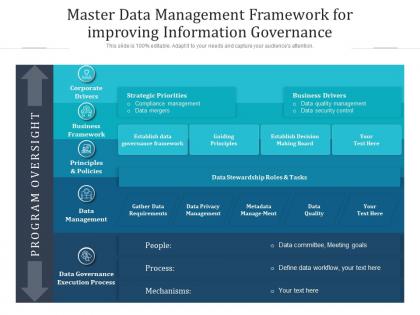
Master data management framework for improving information governance




Try Before you Buy Download Free Sample Product
 Impress Your
 Audience
 100%
100% Editable
 Save Hours
 of Time


Our Master Data Management Framework For Improving Information Governance are topically designed to provide an attractive backdrop to any subject. Use them to look like a presentation pro.
People who downloaded this PowerPoint presentation also viewed the following :
Master data management framework for improving information governance with all 2 slides:
Use our Master Data Management Framework For Improving Information Governance to effectively help you save your valuable time. They are readymade to fit into any presentation structure.
FAQs for Master data management framework for
You'll need data governance first - figure out who owns what data. Get some integration tools and a central spot for your clean "golden records." Quality processes are huge too. Someone needs to actually own keeping this stuff maintained, otherwise it'll turn into a mess again in like 6 months. Model out how your customer or product data should look across all systems. Workflow management helps with approvals, plus you want lineage tracking. Honestly though? Start small with just customers or one domain. Way easier than trying to fix everything at once.
Run a data profiling check on your main systems first - look for duplicates, missing info, and inconsistent formatting. Customer names, addresses, product codes, that kind of stuff. Most companies are genuinely horrified when they see the mess! Don't go crazy trying to analyze everything though, just hit your most critical data first. SQL queries work fine if you don't have fancy tools. Oh, and definitely document what you find - that becomes your whole business case for why you need MDM in the first place.
Oh totally, you need solid tech for MDM or you'll drown in chaos. Data integration platforms are a must to connect everything, plus quality tools for cleaning up the mess. Don't forget governance workflows too. Here's the thing though - figure out your business requirements first before you get excited about shiny software. I've seen companies blow their budget on fancy tools that don't actually fix their data headaches. The tech should work for you, not the other way around. Start with what you need, then find tools that fit. Way better approach.
So basically, MDM means everyone who talks to your customers has the same info - support, sales, whoever. No more asking people to repeat their account details for the third time (honestly, that drives me nuts when I'm the customer). Your team can actually personalize stuff instead of starting from scratch every conversation. First thing I'd do? Figure out where all your customer data is scattered right now. That's usually the mess you need to clean up before anything else works. Once you fix that, you'll actually deliver those smooth experiences instead of just promising them.
Honestly, the biggest pain points are always data quality being a mess, people refusing to give up their beloved Excel sheets, and everyone underestimating how complex integration gets. Start small though - pick one area like customer data instead of trying to fix everything at once. Get your stakeholders on board early by showing them what's in it for them, otherwise you'll hit walls constantly. Oh and definitely do your data profiling and cleanup first. I learned that the hard way on my last project. Trust me, skipping that step just creates bigger headaches later.
So here's the deal with MDM - it creates one solid source for all your important data, which auditors absolutely love. No more embarrassing situations where your CRM says one thing and your billing system says another (trust me, I've seen executives sweat through that). Quality rules get enforced automatically, plus you can trace where data comes from and where it goes. The governance side is pretty straightforward: assign clear data owners, standardize your processes, and set up controls that block crappy data before it causes problems. Honestly, once you get proper stewardship roles in place, compliance reviews become way less stressful.
So operational MDM is for real-time stuff - like when customer service needs someone's current info right now. Analytical is more about getting clean data for reports and dashboards. Then there's foundational, which is kinda like the old data warehouse thing, but honestly most companies don't bother with it anymore. It just sits there feeding other systems without the real-time benefits. I'd go operational if I were you - you get the real-time access plus decent analytics. Two birds, one stone sort of deal.
So basically MDM gives you one master version of your data that pushes out to everything else. Right now your customer info is probably all over the place - sales has one version, marketing another, support something totally different. It's a mess, honestly. You create this single source that syncs everywhere automatically. Set up some validation rules and deduplication stuff to catch problems before they spread. Real-time integration handles the rest. I'd start small though - map out where your key data sits now, then just pick customers or whatever domain matters most and pilot it there first.
So basically MDM creates one clean version of all your important data - customers, products, suppliers, whatever. No more digging through different systems or wondering which duplicate record is actually right. Your teams can just grab the info they need without all that annoying back-and-forth. Decision-making gets way faster, and departments actually start working together better since they're not arguing over conflicting data. Honestly, the time you'll save on manual cleanup alone makes it worth it. I'd say pick your messiest data problem first and start there.
So start with the basics - completeness, accuracy, consistency across your master records. Those are your main indicators. Then track duplicate rates and how fast you're fixing data issues. Honestly, user adoption is huge because perfect data sitting unused is pretty pointless. Also watch for operational wins like less time doing data reconciliation and fewer angry customers calling about bad info. Oh and resolution times for when downstream systems get messy feeds. Pick 3-4 metrics max though - I made the mistake of trying to measure everything once and it was chaos.
Dude, MDM is a game changer for executives. You know how finance and sales always have totally different customer numbers? That stops happening. Leaders get one consistent data source instead of spending half their time figuring out who's right. Decisions get made faster, forecasting actually works, and they can spot trends before competitors do. Honestly, flying blind with bad data is how companies miss huge opportunities. The trick is setting up solid data governance upfront - otherwise you're just moving garbage around faster. Your C-suite will thank you when they're not drowning in conflicting reports anymore.
Honestly, the biggest thing is getting leadership on board first - without that you're dead in the water. Then focus on training that actually shows people what's in it for them, not just how the system works. Find your power users early and turn them into champions. Make the interface as simple as you can (this sounds obvious but so many companies mess it up). Celebrate every small win loudly so people see progress. Oh, and actually listen when users complain and fix stuff - don't just nod and ignore them. People can tell the difference.
First thing - figure out what data actually matters for your business. Healthcare companies obsess over patient records and HIPAA stuff, but retail is more about product catalogs and knowing their customers inside out. Financial services? Completely different world - they're drowning in risk data and compliance reports. Start by mapping your critical processes, then build your MDM strategy around those. Manufacturing focuses on supplier/parts data, telecom lives and breathes customer relationships. Honestly, I've seen too many companies pick fancy tools before understanding their actual pain points. That's backwards. Audit what's broken first, then choose your governance approach.
Look, data stewardship is what makes or breaks your MDM project. Without dedicated people owning data quality, you're just shuffling mess around. These folks resolve conflicts - like when one customer shows up five different ways in your system (happens more than you'd think). They set the rules for data maintenance and act like referees between IT and business teams. Short sentences work. Find people in your company who actually care about data accuracy - those detail-oriented types who notice when something's off. They'll become your stewards and keep everything clean long-term.
Honestly, AI has made MDM so much better. Gone are the days of manually hunting down duplicate records - algorithms now handle matching and deduplication automatically. Quality monitoring happens in real-time too. The pattern recognition is actually insane these days. Your system learns from corrections you make and gets smarter over time. It'll even flag potential data issues before they blow up into bigger problems. My advice? Start with something simple like customer matching first. Let it prove itself there, then you can expand to other areas once you're convinced it works.
-
Great designs, Easily Editable.