


Master data management four components




Try Before you Buy Download Free Sample Product
 Impress Your
 Audience
 100%
100% Editable
 Save Hours
 of Time


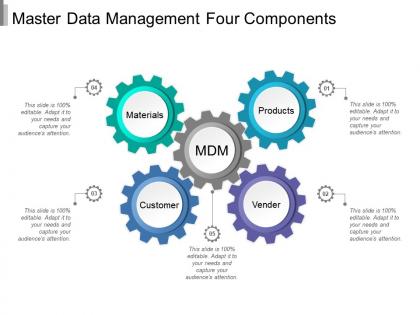
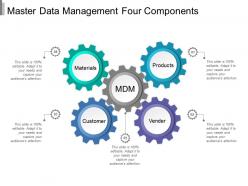
Check our master data management four components PowerPoint slide. In business industry, the term master data management is a technique that is used to describe and manage the important data of a company to provide with data integration. Any data that is mastered may include reference and analytical data. This presentation template shows four crucial aspects of the master data management such as materials, products, customer and vendor. Managing the data in the organized way is vital as it assists you to achieve strategic goals and financial results. Corporate professionals can improve the ability to get real time access to the accurate data by implementing master data management practices. Our PPT layout is quite useful for the people working in the networking team as they can understand the concept in the better way and can communicate the message to other team members. This PowerPoint diagram is completely editable so you can edit and replace the content at any stage as per your preference. Download master data management four components PPT design. Guide them through the grind with our Master Data Management Four Components. Equip them to handle hardship.
People who downloaded this PowerPoint presentation also viewed the following :
Master data management four components with all 5 slides:
Don't allow the applause to go to your head with our Master Data Management Four Components. It helps downplay achievements.

FAQs for Master data
Okay so you need five things to make MDM actually work. Data governance first - somebody has to be the decision-maker on quality stuff. Integration tools are huge because you've got data everywhere (seriously, it's probably worse than you think). Standardized models so teams aren't talking past each other. Quality processes to stop bad data from spreading like wildfire. Oh, and assign actual people as stewards - can't just be "everyone's responsibility" because then it's nobody's. Honestly? Start by just mapping where your critical master data sits right now. That reality check will tell you everything.
So MDM is basically your data's referee - it makes sure everyone's using the same customer info, product details, all that stuff. You know how marketing always has different numbers than sales? Yeah, that stops. It catches duplicate records, fixes weird inconsistencies automatically, and keeps everything synced up across your systems. Honestly, it's kind of a lifesaver once you get it running. Your teams won't be fighting over whose data is "right" anymore. Just start with your most important stuff first - like customer records - don't try to fix everything at once or you'll go insane.
Oh man, you're in for it. Data quality will be your biggest headache - everything's scattered everywhere with duplicates and gaps. Honestly, most companies' data is just chaos. Getting different departments to play nice? Good luck with that. Everyone swears their version is the "right" one. Then there's the technical nightmare of connecting old systems to new MDM platforms. Don't even get me started on trying to get teams to agree on standards. My advice? Pick one data area and focus there first. Trying to fix everything at once is basically suicide.
Honestly, data governance is what makes or breaks your MDM project. Without it you're basically burning money on a fancy data dump. You need clear ownership - like who's responsible for customer data vs product info. Set quality standards upfront and create rules for how data gets added, changed, or deleted. Traffic laws analogy is pretty spot on actually - no rules means total chaos. Don't forget about compliance stuff either, that'll bite you later. My advice? Find your data stewards first and get ownership sorted out. That alone solves like 50% of your headaches.
Track your hard savings first - stuff like lower storage costs, fewer compliance fines, less time on data cleanup. But honestly? The soft benefits usually matter more, even though they're harder to measure. I'm talking about faster decisions, better customer scores, that kind of thing. Get your baseline numbers before you roll out MDM, then check monthly on data quality, process speed, error rates. Oh and build a simple dashboard to watch these metrics - makes it way easier to spot trends. The soft stuff might not have clear dollar signs but it's often where you see the real wins.
So for MDM, check out Informatica MDM, IBM InfoSphere, or Microsoft MDS - they're solid core platforms. They handle data integration, deduplication, all that governance stuff. But honestly? The specific tool doesn't matter as much as getting your data quality processes sorted first. You'll need ETL tools too (Talend or SSIS work well) to pipe data in, plus something for data profiling so you actually know what mess you're dealing with. Oh, and start by auditing your current sources and nailing down your golden record rules. That'll make picking the right stack way easier.
So MDM basically keeps all your data clean and consistent, which honestly saves you from so much compliance headache. When auditors show up, you'll actually have proper records to show them instead of frantically digging through random spreadsheets. It also gives you one place to control all customer data - super helpful for privacy stuff like deletion requests or figuring out what info you even have on people. The trick is getting your governance rules right from the start. That way the system handles compliance automatically rather than you doing everything manually (trust me, that gets old fast).
So MDM gives you one clean view of customers instead of having messy data everywhere. Your teams stop sending mixed messages because they're all looking at the same info. Sales spots upsell chances quicker. Support doesn't fumble around trying to figure out who someone is. Marketing actually makes sense for once. It kills those annoying duplicate records too - you know, when John Smith shows up as three different people in your system. Start by checking what customer data you currently have. Trust me, you'll find way more inconsistencies than you think, and that's basically your to-do list right there.
So operational data is all your daily transaction stuff - orders, payments, inventory moves, you know? Then you've got analytical data, which is basically that same info but chopped up for reports and insights. Master data though? That's your foundation - customer records, product catalogs, supplier info. I always think of master data as the "golden record" everything else pulls from. Honestly, if your master data's a mess, everything downstream gets screwed up too. Your operations go sideways and analytics become totally unreliable. So when you're seeing weird inconsistencies across systems, definitely start by checking your master data quality first.
First thing - map out where your data actually lives and find the silos. Most places skip this boring part and go straight to buying software, which is dumb. Get a team together with people from each department who can actually push this thing forward in their areas. Honestly, the office politics will be way more brutal than any technical stuff. Create data definitions that everyone can agree on (good luck lol), then use your MDM tool to make sure those standards stick. Oh and start small - pick customers or something critical, show it works, then expand from there.
Honestly, start with checking your data quality first - garbage in, garbage out is so real it hurts. Map out where all your data's coming from so you're not flying blind later. Build in validation rules and error handling right away, don't wait on that stuff. Use incremental loads instead of refreshing everything each time, your performance will thank you. Oh and document everything as you go (I know, boring but necessary). Pick one important area to start with, get that working smoothly, then expand from there. Way less painful than trying to do everything at once.
Show them what it's costing them right now - like all the hours wasted on duplicate customer records. Quick wins first, because let's be real, data governance sounds boring until it fixes their headaches. Get exec buy-in early and involve people from different departments. Don't just have IT make all the decisions (that never works). Oh, and definitely find some champions in each team who can sell it internally - way more effective than top-down messaging. Regular updates with concrete examples help too. People need to see actual progress, not just reports.
You absolutely need data stewardship for MDM to work - it's like having referees for your data. Without designated people owning data quality, everything falls apart fast. Stewards resolve conflicts when systems disagree and set rules for how data should behave. They're the translators between IT and business folks, which honestly can be like mediating between two different species sometimes. Look for people in your org who already obsess over data accuracy. Those are your future stewards right there.
Dude, cloud MDM is honestly a game changer. You get that elastic scaling without being stuck with crazy expensive on-premise stuff that takes forever to update. Real-time sync across everything is clutch too. The APIs are usually way cleaner, so connecting systems doesn't make you want to pull your hair out. Plus automatic updates happen without your team dealing with it - which is nice because who has time for that? I'd start with your most critical data stuff and run a pilot there first. Way easier to show it actually works.
So you're gonna want to watch AI automation for data quality - it's getting pretty solid. Real-time MDM is blowing up right now, and honestly everything's just moving to cloud-native by default. Graph databases are having a moment too (they're actually way cooler than they sound once you mess around with them). Self-service governance tools are huge because business folks can finally handle their own data without bugging IT constantly. Oh, and privacy features are baked into everything now thanks to all these regulations. I'd start figuring out how this stuff fits your current setup sooner rather than later.
-
Great quality slides in rapid time.
-
Qualitative and comprehensive slides.