

Data governance maturity model




Try Before you Buy Download Free Sample Product
 Impress Your
 Audience
 100%
100% Editable
 Save Hours
 of Time


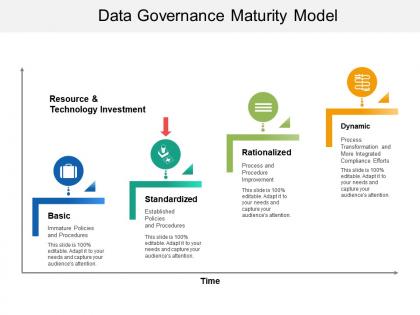
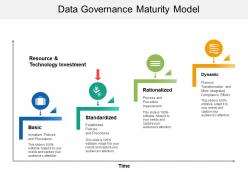
Attempting to conceptualize an idea of data governance into a powerful PPT presentation? Do not worry! We have come up with an editable data governance maturity model PowerPoint template slide that will aid you in explaining the concept of data management in an ideal way. Using this data management maturity framework presentation slide, you can highlight the complete lifecycle of data. This data governance capability maturity model template has been designed using an amazing icon of a briefcase, stamp, layers, and flow process that makes the template self-descriptive and add professionalism to it. You can represent a process of four levels which are basic, standardization, rationalized, and dynamic utilizing this data governance template slide. As enough space has been provided, you can add valuable information related to each level to make the audience understand more clearly the concept of data management, data warehouse, data mining, data integrity, information mapping and profiling, project management, information architecture, information governance, and information technology governance. Quickly download this data governance maturity model PPT template. Refine your approach with our Data Governance Maturity Model. Hit your targets right dead centre.
People who downloaded this PowerPoint presentation also viewed the following :
Data governance maturity model with all 5 slides:
Build the jig with our Data Governance Maturity Model. Enable folks to install the apparatus.


FAQs for Data
Start by figuring out who owns what data - seriously, this is where most companies mess up. Once you've got clear ownership mapped out, build your policies around that. You'll also need data quality management and security controls, plus governance committees (yeah they're boring but someone has to make the tough calls). The ownership thing though? That's your foundation. Without it, people just point fingers when something breaks. Map out your data domains first, assign owners, then tackle the rest. Trust me, it makes everything else way less painful to implement.
Start with a maturity assessment covering data quality, governance, architecture, skills, and tech capabilities. Most places use DAMA-DMBOK or just make their own 1-5 scorecards. The real trick? Don't bullshit yourself about where you actually stand. Sure, you might have data policies written down somewhere, but does anyone follow them? Do you have clear ownership? Standardized processes that people actually use? I'd do a quick self-assessment first. Sometimes bringing in outside help later gives you that brutal honesty you need – we're all a bit blind to our own mess.
So data stewards are basically the people who actually make governance happen on the ground. Your governance team can write all the policies they want, but stewards are the domain experts who know the data inside and out. They're bridging that gap between strategy and reality - and trust me, reality is always messier than the strategy docs suggest. These folks handle quality issues, sort out conflicts, train users on proper handling. Short version: without solid stewards in each area, your governance framework just becomes paperwork that sits there collecting dust. You really need to find the right people and give them actual authority to do the job.
So regulations basically make compliance your starting point for data governance, which honestly isn't the worst thing. First step is figuring out what rules actually apply to your industry - GDPR, HIPAA, SOX, whatever. Then you've gotta map where sensitive data sits, who touches it, retention schedules, all that fun stuff. It's annoying but it actually strengthens your whole governance game. My advice? Use compliance as your floor, not your ceiling. Build policies that check the regulatory boxes but also work for what your business actually needs. Oh, and audit everything first - you can't govern what you don't know exists.
Honestly, the hardest part isn't the tech stuff - it's getting everyone on the same page. Each department thinks they're the special snowflake with unique data needs. Plus nobody wants to own the mess when things break, but they all want control over decisions. Your legacy systems are gonna be a nightmare since data's scattered everywhere with zero consistency. Oh, and good luck getting enough people dedicated to this - it's way more time-intensive than people think. Don't try to fix everything at once though. Pick one critical area and start there.
So data governance is basically your safety net for catching crappy data before it ruins your analysis. You set up standards and validation rules so everyone knows what counts as "good data." Think of it like quality checkpoints throughout your whole pipeline - honestly, this approach saved us from so many disasters last quarter. The trick is figuring out who owns which datasets and making them actually responsible for keeping things clean. I'd start by mapping your most critical data and assigning specific people as stewards. Oh, and make sure those stewards actually have time to do the job properly - learned that one the hard way.
Start with a data catalog - Collibra, Alation, or Apache Atlas are solid picks. You can't manage what you don't know exists, and trust me, you'll be surprised how much random data is floating around. For tracking where everything flows, check out Informatica or DataHub if budget's tight. Great Expectations is decent for data quality stuff without breaking the bank. Oh, and grab something like Privacera for access control - that's becoming huge now. Metadata management platforms help too, but honestly? Catalog first. Everything else builds from there. Most teams skip this step and regret it later.
Map your data stuff directly to what the business actually needs - customer retention issues? Focus governance on customer data quality first. Don't build policies in some ivory tower like I've seen companies do (total time waster). Get people from different departments involved so you're not creating rules nobody can use. Track success with business metrics, not just the technical ones. Oh and this isn't something you set up once - you'll need to keep tweaking as priorities change. Data governance is weirdly political sometimes, so having those cross-department allies really helps.
Honestly, I'd focus on the stuff that actually matters to your business first. Data quality scores are obvious - accuracy, completeness, that whole thing. But also track how fast people can get reliable data when they need it, because that's where you'll feel the real impact. Compliance rates with your policies matter too, though they're kinda boring to measure. User adoption tells you if people are actually using your governance tools or just ignoring them completely. Don't forget incident tracking - breaches and data issues can blow up fast. Start with maybe 3 metrics tied to your biggest headaches, then build from there once you get rolling.
Honestly, you've got to connect data governance to what people actually do every day. Show them how crappy data screws up their work - like when sales numbers are wrong and they look stupid in front of their boss. Leadership buy-in is huge though. If executives ignore their own data rules, nobody else will care either. Keep guidelines super simple and celebrate wins when teams catch mistakes early. Oh, and tie it to performance reviews somehow - people need to see it affects their career, not just some IT checkbox. Training helps but the real-world examples hit harder than any workshop.
So data governance is basically your safety net for keeping stuff secure and private. You set up rules about who gets access to what data and how it's all protected. Classification systems, access controls, compliance processes - all that good stuff. Think of it like a rulebook that stops sensitive info from ending up somewhere it shouldn't (nobody wants to be the next data breach headline, right?). The tricky part is actually following through on the policies instead of just having them sit in a folder somewhere. Oh, and train your people on it too - can't expect them to read minds.
Dude, ML can handle so much of that boring data governance stuff you're doing by hand. It'll automatically tag and classify your data, spot quality problems, catch compliance issues before they blow up. Real-time monitoring of data lineage too. The anomaly detection is honestly game-changing - way faster at catching weird data shifts or sketchy access than you'd ever be manually. Plus it can suggest governance rules based on how people actually use the data, which is pretty smart. My advice? Don't go crazy at first. Just pick one annoying repetitive task and automate that to start.
Honestly, start with consistency - get your metadata fields and schemas standardized first. Focus on business context over technical stuff (way more useful). Don't go crazy trying to catalog everything right away though, that's how projects die. Pick your most critical data and work outward. Automated discovery tools are clutch for keeping things updated. Someone needs to own data stewardship or it'll turn into a mess fast. The whole thing's pointless if it's not searchable and easy to use - I've seen too many catalogs that people just ignore because they're clunky.
So data governance is basically like having rules for who gets access to what data and how they can use it. Your analysts won't waste hours digging around trying to figure out if some random dataset is actually reliable or if they're even supposed to touch it. It's kind of like having a decent filing system - sounds boring but actually speeds everything up. Clean data pipelines mean your team can jump straight into finding insights instead of playing detective. Honestly, I'd start by just figuring out which data sources your analysts are already using most. Way easier than starting from scratch.
Honestly, lead with what's in it for them - faster data access, better decisions, less compliance headaches. Skip the technical jargon completely. Get executives on board first so they're actually pushing this down, not just nodding along in meetings. Quick wins through pilot programs work way better than big announcements. Let your key users help design the framework - they'll actually use it if they had input. And for the love of all that's holy, don't dump twenty new policies on people at once. Roll it out slowly with real training. I've watched so many of these crash and burn because people tried to boil the ocean.
No Reviews