


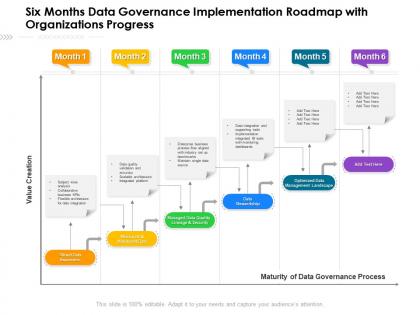
Six months data governance implementation roadmap with organizations progress




Try Before you Buy Download Free Sample Product
 Impress Your
 Audience
 100%
100% Editable
 Save Hours
 of Time


Utilize our pre build Six Months Data Governance Implementation Roadmap With Organizations Progress to present your plan of action in the most effective way. Reduce the paperwork and showcase how different activities are linked to each other by incorporating this attention grabbing PowerPoint theme. This completely editable roadmap PPT layout is suitable to fit all your needs and to have a structured outline of the entire process flow using color coding. Provide guidelines to your teammates about the progression process by employing our PPT theme. Team members can easily be designated into teams by accessing the work milestones to be accomplished within the timeframe. You can easily modify the PowerPoint slide according to real time situations. Download our stunning Six Months Data Governance Implementation Roadmap With Organizations Progress, and you are good to go to prove your expertise in strategic planning.
People who downloaded this PowerPoint presentation also viewed the following :
Six months data governance implementation roadmap with organizations progress with all 2 slides:
Give your audience a fulfilling experience. They will find our Six Months Data Governance Implementation Roadmap With Organizations Progress elevating.


FAQs for Six months data governance implementation roadmap
Look, you need five main things for data governance: someone actually owning the data, clear policies, quality checks, security stuff, and monitoring. Most places totally bomb on the monitoring piece - then act shocked when chaos ensues. Start a governance council too because trust me, teams will fight over who gets access to what. Don't try tackling everything right away though. Pick one dataset that really matters and get that working perfectly first. Way easier than going big and failing spectacularly.
Start with figuring out where you actually are right now - do a full audit of your people, processes, and tech. Most companies think they're way more organized than they really are (spoiler: they're not). Talk to people in different departments about their biggest data headaches and what they actually need. Map out who owns what data, check your current policies if you even have any, and see how information moves around your systems. Don't sugarcoat the mess you find - being honest about your current setup is the only way to build a roadmap that'll actually work.
So data stewards are basically the people who make governance actually happen day-to-day. They're your data quality watchdogs. Usually you assign them to specific business areas or data domains, and they handle the real stuff - fixing data issues, monitoring quality, making sure teams follow the policies you set up. Honestly, without them your governance framework just becomes another dusty document nobody reads. They're like the bridge between your strategy and reality. Oh, and don't forget to give them actual authority to enforce things - otherwise they're just shouting into the void. Clear responsibilities are key too.
Honestly, you've gotta build privacy stuff right into your plan from the start - don't try adding it later like some afterthought. Most companies totally bomb this part because they skip the tedious work of actually mapping where all their data goes. Figure out what personal info you're grabbing and where it lives first. Then set up automated systems for consent, how long you keep data, and deletion requests. Regular privacy reviews for new projects are crucial too. Oh, and make sure someone actually owns each piece of data - can't have it floating around with no accountability. Privacy should be baked into how you think, not just another box to check off.
Track both tech stuff and business impact to see if your governance is actually working. Data quality scores and compliance rates are obvious ones. But honestly? User adoption matters way more than people think - are teams actually using the governance tools or just ignoring them? I'd also measure time-to-insight improvements and whether people can find/trust data easier now. Trust is weirdly hard to quantify though - maybe quarterly surveys work? Don't go crazy with metrics. Pick like 4-5 max that stakeholders care about and stick with those. Nobody wants another dashboard to ignore.
Talk to key people in each department first - figure out what they actually care about and how governance helps them, not just IT. Cross-functional teams work way better than top-down mandates, trust me on this one. Don't use fancy governance speak either, that'll lose them immediately. Quick wins are your friend for building momentum. Let them help shape the policies instead of just following orders. Oh, and definitely get those stakeholder interviews on the calendar like yesterday - you'll learn more in one conversation than weeks of planning meetings.
Oh man, biggest pain points? People get super territorial about their data - like, *really* protective of how they've always done things. Data quality is all over the place between departments, which is a nightmare. Executive buy-in is tough because they want results but don't want to actually fund it properly (classic, right?). Most companies try to do everything at once instead of starting small. My advice? Pick one thing that'll make a real difference, prove it works, then build from there. Way less headache that direction.
Look, tech tools are gonna save your sanity here. Data catalogs automatically find and tag all your stuff, lineage tools show you how everything connects, and quality monitors ping you when things break. Without these? You're basically organizing a warehouse with Post-it notes - total nightmare. I'd focus on tools that actually play nice together because nobody wants to flip between a million different screens all day. Just start with whatever's causing you the biggest headache right now and build from there. Trust me on this one.
So you'll want both tech and business people on your team. Data analysis and database skills are obvious musts. But honestly? Communication might be even more important - you're constantly translating between IT folks and business people who basically speak different languages. Project management helps too, plus someone who gets compliance stuff. Oh, and change management skills since you'll be messing with how everyone handles data. The trick is finding people who can think big picture but also dive deep when things get messy. I'd start by figuring out what skills you already have versus what you need to bring in.
Honestly, just tie everything back to what's actually hurting the business right now. Make a quick scoring thing - high impact vs how much work it'll take. Go after the stuff that's bleeding money first, like crappy data messing up your reports or compliance issues that could get you fined. I mean, data catalogs are cool and all, but not when you're losing deals because nobody trusts the numbers. Quick wins are your friend here. Focus on things that'll either bring in cash, stop you from losing it, or keep the regulators happy. Everything else can wait.
Think of a data catalog like an inventory list for all your company's data. You can't manage stuff you don't even know exists, right? It shows you what data you have, where it's stored, who's responsible for it, and whether you can actually trust it. Without this visibility, data governance becomes impossible - kinda like organizing a garage blindfolded. I'd start with your most important datasets first since cataloging everything at once is overwhelming. Once you get those mapped out, you can expand and start tracking data lineage and quality standards across everything else.
Ugh, start with an audit - you've gotta figure out what data you actually have and where it's hiding. Sort it by business value and compliance stuff, then tackle the high-risk or valuable bits first. This step always turns into a bigger mess than people think it'll be, fair warning! Don't try governing everything at once though - your team will hate you. Set up some retention policies so you're not just shuffling garbage from one place to another. The trick is being picky about what gets priority vs what can sit on the back burner.
Keep your policies ridiculously simple - like explaining it to your neighbor simple. Document who owns data, approval processes, and what happens when people mess up. Don't write novels! Each policy should be 1-2 pages tops. Visual flowcharts are your friend here. Include real scenarios people actually deal with day-to-day. Oh, and this sounds obvious but - actually update the damn things regularly. Nobody wants dusty PDFs buried somewhere. I'd set quarterly reviews to keep everything fresh. The goal is creating documents people will genuinely use, not ignore.
So I'd say check your roadmap every quarter and do big updates once a year. But real talk - most teams I work with are constantly adjusting things because priorities never stop changing. Monthly reviews work better if you're in a crazy-fast industry or dealing with major org changes. Those quarterly check-ins help spot when you're drifting from business goals or missing tech shifts. Annual deep dives are where you really dig into strategy and figure out if you're allocating resources right. Oh, and set those calendar reminders now or you'll definitely forget - I always do.
Look, data quality is literally the foundation everything else sits on. Bad data = your whole governance strategy falls apart. You can't have solid policies managing trash inputs, you know? I'd start with your most critical datasets and set up quality metrics there first. Boring stuff like monitoring and cleanup processes need to happen from day one though. Without that groundwork, you're basically building on quicksand - and honestly, I've seen too many teams learn this the hard way. Once you've got those core assets locked down, then you can expand to other areas.
No Reviews