

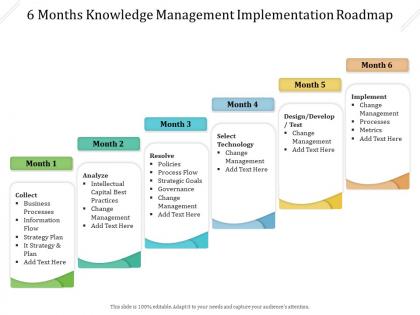
6 months knowledge management implementation roadmap




Try Before you Buy Download Free Sample Product
 Impress Your
 Audience
 100%
100% Editable
 Save Hours
 of Time


A cohesive work plan is essential for achieving the desired target. Communicate your vision and lay a firm ground in front of your audience with our PowerPoint layout. Align your project milestones, budgets, deliverables, deadlines, and all the requisite information for a dynamic presentation by employing this amazingly designed 6 Months Knowledge Management Implementation Roadmap. Maximize team efficiency and streamline a work plan efficiently by introducing our ready made roadmap PowerPoint theme. You can quickly establish coordination between different activities across the organization and present an insight to your colleagues by utilizing this useful business tool. Color code specific tasks, prioritize, and keep a close eye on the deadlines with the help of our eye catchy PowerPoint template. Download our 6 Months Knowledge Management Implementation Roadmap for excelling at productive management.
People who downloaded this PowerPoint presentation also viewed the following :
6 months knowledge management implementation roadmap with all 2 slides:
Give your audience a fulfilling experience. They will find our 6 Months Knowledge Management Implementation Roadmap elevating.
FAQs for 6 months knowledge
Key components of an effective knowledge management roadmap include strategic objectives alignment, current knowledge audit, technology infrastructure planning, governance frameworks, and change management protocols. These elements work together by establishing clear direction, identifying knowledge gaps, selecting appropriate platforms, defining roles and responsibilities, and ensuring user adoption, with many organizations finding that this comprehensive approach ultimately delivers improved decision-making and operational efficiency.
Organizations can assess their current knowledge management practices through knowledge audits, stakeholder interviews, technology evaluations, workflow analysis, and gap identification surveys. Through comprehensive assessments, companies in sectors like consulting, healthcare, and manufacturing identify inefficiencies in information sharing, outdated systems, and collaboration barriers, ultimately enabling strategic roadmap development that addresses specific organizational needs.
Companies typically face challenges including organizational resistance to change, difficulty capturing tacit knowledge from employees, inadequate technology infrastructure, lack of executive support, and insufficient user adoption. These obstacles often stem from cultural barriers, resource constraints, and competing priorities, with many organizations finding that successful implementation requires strategic change management, comprehensive training programs, and sustained leadership commitment to ultimately deliver improved collaboration and operational efficiency.
Technology enhances knowledge management roadmaps through AI-powered search capabilities, automated content categorization, collaborative platforms, analytics dashboards, and cloud-based accessibility systems. These technologies streamline knowledge capture and retrieval processes while enabling real-time collaboration, with many organizations finding that integrated platforms reduce information silos and accelerate decision-making across departments.
A knowledge management roadmap aligns with business strategy by identifying critical knowledge gaps, mapping information flows to strategic objectives, and prioritizing initiatives that support competitive advantages. This strategic alignment enables organizations to streamline decision-making processes, accelerate innovation cycles, and enhance operational efficiency, with many companies finding that integrated knowledge systems ultimately deliver measurable improvements in performance and market responsiveness.
Knowledge management success metrics include user adoption rates, content utilization frequency, knowledge retrieval time, employee satisfaction scores, and business impact measurements like reduced training costs or faster problem resolution. These metrics enable organizations to track both engagement and outcomes, with many companies finding that combining quantitative data with qualitative feedback ultimately delivers comprehensive insights into knowledge-sharing effectiveness and competitive advantage.
A knowledge management roadmap should be reviewed quarterly and updated annually, with major revisions triggered by organizational changes, technology upgrades, or strategic shifts. Many organizations find that regular assessments enable them to adapt to evolving business needs, incorporate new technologies, and address emerging knowledge gaps, ultimately maintaining competitive advantage in increasingly dynamic markets.
Organizational culture serves as the foundation for knowledge management success, determining employee willingness to share expertise, collaborate across departments, and adopt new systems. A culture that values transparency, continuous learning, and collective problem-solving enables seamless knowledge flow, while organizations with collaborative cultures find that employees actively contribute to knowledge repositories, ultimately delivering competitive advantage through enhanced innovation and decision-making.
Employee engagement in knowledge management roadmaps flourishes through collaborative planning sessions, clear role definitions, recognition programs, and regular feedback loops that demonstrate individual contributions to organizational success. Many companies enhance participation by appointing knowledge champions across departments, providing training on content creation tools, and showcasing how shared expertise directly impacts project outcomes, ultimately delivering stronger buy-in and sustainable knowledge-sharing cultures.
Best practices include establishing standardized documentation processes, implementing user-friendly knowledge management platforms, creating cross-functional communities of practice, incentivizing knowledge sharing through recognition programs, and conducting regular knowledge audits. These approaches streamline information flow by embedding sharing into daily workflows, fostering collaborative environments, and ensuring critical expertise remains accessible, with many organizations finding that strategic knowledge capture ultimately delivers enhanced operational efficiency and accelerated decision-making across teams.
A knowledge management roadmap accommodates continuous learning through adaptive frameworks, regular content audits, real-time feedback mechanisms, and scalable technology infrastructure that evolves with organizational needs. By incorporating agile methodologies, automated knowledge capture, and cross-functional collaboration tools, organizations streamline learning processes while maintaining knowledge currency, ultimately delivering enhanced innovation capabilities and competitive advantage in dynamic markets.
Poor knowledge management risks include knowledge loss through employee turnover, duplicated efforts, inconsistent decision-making, reduced innovation, and decreased competitive advantage. Organizations mitigate these through comprehensive documentation systems, cross-training programs, and centralized knowledge repositories, with many companies finding that strategic knowledge capture and sharing processes ultimately enhance operational efficiency and preserve critical institutional expertise.
Collaboration tools integrate into knowledge management roadmaps by establishing centralized platforms for real-time communication, shared workspaces, and cross-functional project coordination, while implementing automated knowledge capture workflows and social learning networks. These integrations streamline information flow between departments, enhance collective problem-solving capabilities, and create seamless knowledge transfer processes, ultimately delivering improved operational efficiency and organizational learning outcomes.
**INPUT**: What strategies can be employed to encourage knowledge retention among employees nearing retirement or leaving the organization? **OUTPUT**: Effective knowledge retention strategies include structured mentorship programs, comprehensive documentation processes, video-based knowledge capture, cross-training initiatives, and incentivized knowledge transfer sessions. These approaches streamline institutional memory preservation by pairing experienced workers with successors, creating searchable knowledge repositories, and establishing formal handover protocols, ultimately ensuring critical expertise remains accessible and operational continuity is maintained across organizational transitions. **Word count**: 59 words
Feedback mechanisms can be built into knowledge management roadmaps through user surveys, analytics tracking, content usage metrics, regular stakeholder interviews, and performance dashboards that monitor adoption rates. These systems enable organizations to identify knowledge gaps, assess content relevance, and optimize search functionality, with many companies finding that continuous feedback loops significantly enhance knowledge accessibility and ultimately deliver improved decision-making across departments.
No Reviews