

 0 Comment
 Customer Reviews

The production schedule's been approved. Materials are ordered. And somewhere between the warehouse and the line, there's three weeks of inventory nobody asked for.
That's the thing about traditional manufacturing—it produces first, then hopes demand shows up. JIT production flips that. You make what's needed, when it's needed, in exactly the amount needed. Simple to say. Hard to actually show someone.
The real problem isn't understanding the concept. Most operations managers get it. The problem is explaining it—to leadership, to suppliers, to a floor team that's used to buffer stock as a safety blanket. There's a gap between knowing how pull-based production works and making a room full of stakeholders trust it enough to change how they've been doing things for years.
And that gap gets worse when the presentation is just a wall of text and a generic flowchart. No visual structure. No clear sequence. Just slides that could have been written by anyone, about anything.
So the templates exist because this is a very specific communication problem. Lean manufacturing principles—kanban systems, demand-driven production, waste reduction, supplier lead time—these aren't abstract ideas. They have sequences, dependencies, visual logic. They need slides that reflect that logic, not slides that apologize for it.
SlideTeam's JIT production templates are built for exactly this kind of presentation. Pre-designed frameworks that map how demand signals flow, how inventory levels shrink, how supplier relationships anchor the whole system. You fill in your numbers, your context, your specifics—the structure's already there.
Here's what's in the collection.
Template 1: Implementing JIT Aligning Production with Demand PPT Presentation
Aligning production with actual demand is the operational challenge most factory managers deal with daily. This PowerPoint slide is built for operations leads who need to present demand-driven production logic to cross-functional teams. It maps how JIT inventory signals move from customer orders back through the production floor. For context, this PPT works well in supply chain optimization reviews or lean transformation kick-offs. The template is 100% editable and customizable.
[product_image id=1674620]
Template 2: JIT Quality Control Ensuring Defect Free Production Processes PPT Summary
Quality control in a zero-inventory environment requires near-perfect defect detection at every production stage. This PPT template is designed for quality managers presenting defect-free production targets to plant leadership or auditors. It covers the process checkpoints where JIT methodology and total quality management intersect. Use this deck when walking through supplier quality agreements or internal production scheduling reviews. The template is 100% editable and customizable.
[product_image id=1734388]
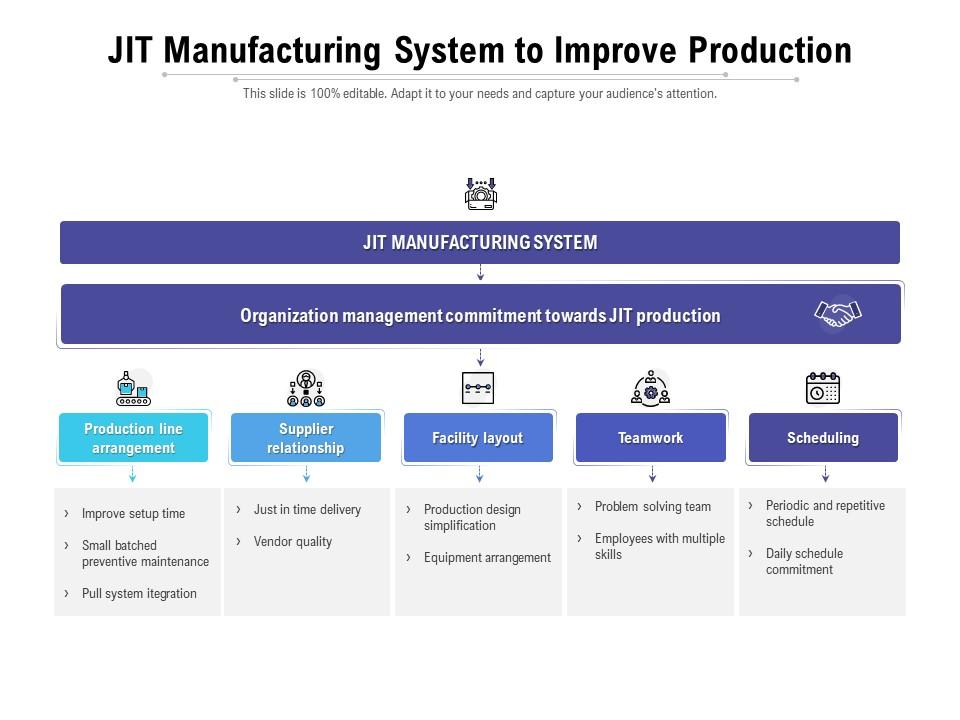
Template 3: JIT Manufacturing System to Improve Production
Production line efficiency depends on how well scheduling, supplier relationships, and facility layout work together. This PPT preset gives operations managers a ready structure for presenting JIT manufacturing system design. It covers production line arrangement, supplier relationship management, teamwork, and scheduling in one cohesive visual. Use it in lean transformation briefings or shop-floor planning sessions. The template is 100% editable and customizable.
Download this PowerPoint Template
Template 4: JIT Structure for Maintaining Suppliers Relationship and Production Line
Supplier relationship management and production line coordination are two sides of the same JIT coin. This PowerPoint slide gives supply chain managers a clean visual structure to present how both connect. It covers facility layout, scheduling, team coordination, and supplier relationship management in one flow. Lean supply chain reviews and JIT production planning sessions are natural homes for this PPT. The template is 100% editable and customizable.

Download this PowerPoint Template
Template 5: Case Study Implementing Just in Time JIT at Toyota Lean Manufacturing PPT Presentation
Toyota's JIT implementation is the most cited proof point in lean manufacturing—and for good reason. This slide deck examines that case study across three clear stages: challenges, solutions, and measurable results. Structured layouts translate complex operational agility gains into persuasive, audience-ready narratives. Inventory management insights are presented alongside waste reduction outcomes in a logical, compelling sequence. Use this deck to anchor executive briefings or lean manufacturing training sessions with credible, real-world evidence. Transform your lean manufacturing case study presentations today. Download this dynamic template now and unlock a powerful operational storytelling framework.
[product_image id=1243690]
Template 6: JIT Icon for Innovation in Manufacturing Process
Innovation in manufacturing process communication starts with visuals that actually hold attention. This slide deck is built for presenters who need to anchor JIT innovation concepts in clear, recognizable iconography. It gives manufacturing teams a ready visual vocabulary for on-demand manufacturing and process improvement discussions. Use this PPT in team briefings or Kaizen methodology workshops to ground abstract ideas quickly. The template is 100% editable and customizable.
Download this PowerPoint Template
Template 7: JIT Concept for Organization Manufacturing Process Optimization
Seven distinct stages of JIT process optimization require a visual framework that holds audience attention across all of them. This slide deck maps pull production system logic, waste reduction, and total quality control into a single coherent flow. Structured layouts convert complex manufacturing efficiency concepts into clear, stakeholder-ready narratives. Creative design empowers presenters to move from concept to action plan without losing the thread. Use this deck for production workflow optimization briefings and continuous improvement program launches. Transform your JIT concept presentations today. Download this dynamic template now and unlock structured manufacturing clarity.

Download this PowerPoint Template
Template 8: JIT Evaluating Process for Organization
Evaluating how a JIT system actually performs inside an organisation requires a structured, honest framework. This PPT preset covers four key assessment areas: management principles, pull system integration, fulfilment process, and employee engagement. It gives operations analysts and plant managers a ready tool for internal JIT reviews. So yeah, this deck fits naturally into quarterly manufacturing efficiency evaluations or lean audit presentations. The template is 100% editable and customizable.

Download this PowerPoint Template
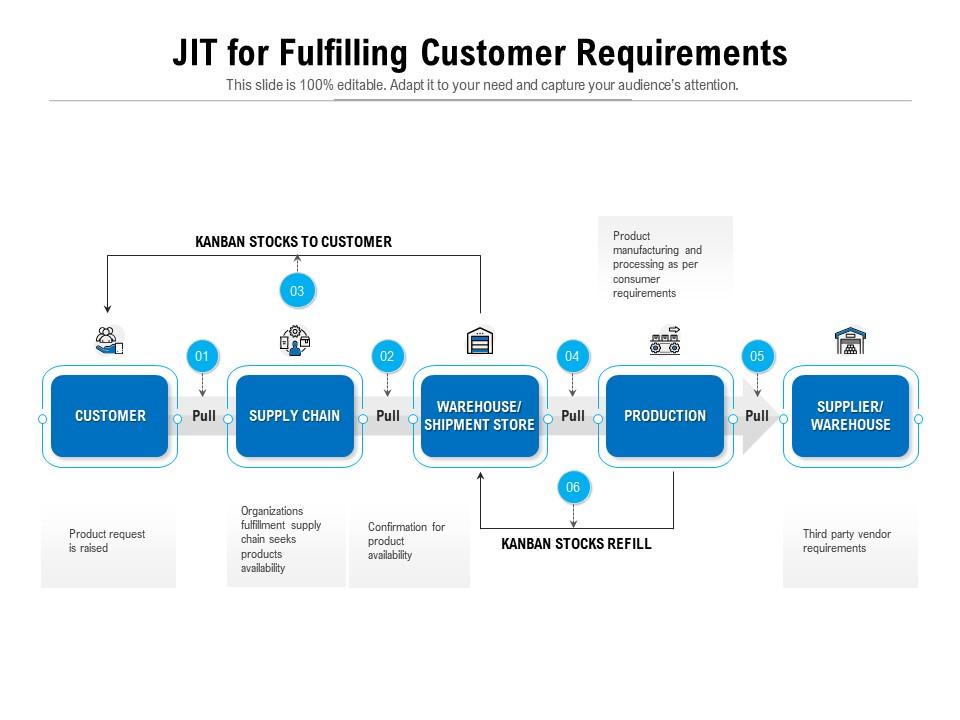
Template 9: JIT for Fulfilling Customer Requirements
Customer fulfilment in a JIT environment depends on how cleanly demand signals travel through the supply chain. This deck maps five critical stages—customer, supply chain, warehouse, production, and supplier—into one clear visual flow. Structured layouts make pull-based fulfilment logic easy to follow for any cross-functional audience. Each stage anchors accountability and makes the sequence visible. Use this deck for demand-driven production briefings and supply chain partner alignment sessions. Transform your customer fulfilment presentations today. Download this dynamic template now and unlock a compelling end-to-end supply chain narrative.
Download this PowerPoint Template
Template 10: Just in Time JIT Methodology in Lean Executing Lean Production System to Enhance Process
Lean production system execution needs a slide that connects production instruction, schedule, and plan without ambiguity. This deck covers JIT methodology in lean manufacturing—product order flow, production scheduling, storage requirements, and waste management in one structured view. Compelling visual logic translates lean manufacturing principles into a narrative any operations audience can follow. Use it as a discussion and navigation tool for Kaizen methodology sessions or lean system rollouts. Transform your lean production presentations today. Download this dynamic template now and unlock a sharper manufacturing process story.

Download this PowerPoint Template
Template 11: Just in Time JIT Delivery Systems in Plant Logistics PPT Slides
Plant logistics decisions hinge on how clearly JIT delivery systems are communicated to operations and planning teams. This PPT slide is built for supply chain managers presenting lean manufacturing delivery frameworks to leadership or logistics partners. It connects inventory management, demand forecasting, and supply chain optimization in a single visual sequence. Use this deck in plant logistics reviews or JIT system implementation briefings. The template is 100% editable and customizable.
[product_image id=1308153]
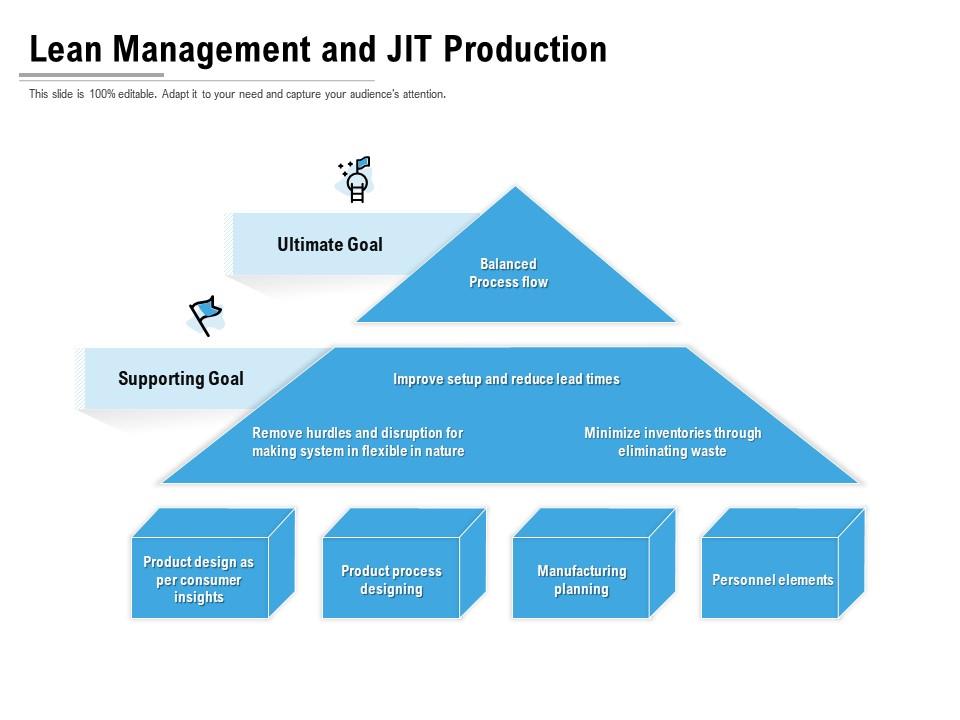
Template 12: Lean Management and JIT Production
Lean management and JIT production belong in the same conversation—and this deck holds both with clarity. Five interconnected topics—ultimate goal, supporting goal, balanced process flow, product process design, and manufacturing planning—are structured into one polished visual. Striking layouts make complex manufacturing efficiency logic accessible to any executive or operations audience. Each stage drives a clear narrative from planning intent to production reality. Use this deck to anchor lean transformation discussions and manufacturing planning reviews. Transform your lean management presentations today. Download this dynamic template now and unlock a unified production planning framework.
Download this PowerPoint Template
Elevate Your JIT Production Presentations with SlideTeam
SlideTeam's PowerPoint templates are the best in the industry for communicating JIT production principles with clarity and confidence. These content-ready slides cover everything from lean manufacturing workflows to supplier relationship management and demand-driven production logic—saving you hours of design work. Use these ready-made PowerPoint slides to align your teams, brief stakeholders, and drive lean transformation with professional-grade structure. Deploy these pre-designed templates today and make every production presentation count.
FAQs on JIT Production
How does JIT production differ from traditional mass production in terms of inventory management?
Traditional mass production builds to forecast, creating large inventory buffers. JIT production builds to actual demand, keeping stock at near-zero levels. Factories hold materials only for immediate production needs. This reduces storage costs and cuts the risk of obsolete stock. The key shift is from push-based scheduling to a pull production system driven by real customer orders.
What are the core principles that define a successful JIT production system?
A successful JIT system rests on three core principles: produce only what is demanded, only when it is demanded, and only in the quantity required. Reliable supplier lead times, consistent production scheduling, and a functioning kanban signal system are the operational anchors. Waste reduction at every stage—materials, time, motion—keeps the system lean and responsive.
How can companies calculate the ideal reorder point to support JIT manufacturing?
The reorder point equals average daily usage multiplied by supplier lead time. In JIT manufacturing, this number should be as close to zero as supplier reliability allows. Companies calculate it by tracking actual consumption rates and confirmed supplier delivery windows. Tighter lead times directly shrink the reorder point and reduce WIP inventory on the floor.
What role does supplier reliability play in maintaining a JIT production schedule?
Supplier reliability is the single biggest operational dependency in JIT production. A late delivery stops the production line—there is no buffer stock to absorb the gap. Companies manage this through long-term supplier agreements, shared production schedules, and frequent performance reviews. Qualifying multiple suppliers for critical components adds resilience without abandoning the lean supply chain model.
How does JIT production impact a company's cash flow and working capital requirements?
JIT production frees up working capital by eliminating excess inventory. Less stock on hand means less cash tied up in materials sitting in a warehouse. Cash flow improves because companies pay for materials closer to the point of actual production and sale. Reduced storage costs and lower obsolescence write-offs further strengthen the balance sheet over time.
What are the biggest risks associated with implementing JIT production in a global supply chain?
The biggest risk is supply chain disruption—a delayed shipment halts production with no buffer. Geopolitical instability, port congestion, and single-source supplier failures all amplify this exposure. Companies mitigate risk through geographic supplier diversification and building strategic reserves for only the most critical components. JIT works best when supplier lead times are short, stable, and predictable.
How does the kanban system function as a visual tool within JIT production environments?
A kanban card or signal authorises production or replenishment of one specific part or batch. When a workstation consumes a bin of parts, the empty bin triggers a replenishment order upstream. Nothing is produced without a kanban signal—this is how JIT production stays pull-based. The visual nature of the system makes overproduction and shortages immediately visible to the floor team.
What metrics should manufacturers track to measure the effectiveness of their JIT system?
Track four key metrics: inventory turnover rate, WIP levels, on-time delivery rate, and defect rate per production run. High inventory turnover and low WIP confirm the pull system is working. On-time delivery measures supplier and scheduling reliability. Defect rate links directly to total quality management—defects in a zero-buffer system stop the line immediately, so this number must stay near zero.