


6 months process roadmap for itil implementation strategy




Try Before you Buy Download Free Sample Product
 Impress Your
 Audience
 100%
100% Editable
 Save Hours
 of Time


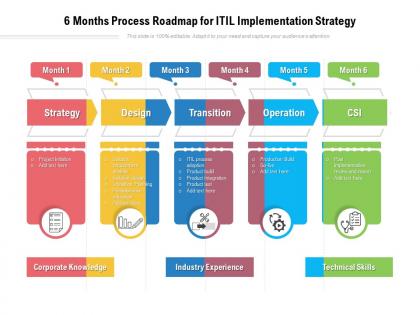
Visualize your work plan and communicate your ideas impactfully with our pre designed 6 Months Process Roadmap For ITIL Implementation Strategy. Showcase the detailed overview of the project, the key deliverables, and the milestones to be achieved with the help of our fully customizable PowerPoint layout. You can easily emphasize on the project goals and discuss all the activities involved in an easy to comprehend manner by utilizing our professionally designed PPT theme. This roadmap PowerPoint layout is a perfect strategic planning tool that can help in keeping the project on track. With our attractive PowerPoint theme, you can articulate the workflow, track the work progress, and have a clear vision of the goal to be achieved. Download this versatile 6 Months Process Roadmap For ITIL Implementation Strategy and save your hours of work.
People who downloaded this PowerPoint presentation also viewed the following :
6 months process roadmap for itil implementation strategy with all 2 slides:
Use our 6 Months Process Roadmap For ITIL Implementation Strategy to effectively help you save your valuable time. They are readymade to fit into any presentation structure.

FAQs for 6 months process roadmap for
ITIL implementation involves five key phases: assessment and planning, service strategy development, process design and documentation, pilot implementation, and full rollout with continuous improvement. These phases enable organizations to systematically transition from current state to ITIL-aligned operations, with many enterprises finding that phased approaches reduce risks while delivering improved service quality and operational efficiency.
An organization's IT maturity level significantly influences ITIL implementation timeline, resource requirements, and adoption strategies, with mature organizations leveraging existing processes while less mature ones require foundational infrastructure development. Organizations with higher maturity levels streamline implementation through established governance frameworks, skilled personnel, and documented procedures, while those with lower maturity find opportunities to build strategic capabilities, ultimately delivering enhanced service quality and operational efficiency.
**INPUT**: What specific objectives should be established before starting the ITIL implementation process? **OUTPUT**: ITIL implementation objectives should include defining service quality targets, establishing cost reduction goals, improving incident resolution times, enhancing customer satisfaction metrics, and streamlining operational workflows. These strategic objectives enable organizations to measure progress systematically, align stakeholder expectations, and ultimately deliver measurable improvements in service delivery efficiency and competitive advantage across their IT operations. [Word count: 54 words]
Organizations effectively engage stakeholders during ITIL implementation by establishing clear communication channels, conducting regular training sessions, creating cross-functional implementation teams, and demonstrating quick wins through pilot programs. Through structured change management approaches, companies streamline stakeholder buy-in, enhance process adoption, and minimize resistance, with many finding that early involvement in planning phases ultimately delivers smoother transitions and sustained operational improvements.
Tools supporting ITIL implementation include service desk platforms, configuration management databases (CMDBs), incident management systems, change management tools, and monitoring solutions. These technologies streamline processes by automating workflows, centralizing asset tracking, and enhancing service visibility, with many organizations finding that integrated ITSM suites deliver faster incident resolution and improved operational efficiency.
**INPUT**: How do you measure the success of an ITIL implementation? **OUTPUT**: ITIL implementation success is measured through key performance indicators including incident resolution times, service availability percentages, customer satisfaction scores, and cost per service delivery. These metrics enable organizations to track operational efficiency improvements, enhanced service quality, and reduced downtime, with many enterprises finding that strategic ITIL adoption delivers measurable competitive advantage and streamlined IT operations. **Word count: 54 words**
Common ITIL implementation challenges include resistance to change, lack of executive support, insufficient training, inadequate resource allocation, and poor communication across departments. These obstacles can be overcome by securing strong leadership commitment, investing in comprehensive staff training, establishing clear communication channels, and implementing changes gradually through pilot programs, with many organizations finding that phased approaches deliver better user adoption, reduced operational friction, and ultimately stronger service management outcomes.
ITIL practices can be customized through selective framework adoption, process modification based on organizational size and complexity, integration with existing workflows, and tailoring service categories to industry-specific requirements. Organizations in healthcare, financial services, and manufacturing increasingly adapt ITIL's incident management, change control, and service delivery processes to their regulatory environments and operational structures, ultimately delivering streamlined IT operations while maintaining compliance and enhancing customer experiences.
Training and development serve as the foundation for successful ITIL adoption by ensuring staff understand processes, acquire necessary skills, and embrace cultural change management principles. Through comprehensive training programs, organizations enhance service delivery, reduce implementation resistance, and accelerate process maturity, with many IT departments finding that well-trained teams deliver measurably better customer experiences and operational efficiency.
Organizations ensure continuous improvement post-ITIL implementation through regular service reviews, performance metrics monitoring, customer feedback analysis, process optimization initiatives, and staff training programs. These practices enable businesses to identify service gaps, enhance operational efficiency, and adapt to changing requirements, with many finding that systematic reviews and stakeholder engagement ultimately deliver sustained service excellence and competitive advantage.
Change management is crucial for ITIL implementation because it ensures organizational readiness, minimizes resistance to new processes, and facilitates smooth adoption of service management frameworks across teams. Through structured change management, organizations streamline staff training, enhance process compliance, and accelerate cultural transformation, with many enterprises finding that strategic change management ultimately delivers faster implementation timelines and higher adoption rates.
ITIL implementation roadmaps should be reviewed quarterly and updated semi-annually, with additional assessments triggered by major organizational changes, technology upgrades, or service delivery shifts. This regular evaluation enables organizations to adapt to evolving business requirements, incorporate lessons learned from initial phases, and maintain alignment with strategic objectives, ultimately ensuring the roadmap remains relevant and delivers measurable service improvement outcomes.
ITIL process performance should be evaluated using service availability percentages, incident resolution times, customer satisfaction scores, first-call resolution rates, and cost per service delivery. These metrics enable organizations to track operational efficiency, service quality improvements, and customer experience enhancements across IT departments, with many enterprises finding that systematic measurement ultimately delivers competitive advantage and optimized resource allocation.
Communication optimization throughout ITIL implementation phases involves establishing clear stakeholder mapping, regular progress updates, role-specific training sessions, feedback loops, and cross-departmental collaboration channels. These strategies streamline adoption by ensuring alignment between IT teams and business units, minimizing resistance through transparency, and enabling continuous improvement, with many organizations finding that structured communication frameworks significantly accelerate successful ITIL transformation and enhance operational efficiency.
Key lessons from previous ITIL implementations include starting with organizational readiness assessments, securing executive sponsorship early, focusing on cultural change alongside process improvements, implementing incrementally rather than attempting full transformation simultaneously, and investing heavily in staff training and communication. Organizations consistently find that successful ITIL adoption requires balancing standardized frameworks with existing workflows, with many enterprises discovering that gradual, well-supported transitions deliver significantly better user adoption and sustainable operational improvements.
-
Attractive design and informative presentation.
-
Illustrative design with editable content. Exceptional value for money. Highly pleased with the product.