


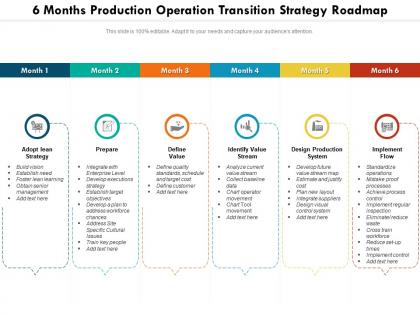
6 months production operation transition strategy roadmap




Try Before you Buy Download Free Sample Product
 Impress Your
 Audience
 100%
100% Editable
 Save Hours
 of Time


A cohesive work plan is essential for achieving the desired target. Communicate your vision and lay a firm ground in front of your audience with our PowerPoint layout. Align your project milestones, budgets, deliverables, deadlines, and all the requisite information for a dynamic presentation by employing this amazingly designed 6 Months Production Operation Transition Strategy Roadmap. Maximize team efficiency and streamline a work plan efficiently by introducing our ready made roadmap PowerPoint theme. You can quickly establish coordination between different activities across the organization and present an insight to your colleagues by utilizing this useful business tool. Color code specific tasks, prioritize, and keep a close eye on the deadlines with the help of our eye catchy PowerPoint template. Download our 6 Months Production Operation Transition Strategy Roadmap for excelling at productive management.
People who downloaded this PowerPoint presentation also viewed the following :
6 months production operation transition strategy roadmap with all 2 slides:
Use our 6 Months Production Operation Transition Strategy Roadmap to effectively help you save your valuable time. They are readymade to fit into any presentation structure.
FAQs for 6 months production operation
So basically you've got four main stages: planning, pilot testing, gradual rollout, then full deployment. Start by mapping where you are now vs where you need to be. Run a small pilot first - this is where you'll catch the weird issues that pop up. Then do a phased rollout, expanding bit by bit to more locations or users. Final stage is going full production with monitoring. Oh and seriously, don't rush the pilot like everyone does. I've seen teams skip proper testing and then spend months fixing stuff they could've caught early. Document what you learn at each step too - future you will thank you.
Start with figuring out what you actually have right now - audit everything. Your production flow, equipment, who can do what on your team. Map it all out because I guarantee you're not using resources the way you think you are (we never do). Document where things get stuck and what your real capacity limits look like. Quality metrics too if you're tracking those. Honestly, the skills gap assessment is probably the trickiest part but super necessary. Once you've got that baseline down, then you can figure out what needs fixing first and tackle it in some logical order.
Look, you absolutely need to talk to people before building that roadmap - learned this the hard way on a project last year. Map out everyone who'll be affected first: ops teams, engineering, finance, customers, leadership. They all see different angles you're gonna miss otherwise. Schedule some actual conversations with them before drafting anything. Trust me, way too many roadmaps crash because someone thought they could figure it out alone. These chats help you spot risks early and get realistic timelines instead of wishful thinking. Plus you'll need their buy-in anyway, so might as well get them involved from the start.
Honestly, new tech can completely change how you handle production transitions. Automation tools let you skip tons of manual testing - saves so much time. AI monitoring catches problems way before old-school methods would even notice. Cloud stuff is where it gets really interesting though - you can run multiple environments and test everything without worrying about hardware limits. Modern CI/CD pipelines handle rollbacks automatically now, which used to be such a pain to do manually. The trick is figuring out what actually helps your specific situation instead of just chasing every new tool that pops up.
Okay so track these four things during your rollout. System uptime and performance are obvious - if those tank, you're rolling back immediately. Error rates will spike when stuff breaks, so watch those like a hawk. Customer satisfaction matters tons, especially if users see the changes. Oh and this might sound weird but seriously monitor your team's stress levels and overtime. I've seen way too many transitions fail because everyone burned out before the technical stuff even broke. Just set hard limits for each metric upfront so you're not making emotional decisions when things get messy.
Start by mapping out your whole production process step by step. Then hunt for what could break at each handoff point - dependencies, bottlenecks, anything that's a single point of failure. There's always way more than you'd expect, honestly. Don't forget resource limits and skill gaps on your team too. Get everyone involved to weigh in since they'll catch stuff you totally missed. Compatibility between old and new systems is huge. Make a risk matrix ranking everything by how likely it is and how bad the impact would be. That'll show you what needs fixing first.
Start with a big kickoff meeting - walk everyone through the whole timeline and major deadlines. Set up a shared doc or dashboard they can all check, plus honestly Slack works amazing for quick updates. Don't wait for problems to schedule check-ins. Each team needs to know exactly what they're doing and who they're waiting on, because nothing kills momentum like surprise blockers. Build in extra time since stuff always runs long (trust me on this). Oh and send those weekly updates even when nothing's happening - silence makes people nervous.
Don't treat training like something you'll figure out later - build it right into your timeline from the start. First thing is mapping out what skills your team actually needs, then block out time for training way before launch. Seriously, I've watched so many rollouts crash because people skimped on this part. Your people need real hands-on practice, not just sitting through presentations. They've got to feel solid with the new stuff before you go live. Oh, and book your trainers early - good ones get snatched up fast. Make finishing training a hard requirement before moving to the next phase.
Honestly, market trends will completely mess with your timeline - there's no way around it. Look at COVID - companies had to drop everything and rush contactless tech that wasn't supposed to roll out for years. When customers suddenly want sustainable stuff, you can't just stick to your original plan and say "we'll get there eventually." Your competitors are probably moving faster too, which sucks but you have to keep up. I'd build in flexibility from the start - like, actually plan for things to change. Also check market signals way more often than you think you need to. Monthly beats quarterly every time.
Gantt charts are seriously your lifesaver for this - they show all the dependencies super clearly. I'd start with something like Microsoft Project or Smartsheet if you want the full setup. Asana works too for basic timelines. Manufacturing stuff gets trickier though, so maybe look into MindBridge or Valor Process Preparation for the technical validation side. But honestly? I've worked with teams who crushed it using just Excel because everyone actually knew how to use it. Pick whatever your team won't ignore. Start simple with tools you already have, then figure out what's missing later.
Dude, start by figuring out what'll actually hurt your business if it breaks. Customer delivery stuff? Revenue flows? That's priority one, no question. I'd grab maybe 4 key things max - trying to juggle more is where teams totally lose their minds. Infrastructure changes first, then roll out the shiny new features after. Makes way more sense that way. Also, check in every week because honestly? Priorities change constantly during these transitions and you don't want to be working on yesterday's crisis.
Resource conflicts are your worst enemy - everyone wants their project prioritized. Timeline compression will make you want to scream. Plus you're asking people to juggle old workflows while learning new ones, which honestly never goes smoothly. Dependencies you didn't see coming will bite you. Some staff will resist change no matter what because they're comfortable with how things work now. Oh, and communication falls apart fast when everyone's stressed. Build in way more buffer time than you think you need. Find your change champions early - those people are worth their weight in gold.
Honestly, just bake the sustainability stuff into your roadmap from day one - way less headache than trying to add it later. Set your green targets (energy cuts, waste reduction, sustainable sourcing) right alongside production goals during planning. Each milestone should have environmental KPIs tracked weekly, same as your regular metrics. Map out which eco practices fit each production stage and assign owners like any other task. I learned this the hard way on a previous project - treating it as an afterthought was a nightmare. Make sustainability a core requirement, not some nice-to-have checkbox.
Dude, supply chain stuff will absolutely wreck your timeline if you're not careful. Lead times for new materials are brutal right now, plus you'll probably need to qualify new suppliers which takes forever. Running two supply chains at once? Yeah, that's gonna cost you. I learned this the hard way last year - always map out your critical dependencies first. Your suppliers might need months to ramp up for whatever new specs you're throwing at them. Build in way more buffer time than feels reasonable. Trust me on this one.
Build quality checks into every single step - don't just slap them on at the end. Each phase needs clear acceptance criteria, and your testing setup should match production as much as possible. Most teams totally blow this part because they're scrambling to hit deadlines. Run automated tests constantly, then do manual checks at the big milestones. Write down everything that breaks (I know, annoying but worth it) so you can spot similar problems earlier next time. Trust me, catching issues early beats dealing with a complete disaster later.
-
Great product with effective design. Helped a lot in our corporate presentations. Easy to edit and stunning visuals.
-
Unique research projects to present in meeting.
-
Visually stunning presentation, love the content.