

 0 Comment
 Customer Reviews

When most people imagine a factory, they think of a worker pushing a big red button and a conveyor belt whirling to pop out a shiny new product. However, the real production process is starkly different. To transform raw materials into finished products, many operational activities happen behind the scenes. A supply chain delivers the necessary parts and components to the plant, informs production schedules, allocates resources and quality control checks ensure compliance with safety standards. All these activities of the production process fall under manufacturing operations.
Manufacturing operations refer to activities and processes involved in the production of goods and products using raw materials, human labor and machines. It includes the production process, from design, development to production, assembly, testing, and delivery of the final product. Its goal is to produce high-quality products cost-effectively and efficiently.
Manufacturing operations aim at improvement, quality control, scalability, cost reduction and flexibility of operations. These goals are interdependent and are balanced to achieve optimal results in the manufacturing process. Manufacturing operations jobs require careful planning, ongoing evaluation and diligent implementation. This is to ensure success and meet the needs of customers and stakeholders.
To understand the concept better and ensure businesses are able to use the process well, SlideTeam has curated expert-level, 100% editable, customizable, and content-ready presentations.
Let’s explore these slides now!
Template 1: Operations Strategy in Manufacturing PPT Template Bundles
Strategies to improve manufacturing operations in business, dimensions in manufacturing industry operations, operational framework for manufacturing business, digital transformation strategy for business operations, strategies to increase operational efficiency, etc are covered in this slide. Companies can use this PPT Template to create a roadmap for digital transformation, overcome challenges in manufacturing operations and track performance. The PPT outlines how a manufacturing company will manage its production process, source raw materials, deliver finished products, achieve business goals, include cost efficiency, quality control, and timely delivery and align with the overall business strategy.
[product_image id=802318]
Template 2: Manufacturing Operations Annual Plan with Strategies PPT Template
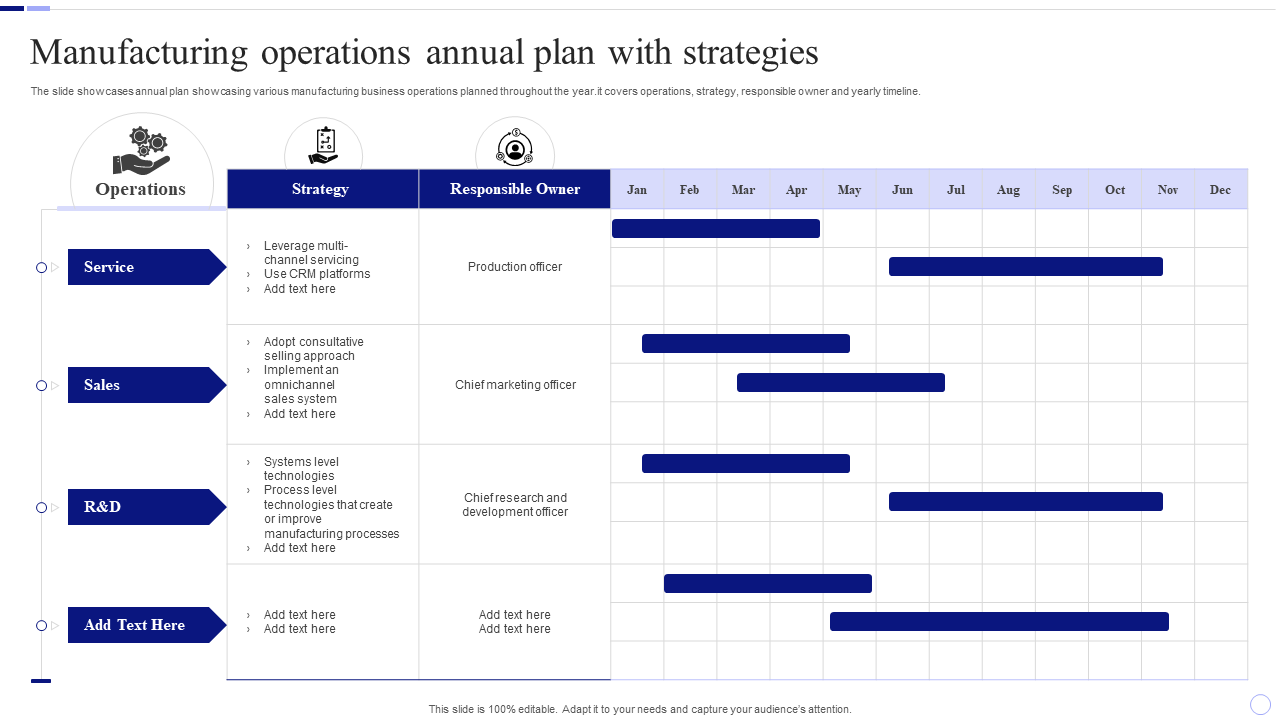
This template displays the annual plan of business operations. It covers operations, the associated strategies, the responsible owner, and a yearly timeline. Operations, according to the slide, covers Services, Sales, R&D (Research and Development) along with their strategies and the timeline of tasks. The slide makes strategic decisions about production and delivery of goods within a manufacturing environment, facility location, production processes, inventory management, technology utilization and quality control to increase efficiency and meet customer demands effectively.
Template 3: Manufacturing Operation Best Practices 5S System For Manufacturing & Operations
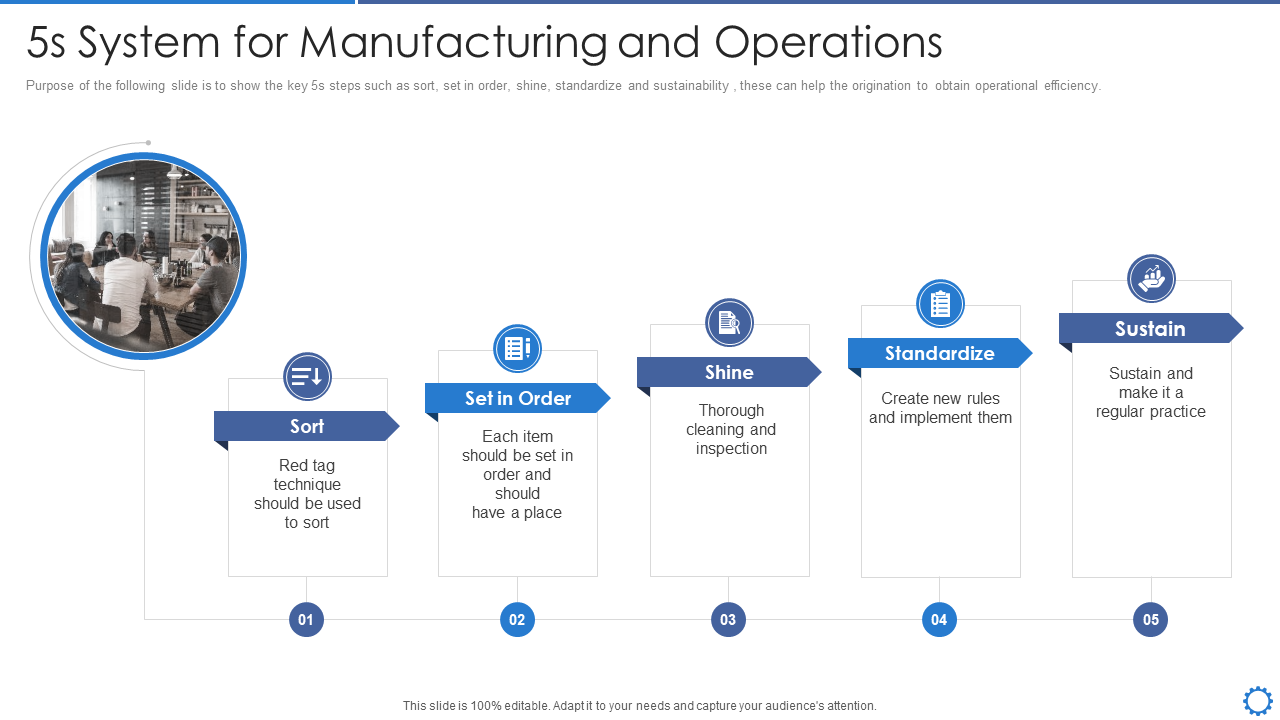
This PPT outlines the 5s system in manufacturing and Operations which stands for: Sort, Set in Order, Shine, Standardize, and Sustain. The 5s have been explained below:
- Sort
-
-
- Red tag technique should be used to sort.
-
- Set in Order
-
-
- Each item should be set in order and should have a place.
-
- Shine
-
-
- Thorough cleaning and inspection.
-
- Standardize
-
-
- Create new rules and implement them.
-
- Sustain
-
- Sustain and make it a regular practice.
Companies download the slide to implement the 5S system and eliminate waste, create a clean and productive environment by removing unnecessary items, cleaning the work area, organizing the remaining items, establishing standards for maintenance, and sustaining the practices through employee engagement and continuous improvement.
Template 4: Manufacturing Operations PowerPoint Template Bundles
This PPT covers manufacturing operations KPIs for performance evaluation, techniques for types of manufacturing operations, benefits of inventory management in manufacturing operations, manufacturing operation methods, etc. Companies can use the slide to plan inventory, manage software markets and process production. The PPT Presentation creates and delivers a product or service, source raw materials and assemble finished products. It can also be used to maintain inventory and deliver products to customers. Our PPT has been designed to integrate and optimize operational activities and provide real-time visibility to the production process.
[product_image id=779333]
Template 5: Optimizing Manufacturing Operations PPT
In this PPT, an organized outline of key topics relevant to improving manufacturing processes has been discussed. It includes an overview of the current scenario, understanding phases of production planning and control, maintenance & audit checklist, risk management, impact analysis, cost assessment and dashboard analysis. In the template, we have highlighted statistics associated with industry trends, key production challenges organizations face, need for streamlined production planning and control, factory machine maintenance and inspection checklist, internal audit checklist for production management, impact assessment of production planning and control, cost assessment for production planning and control, production risks and mitigation plan, vendor risk assessment and control measures, dashboard to evaluate manufacturing quality in the organization, etc.
[product_image id=786871]
Template 6: Strategies to Improve Manufacturing Operations in Business PPT
The following slide presents strategies to improve the operational pipeline of the manufacturing department to increase efficiency and reduce losses. The strategies are:
- Improve Productivity & Efficiency:
-
-
- Review targets on a regular basis
- Minimize activities that waste time
- Make use of productivity apps
- Outcome: Increased productivity
-
- Optimize Operational Efficiencies:
-
-
- Implement and increase automation
- Ensure maintenance of machines
- Impart training to machine operators about safety, usage etc
- Conduct preventive maintenance plans and schedules
- Outcome: Reduction in wastage
-
- Automate Manufacturing Process:
-
-
- Shifting from manual data entry to digital entry
- Automate documentation process
- Make use of tools such as PCS, PAC for automation
- Outcome: Reduces manual errors
-
- Reduce Production Losses:
-
-
- Install sensors for early detection of machine breakdown
- Conduct preventive maintenance plans and schedules
- Conduct trainings for employees
- Outcome: Increased profit margin
-
- Productivity Measurement:
-
- Determine the total output

Template 7: Strategic Dimensions in Manufacturing Industry Operations
This slide highlights strategic dimensions in the manufacturing industry and provides results of automating such operations. The key dimensions are production, quality, maintenance, and stock.
Production
- Description:
- Analysis of production capacity
- Planning and scheduling of production process
- Software Implementations:
- Planning and scheduling in advance
- Manufacturing automation
- Result:
- Overall productivity improvement
Quality
- Description:
- Quality assessment of processes
- Quality check on finished goods
- Software Implementations:
- R&D management with quality compliance
- Quality management system
- Result:
- More consistent quality in products cost reductions
Maintenance
- Description:
- Keep track of equipment's status, purchase date, warranty expiration date, etc.
- Software Implementations:
- Tracking maintenance schedules and work orders.
- Result:
- Increase in production efficiency
Stock
- Description:
- Audit and identify slow-moving stock that is not in demand by dealers
- Software Implementations:
- Determine sufficient amount and type of input products
- Keeping track of deliveries

Template 8: Manufacturing Operations KPIs For Performance Evaluation
This slide outlines KPIs of manufacturing operations. The purpose is for greater accountability, better performance, etc. The key components are leading indicators, lagging indicators, input indicators, process indicators, and output indicators.
- Leading Indicators
- Focus Areas: Forecasting the outcome of events, Influences change
- KPIs: Safety equipment usage, Quality control requirements, Average weekly working hours
- Lagging Indicators
- Focus Areas: Showcasing the success or failure of an event, Record the observations
- KPIs: Number of accidents, Customer fulfillment, Expenditure
- Input Indicators
- Focus Areas: Calculate the amount of resources consumed
- KPIs: The amount of resources - electricity, water or workforce used for the manufacturing process per day
- Process Indicators
- Focus Areas: Represent the productivity of the process
- KPIs: Time taken for product creation, Utilization of personnel training
- Output Indicators
- Focus Areas: Outcomes of the process
- KPIs: Product quality, Amount of waste produced

Template 9: Techniques for Types of Manufacturing Operations
This PPT exhibits manufacturing operations with their techniques and usage. The components are: Repetitive manufacturing, job shop manufacturing, discrete and continuous process manufacturing. In Repetitive Manufacturing (REM) the commodities are produced with an automated assembly line process and manufactured in a high-speed process following a repetitive or occurring over a long period of time. In Discrete Manufacturing, the commodities are manufactured in an assembly line, with simultaneous modifications. It is used for nuts and bolts, brackets, wires, assemblies and individual products. In Job Shop Manufacturing, the production takes place at multiple workstations with simultaneous modifications. Continuous Process Manufacturing is used for repetitive production of raw materials that are commonly gases, liquids, and powders.

Template 10: Benefits of Inventory Management In Manufacturing Operations
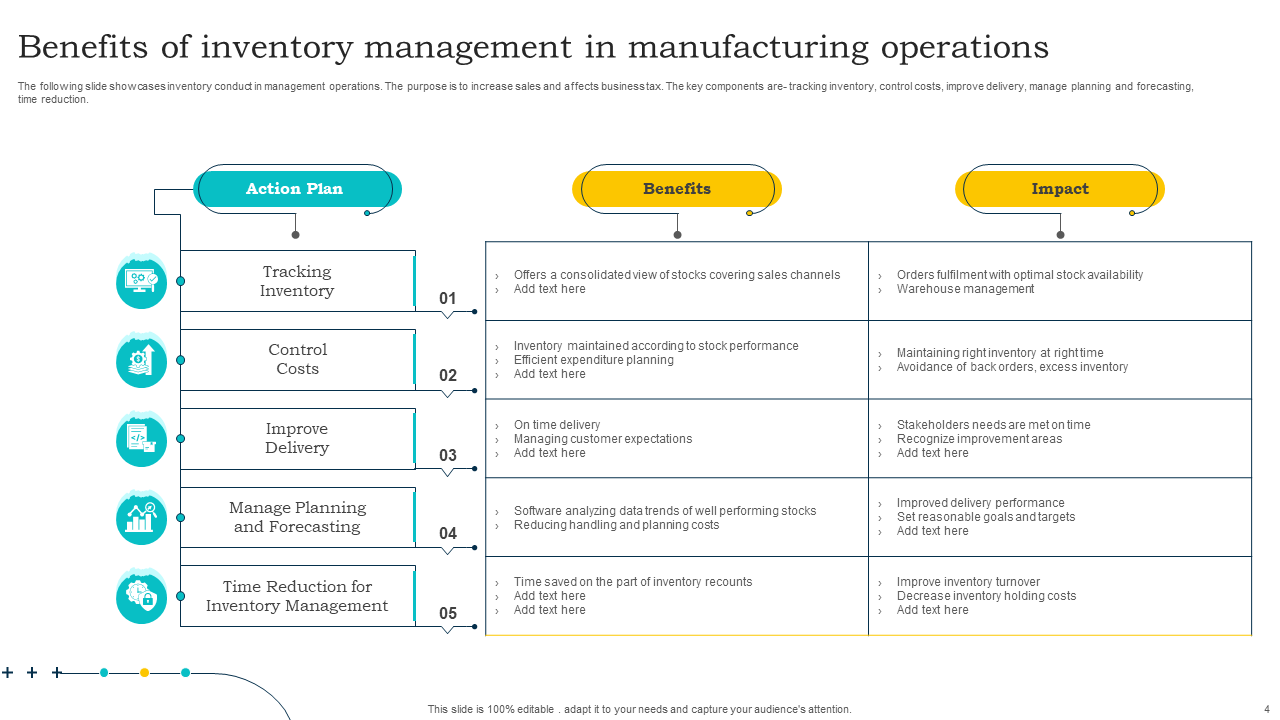
Key components in manufacturing operations, such as tracking inventory, controlling costs, improving delivery, managed planning and forecasting and time reduction are outlined in this template. In the action plan, the aim is to track inventory and control through inventory maintained according to stock performance. Improvement of delivery is also outlined through on-time delivery and managing customer expectations. For planning and forecasting, we have software analyzing data trends of well performing stocks.
BUSINESS GROWTH IS POWERED BY MANUFACTURING EXCELLENCE
Manufacturing operations is a comprehensive system where manufacturers make decisions and respond to changing conditions. It helps the company reduce waste, make better products and increase profits and customer satisfaction. Companies that succeed at managing manufacturing operations collect and use the data well. They standardize important procedures and make decisions based on monitored KPIs. It uses real-time monitoring and data analysis to identify and address quality issues, setting a higher standard for goods. Manufacturers operations can adapt to changing market conditions or customer demands and give a competitive edge. It keeps customers satisfied by helping manufacturers meet demand, leading to on-time delivery and good quality. Better management operations helps manufacturers comply with industry rules and regulations reducing the risk of reputational damage and penalties.
PS Do check out our blog on Top 10 Manufacturing Strategy Templates to ensure a brilliantly-run operation.