


Smart Manufacturing Powerpoint Presentation Slides




Try Before you Buy Download Free Sample Product
 Impress Your
 Audience
 100%
100% Editable
 Save Hours
 of Time


Our Smart Manufacturing IT template is a comprehensive guide to the technologies used in the manufacturing industry. It provides a brief overview of the industrys evolution from 1.0 to 4.0 and covers various technologies, including Automation Robotics, Artificial Intelligence AI, and Explainable AI, that are used to overcome production issues. The PPT includes an introduction to the manufacturing industry and its key features, along with market size, share, and global spending. It also delves into the application areas, types, impact, working, and safety measures of every technology used in manufacturing. The template further discusses the role of cybersecurity in smart manufacturing, a 30-60-90 days plan, and a training program for cybersecurity awareness among employees. It caters to the training budget and pricing for technologies used, provides a timeline and a roadmap to implement IT in the manufacturing industry, and includes a predictive analytics dashboard to track manufacturing operations. Access our Smart Manufacturing template now to gain insights into the technologies driving the manufacturing industry.
People who downloaded this PowerPoint presentation also viewed the following :
Content of this Powerpoint Presentation
Slide 1: This slide introduces Smart manufacturing (IT). State your company name and begin.
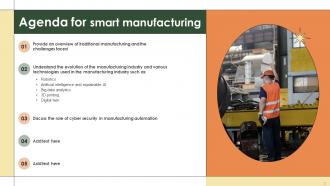
Slide 2: This slide depicts the Agenda of the presentation.
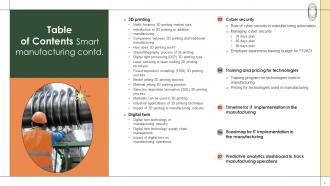
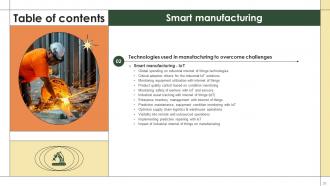
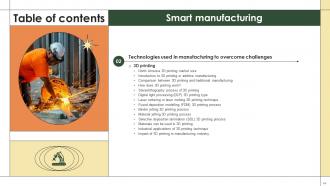
Slide 3: This slide shows Table of Content for the presentation.
Slide 4: This is yet another slide continuing the Table of contents.
Slide 5: This slide highlights the Title for the Topics to be covered next.
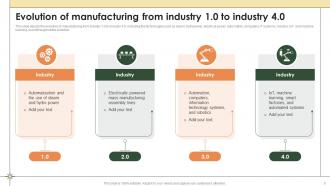
Slide 6: This slide depicts the evolution of manufacturing from industry 1.0 to industry 4.0, including the technologies such as steam, hydropower, electrical power, etc.
Slide 7: This slide exhibits the Heading for the Contents to be discussed further.
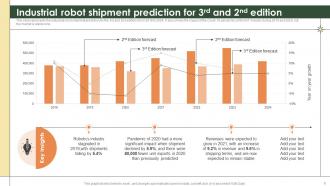
Slide 8: This slide elucidates the Industrial robot shipment prediction for 3rd and 2nd edition.
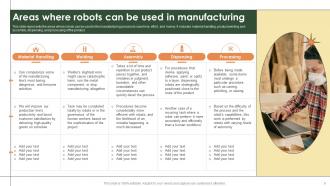
Slide 9: This slide represents the areas where robots can be used in the manufacturing process to save time, effort, and money.
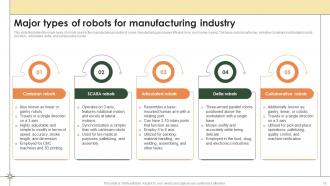
Slide 10: This slide illustrates the major types of robots used in the manufacturing industry to make manufacturing processes efficient, time, and money-saving.
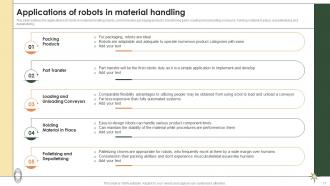
Slide 11: This slide outlines the applications of robots in material handling chores, and it includes packaging products, transferring parts, etc.
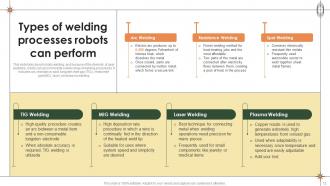
Slide 12: This slide talks about robotic welding, and because of the diversity of gear available, robots can accommodate a wide range of welding procedures.
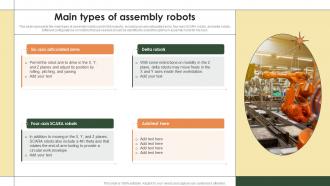
Slide 13: This slide discusses the Main types of assembly robots.
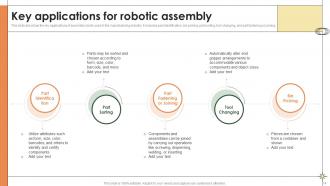
Slide 14: This slide describes the key applications of assembly robots used in the manufacturing industry.
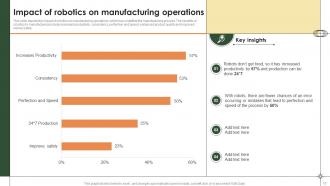
Slide 15: This slide highlights the Impact of robotics on manufacturing operations.
Slide 16: This slide elucidates the Heading for the Contents to be discussed next.
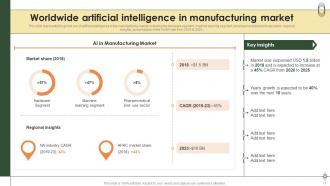
Slide 17: This slide focuses on the Worldwide artificial intelligence in manufacturing market.
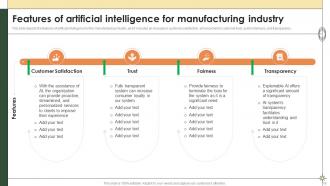
Slide 18: This slide exhibits the Features of artificial intelligence for manufacturing industry.
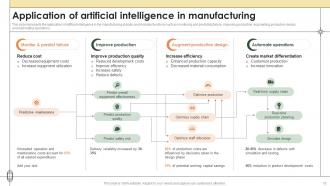
Slide 19: This slide focuses on the Application of artificial intelligence in manufacturing.
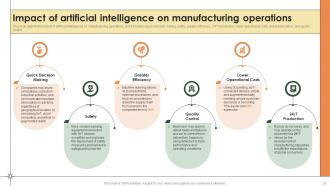
Slide 20: This slide highlights the Impact of artificial intelligence on manufacturing operations.
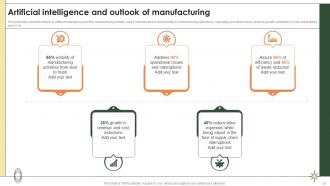
Slide 21: This slide deals with the Artificial intelligence and outlook of manufacturing.
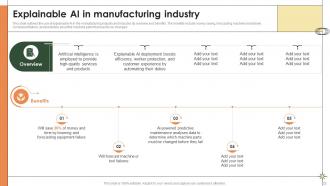
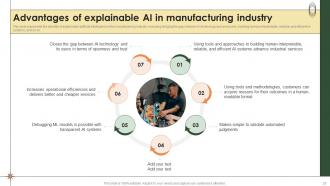
Slide 22: This slide outlines the use of explainable AI in the manufacturing industry and includes its overview and benefits.
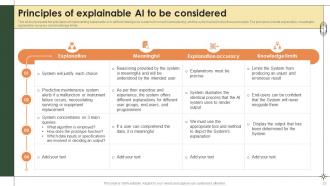
Slide 23: This slide represents the principles of implementing explainable AI in artificial intelligence systems for smart manufacturing, and the system should obey these principles.
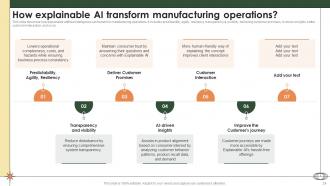
Slide 24: This slide describes how explainable artificial intelligence can transform manufacturing operations.
Slide 25: This slide showcases the Advantages of explainable AI in manufacturing industry.
Slide 26: This slide elucidates the Title for the Ideas to be discussed further.
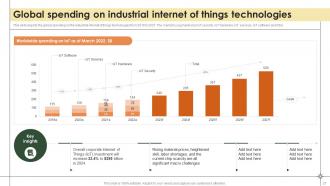
Slide 27: This slide depicts the global spending on the industrial internet of things technologies from 2019 to 2027.
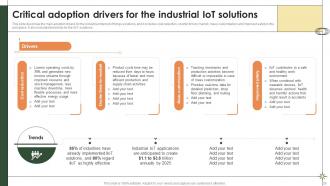
Slide 28: This slide describes the main adoption drivers for the industrial internet of things solutions.
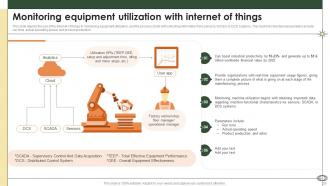
Slide 29: This slide depicts the use of the internet of things in monitoring equipment utilization, and the process starts with collecting information from sensors, SCADA or DCS systems.
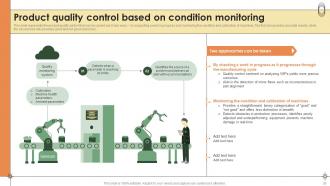
Slide 30: This slide represents the product quality control that can be carried out in two ways – by inspecting a work in progress and monitoring the condition and calibration of machines.
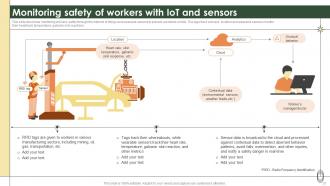
Slide 31: This slide focuses on Monitoring safety of workers with IoT and sensors.
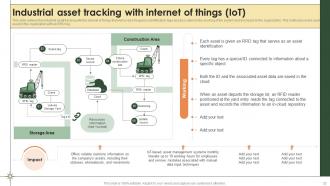
Slide 32: This slide outlines the industrial asset tracking with the internet of things that works radio frequency identification tags and also caters to the working of the system and its impact on the organization.
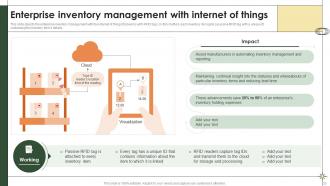
Slide 33: This slide shows the Enterprise inventory management with internet of things.
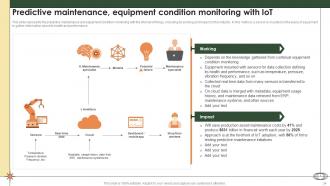
Slide 34: This slide represents the predictive maintenance and equipment condition monitoring with the internet of things, including its working and impact on the industry.
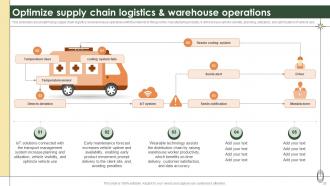
Slide 35: This slide talks about optimizing supply chain logistics and warehouse operations with the internet of things in the manufacturing industry.
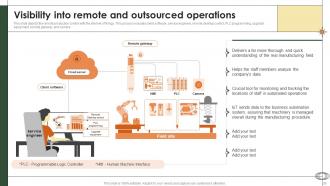
Slide 36: This slide depicts the remote production control with the internet of things.
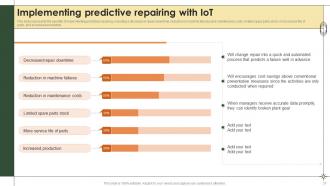
Slide 37: This slide focuses on Implementing predictive repairing with IoT.
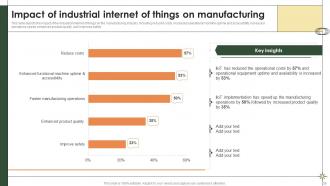
Slide 38: This slide highlights the Impact of industrial internet of things on manufacturing.
Slide 39: This slide showcases the Heading for the Components to be covered further.
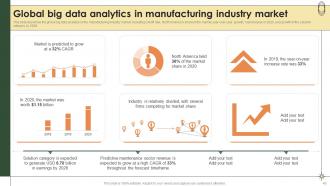
Slide 40: This slide describes the global big data analytics in the manufacturing industry market, including CAGR rate, North America's share in the market, year-over-year growth, etc.
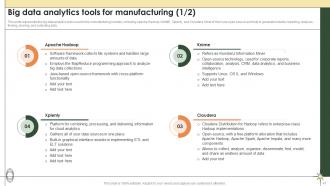
Slide 41: This slide represents the big data analytics tools used in the manufacturing industry, including Apache Hadoop, KNIME, Xplenty, and Cloudera.
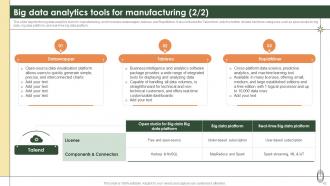
Slide 42: This is yet another slide continuing the Big data analytics tools for manufacturing.
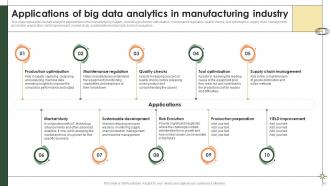
Slide 43: This slide highlights the Applications of big data analytics in manufacturing industry.
Slide 44: This slide elucidates the Title for the Topics to be discussed next.
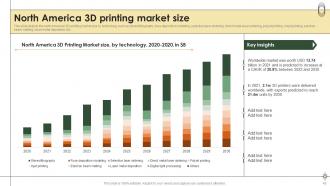
Slide 45: This slide depicts the north American 3D printing market size by technology such as stereolithography, fuse deposition modeling, etc.
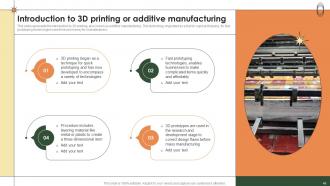
Slide 46: This slide shows the introduction to 3D printing, also known as additive manufacturing.
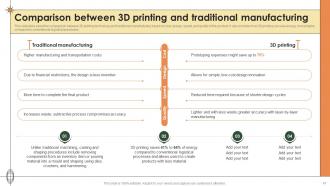
Slide 47: This slide talks about the comparison between 3D printing technology and traditional manufacturing based on cost, design, speed, and quality of the product.
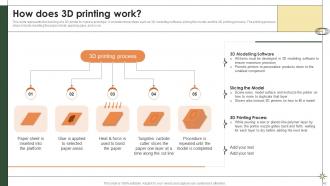
Slide 48: This slide presents the working of a 3D printer to make a prototype.
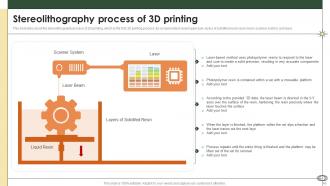
Slide 49: This slide showcases the Stereolithography process of 3D printing.
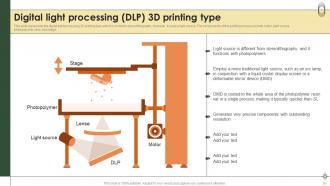
Slide 50: This slide reveals the digital light processing 3D printing type which is similar to stereolithography.
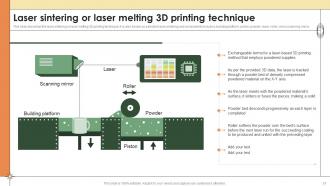
Slide 51: This slide describes the laser sintering or laser melting 3D printing technique.
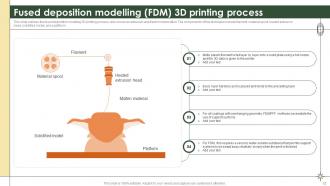
Slide 52: This slide outlines the fused deposition modeling 3D printing process, also known as extrusion and freeform fabrication.
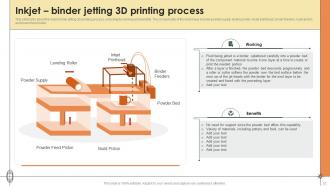
Slide 53: This slide talks about the inkjet binder jetting 3D printing process, including its working and benefits.
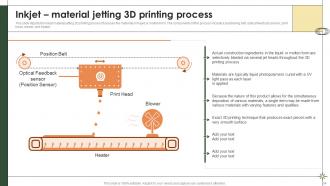
Slide 54: This slide depicts the inkjet material jetting 3D printing process that uses the materials in liquid or molten form.
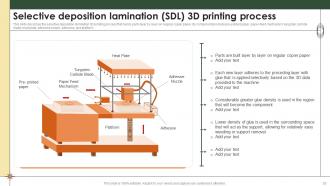
Slide 55: This slide describes the selective deposition lamination 3D printing process that builds parts layer by layer on regular copier paper.
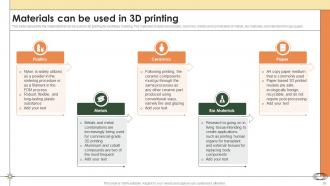
Slide 56: This slide represents the materials that can be used in 3D printing for prototype building.
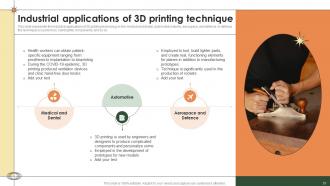
Slide 57: This slide highlights the industrial applications of 3D printing technology in the medical and dental, automotive industry, aerospace, and defence.
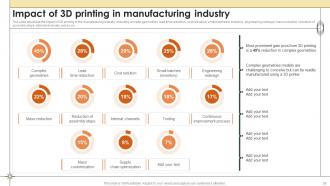
Slide 58: This slide elucidates the Impact of 3D printing in manufacturing industry.
Slide 59: This slide incorporates the Heading for the Ideas to be discussed next.
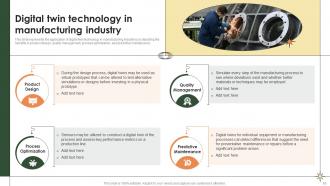
Slide 60: This slide contains the application of digital twin technology in manufacturing industries by depicting the benefits in product design, quality management, process optimization, and predictive maintenance.
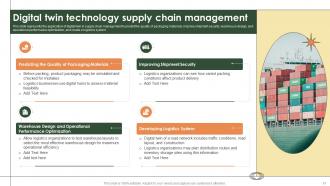
Slide 61: This slide showcases the Digital twin technology supply chain management.
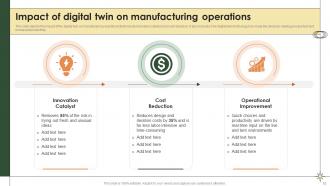
Slide 62: This slide depicts the impact of the digital twin on manufacturing operations that include innovation catalyst and cost reduction.
Slide 63: This slide highlights the Title for the Topics to be covered further.
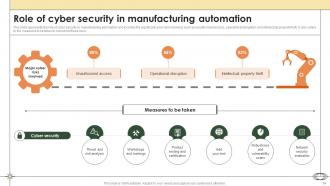
Slide 64: This slide reveals the Role of cyber security in manufacturing automation.
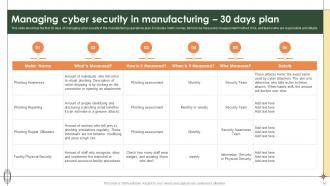
Slide 65: This slide describes the first 30 days of managing cyber security in the manufacturing operations plan.
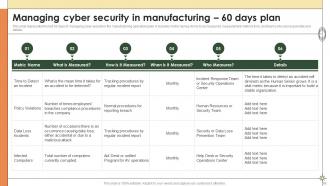
Slide 66: This slide deals with the next 60 days of managing cyber security in the manufacturing operations plan.
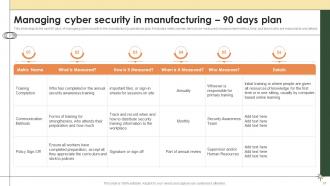
Slide 67: This slide depicts the next 90 days of managing cyber security in the manufacturing operations plan.
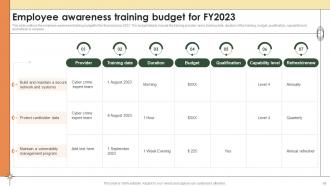
Slide 68: This slide outlines the employee awareness training budget for the financial year 2023.
Slide 69: This slide incorporates the Title for the Topics to be discussed in the upcoming template.
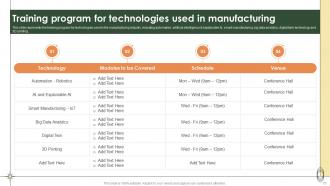
Slide 70: This slide displays the training program for technologies used in the manufacturing industry, including automation, artificial intelligence & explainable AI, etc.
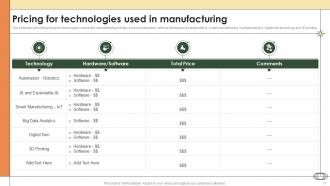
Slide 71: This slide talks about the pricing for technologies used in the manufacturing industry, such as automation, artificial intelligence & explainable AI, etc.
Slide 72: This slide lists the Heading for the Components to be covered in the upcoming template.
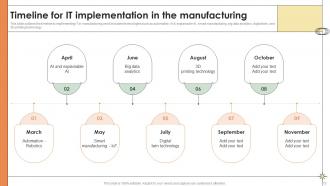
Slide 73: This slide outlines the timeline to implementing IT in manufacturing and it includes technologies such as automation, AI & explainable AI, smart manufacturing, etc.
Slide 74: This slide highlights the Title for the Ideas to be discussed next.
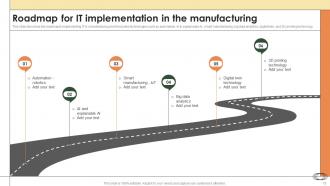
Slide 75: This slide presents the roadmap to implementing IT in manufacturing and it includes technologies such as automation, AI & explainable AI, smart manufacturing, and many more.
Slide 76: This slide contains the Heading for the Components to be covered in the forth-coming template.
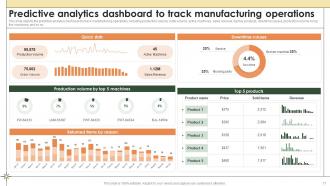
Slide 77: This slide reveals the predictive analytics dashboard to track manufacturing operations, including production volume, order volume, downtime causes, etc.
Slide 78: This slide contains all the icons used in this presentation.
Slide 79: This slide is titled as Additional Slides for moving forward.
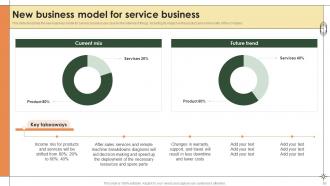
Slide 80: This slide shows New business model for service business.
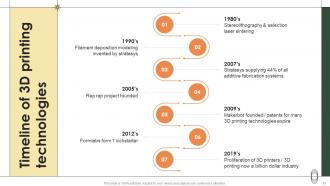
Slide 81: This slide presents Timeline of 3D printing technologies.
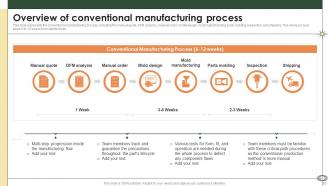
Slide 82: This slide displays Overview of conventional manufacturing process.
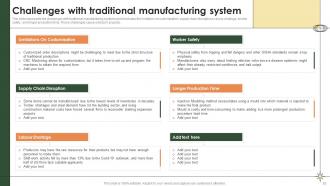
Slide 83: This slide represents Challenges with traditional manufacturing system.
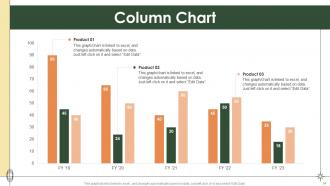
Slide 84: This slide displays Column chart with two products comparison.
Slide 85: This slide depicts Venn diagram with text boxes.
Slide 86: This slide shows Post It Notes. Post your important notes here.
Slide 87: This is Our Team slide with names and designation.
Slide 88: This is a Timeline slide. Show data related to time intervals here.
Slide 89: This is Our Target slide. State your targets here.
Slide 90: This slide displays Mind Map with related imagery.
Slide 91: This slide shows SWOT describing- Strength, Weakness, Opportunity, and Threat.
Slide 92: This is Our Mission slide with related imagery and text.
Slide 93: This is a Thank You slide with address, contact numbers and email address.
Smart Manufacturing Powerpoint Presentation Slides with all 98 slides:
Use our Smart Manufacturing Powerpoint Presentation Slides to effectively help you save your valuable time. They are readymade to fit into any presentation structure.









FAQs for Smart Manufacturing
Dude, IoT is a game changer - it hooks up all your machines and sensors so you can actually see what's going on in real-time. Instead of waiting days to figure out why production slowed down, you'll know instantly. Energy waste, bottlenecks, equipment about to break - the sensors catch it all before it costs you money. Honestly, you won't believe how much inefficiency was hiding right under your nose. My advice? Don't try to do everything at once though. Pick one line, get it connected, show the suits it works, then expand from there.
So basically you use sensors to monitor your equipment and catch problems before everything breaks down. Way better than scrambling when stuff randomly fails, you know? I've seen places cut surprise downtime by like 30-50% with this approach. You'll spend less on parts too since you're replacing things when they actually need it, not just because the calendar says so. Your maintenance crew will thank you - no more constant emergency repairs. Oh, and don't try to do everything at once. Pick your most critical machines first, then expand once you get the hang of it.
Dude, predictive maintenance is where it's at - catches equipment problems before everything breaks down. Quality control gets way better too since AI spots defects faster than people can. Your scheduling becomes smarter, less waste, better forecasting. Supply chain gets more responsive. ROI's pretty decent after you survive the initial costs (which honestly can sting a bit). Don't go crazy though - just pick one production line to test it out first. Way easier than overhauling your entire operation at once.
So basically, digital twins are like having a sandbox version of your production line. You can mess around with different setups and test scenarios without actually breaking anything expensive - which is huge. The cool part? You'll spot equipment failures before they happen and optimize workflows by running thousands of simulations in minutes instead of waiting weeks for real-world results. Honestly, I think the real-time adjustments are where it gets interesting - you're catching problems before they even become problems. My advice would be to pick one critical process first and just see how it goes.
Honestly, smart manufacturing is a game changer for supply chain visibility. You've got IoT sensors and RFID tags tracking everything automatically - from raw materials straight to the customer's door. The data connects suppliers, manufacturers, and logistics so there's no guessing where stuff is or if delays are coming. Quality issues get caught early too, which is huge. I'd probably start by figuring out where you're currently flying blind - those are your biggest wins. Once you connect those areas, you'll spot problems faster and waste way less time putting out fires.
Cost is gonna hit you first - smart tech ain't cheap upfront. Your old equipment probably won't mesh well with new systems either, which makes integration a total pain. I've seen companies struggle for months just getting everything to talk to each other. Plus your team needs training on this stuff, and good luck finding people who actually know both manufacturing AND digital tech. Oh, and cyber threats become way more of a thing once you're connected. Honestly? Start with small pilot projects first. Test the waters before dumping your whole budget into it.
So basically, all that sensor data gets turned into stuff you can actually act on. Equipment failures? You'll catch them before they happen. Production schedules get way smarter based on what people actually want. Quality problems get spotted early too - honestly that alone saves tons of headaches. The real game-changer is it's all happening live now, not just looking backwards at reports. Your machines start adjusting themselves and flagging weird stuff automatically. My advice though? Don't go crazy at first. Pick something specific like random breakdowns and nail that before moving on to other problems.
Honestly, smart manufacturing is more about changing jobs than killing them off. Yeah, the manual stuff gets automated, but then you need people who can handle IoT systems and make sense of all that data. Pretty cool shift if you ask me - we're talking predictive maintenance specialists, data analysts, that kind of thing. Your team's gonna need new skills though. Programming, data interpretation, working alongside machines. I'd start looking at who on your current crew is already tech-curious and get them trained up now. Better to get ahead of it than scramble later.
Dude, robots can totally flip your whole production setup. You know those painful changeovers that take days? Now you're talking hours or minutes - just reprogram instead of physically retooling everything. Smaller batches become way more doable. Plus you can customize stuff on demand without wanting to pull your hair out. The learning curve isn't too bad either since robots pick up new tasks through software updates. Honestly, I'd start by looking at whatever changeover process makes you want to cry the most. That's your sweet spot for automation.
Start with network segmentation - separate your OT and IT systems so hackers can't hop between them. Strong authentication and encryption for data transmissions is crucial. Those firmware updates on IoT devices? Yeah, they're annoying but that's where most attacks happen, so stay on top of them. Set up continuous monitoring to catch weird activity right away. Only let authorized people touch critical systems - sounds obvious but you'd be surprised. Oh, and run a vulnerability audit first. That'll tell you exactly where you're bleeding so you don't waste time guessing.
Start with energy monitoring - that's your easiest win and shows ROT immediately. Your IoT sensors can track resource usage across production lines and spot waste in real-time. Honestly, the data insights are pretty mind-blowing once you dive in. Smart systems predict equipment failures before they waste materials too. AI helps optimize supply chain routes, and predictive maintenance extends equipment life. You can even create closed-loop systems for recycling materials. I'd focus on energy first though - it builds a solid case for rolling out bigger sustainable manufacturing stuff later.
Dude, 5G is what makes all that smart factory stuff actually work in real-time. Your robots and sensors can talk to each other in milliseconds instead of waiting around forever. Massive bandwidth means you can run HD quality control cameras while your AI crunches data simultaneously. Honestly, the connectivity is insane - thousands of devices all linked up without lag. If you're doing any factory upgrades, get the 5G sorted first. I learned that the hard way watching a client try to retrofit it later.
Honestly, you don't need a huge budget for this stuff. IoT sensors are way cheaper now - just throw some on your equipment to catch problems before they blow up into major repairs. Those cloud analytics platforms? They'll handle your production scheduling without needing to hire some expensive data scientist. Start small though. Pick whatever's driving you crazy right now and tackle just that one thing. Basic automation for repetitive tasks is a game-changer - suddenly your people can actually focus on stuff that matters. The gradual approach works best anyway. You'll be surprised how much of a difference even simple changes make.
So I'd definitely track both the operations stuff and financial metrics to see the whole picture. Start with OEE, production throughput, and defect rates - those show quick wins. Energy per unit is massive too since smart systems usually crush it there. ROI and cost per unit on the money side. The data thing gets crazy overwhelming fast though, trust me. Pick like 3-4 metrics you actually care about and can move the needle on. I learned this the hard way - focus on stuff where you'll see results in a few months, not everything at once.
Look for those annoying, repetitive tasks that are hard on your workers' bodies - that's where cobots shine. Assembly, packaging, material handling are perfect starting points because you'll see results fast. Yeah, some people will be skeptical at first (totally get it), but proper training helps a lot. Do a solid risk assessment and make it clear these bots are helpers, not replacements. Honestly, I'd just pick one pilot project to start. See how it goes, then expand based on what actually works in your specific setup. Don't try to do everything at once.
-
Design layout is very impressive.
-
“Thanks to SlideTeam. Now I can make smart presentations in a fraction of time without any hassle.”