


Improving product quality in manufacturing powerpoint presentation slides




Try Before you Buy Download Free Sample Product
 Impress Your
 Audience
 100%
100% Editable
 Save Hours
 of Time


Enhance the quality management system by incorporating our professionally designed Improving Product Quality In Manufacturing PowerPoint Presentation Slides. This thoroughly researched presentation explains the current quality management system, major issues faced by the firm, solutions to overcome issues, setting quality control benchmarks, skill evaluation and training, developing quality control and assurance plan, maintenance and audit checklist, risk management, business performance forecasting, dashboard. Take the assistance of this quality control in manufacturing PPT slideshow, and discuss the major quality issues faced by the firm and solutions to overcome them. The slides also display an acceptable level of product quality and quality assurance criteria in tabular form. Utilize our ready-to-use manufacturing quality improvement plan PowerPoint visuals, and showcase details of employee performance assessment. It also covers the skill enhancement training schedule. This improving product quality PPT slide deck aptly displays the quality control plan of a manufacturing firm. Further, it illustrates the machine maintenance plan, audit checklist, risk identification, and mitigation plan of a manufacturing firm.
People who downloaded this PowerPoint presentation also viewed the following :
Content of this Powerpoint Presentation
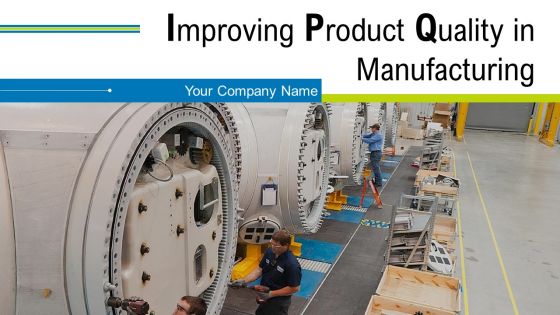
Slide 1: This title slide introduces Improving Product Quality in Manufacturing. Add the name of your company here.
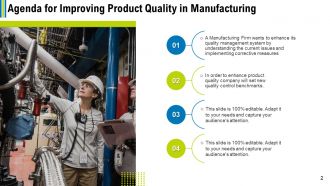
Slide 2: This slide presents the Agenda for Improving Product Quality in Manufacturing. It includes - A Manufacturing Firm wants to enhance its quality management system by understanding the current issues and implementing corrective measures, In order to enhance product quality company will set new quality control benchmarks, etc.
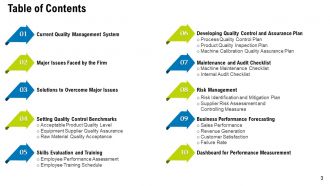
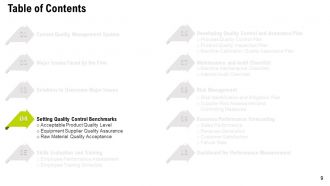
Slide 3: This slide contains the Table of Contents. It includes - Developing Quality Control and Assurance Plan, Current Quality Management System, Machine Maintenance Checklist, etc.
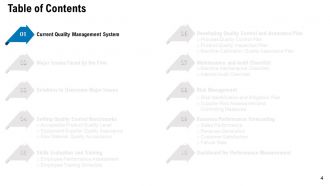
Slide 4: This is a table of content slide showing the Current Quality Management System.
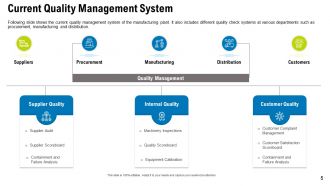
Slide 5: This slide presents the Current Quality Management System. It shows the current quality management system of the manufacturing plant.
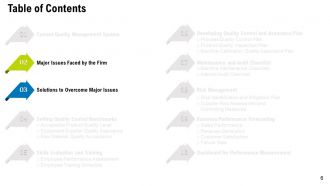
Slide 6: This is a table of content slides showing Major Issues Faced by the Firm and Solutions to Overcome Major Issues.
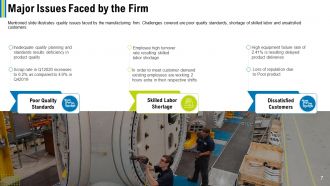
Slide 7: This slide presents the Major Issues Faced by the Firm. It illustrates quality issues faced by the manufacturing firm.
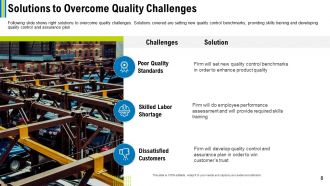
Slide 8: This slide presents the Solutions to Overcome Quality Challenges. It shows the right solutions to overcome quality challenges. Solutions covered are setting new quality control benchmarks, providing skills training, and developing a quality control and assurance plan
Slide 9: This is a table of content slide showing Setting Quality Control Benchmarks. It includes
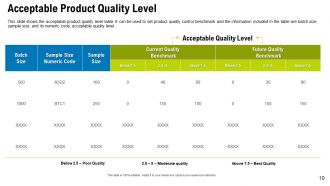
Slide 10: This slide presents the Acceptable Quality Level. It shows the acceptable product quality level table. It can be used to set product quality control benchmarks and the information included in the table are batch size, sample size, and its numeric code, acceptable quality level.
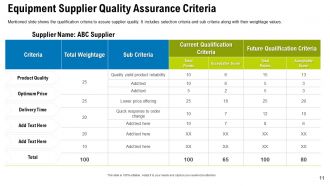
Slide 11: This slide presents the Equipment Supplier Quality Assurance Criteria. Mentioned slide shows the qualification criteria to assure supplier quality. It includes selection criteria and sub-criteria along with their weightage values.
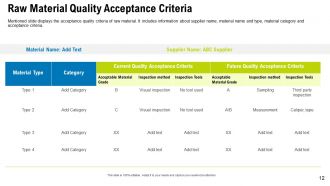
Slide 12: This slide presents the Raw Material Quality Acceptance Criteria. Mentioned slide displays the acceptance quality criteria of raw material. It includes information about supplier name, material name and type, material category, and acceptance criteria.
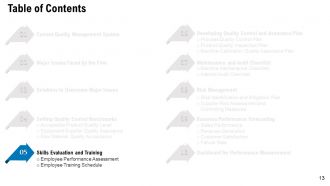
Slide 13: This is a table of content slide showing Skills Evaluation and Training. It includes - Employee Performance Assessment and Employee Training Schedule.
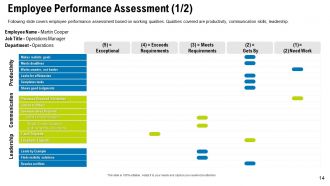
Slide 14: This slide presents the Employee Performance Assessment (1/2). Following slide covers employee performance assessment based on working qualities.
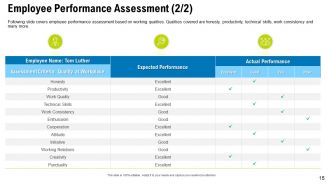
Slide 15: This slide presents the Employee Performance Assessment (2/2). Following slide covers employee performance assessment based on working qualities.
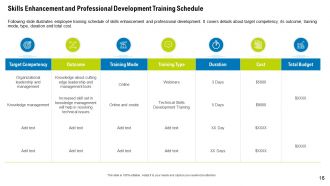
Slide 16: This slide presents the Skills Enhancement and Professional Development Training Schedule. It illustrates the employee training schedule of skills enhancement and professional development.
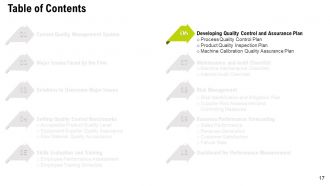
Slide 17: This is a table of content slide showing the Developing Quality Control and Assurance Plan. It includes - Process Quality Control Plan, Product Quality Inspection Plan, and Machine Calibration Quality Assurance Plan.
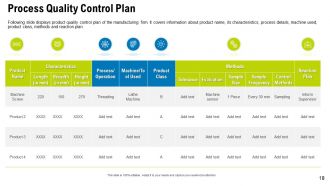
Slide 18: This slide presents the Process Quality Control Plan. It displays the product quality control plan of the manufacturing firm.
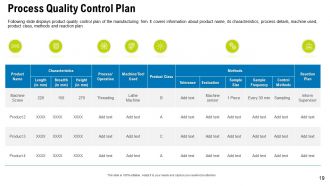
Slide 19: This slide presents the Process Quality Control Plan. It displays the product quality control plan of the manufacturing firm.
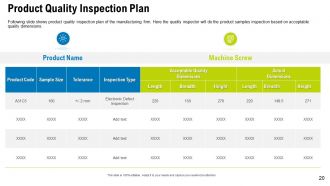
Slide 20: This slide presents the Product Quality Inspection Plan. It shows the product quality inspection plan of the manufacturing firm.
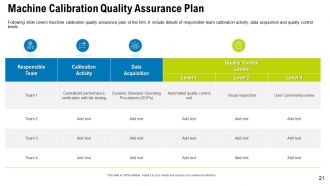
Slide 21: This slide presents the Machine Calibration Quality Assurance Plan. It covers the machine calibration quality assurance plan of the firm.
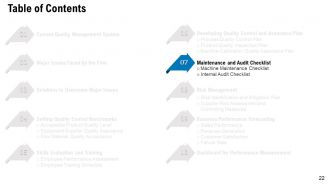
Slide 22: This is a table of content slide showing the Maintenance and Audit Checklist. It includes - Machine Maintenance Checklist and Internal Audit Checklist.
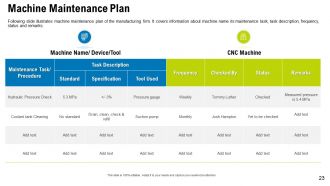
Slide 23: This slide presents the Machine Maintenance Plan. It illustrates the machine maintenance plan of the manufacturing firm.
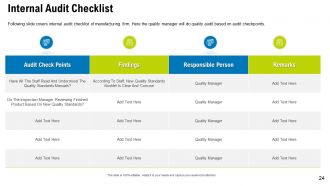
Slide 24: This slide presents the Internal Audit Checklist. It is an internal audit checklist of a manufacturing firm. Here the quality manager will do quality audits based on audit checkpoints.
Slide 25: This is a table of content slide showing Risk Management. It includes - Risk Identification and Mitigation Plan and Supplier Risk Assessment and Controlling Measures.
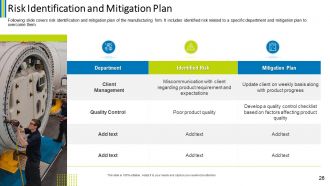
Slide 26: This slide presents the Risk Identification and Mitigation Plan. It covers the risk identification and mitigation plan of the manufacturing firm.
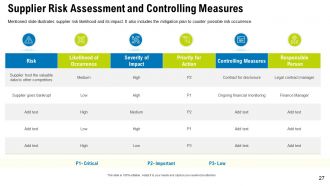
Slide 27: This slide presents the Supplier Risk Assessment and Controlling Measures. It illustrates supplier risk likelihood and its impact.
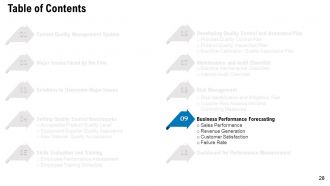
Slide 28: This is a table of content slide showing Business Performance Forecasting. It includes - Sales Performance, Revenue Generation, Customer Satisfaction, and Failure Rate.
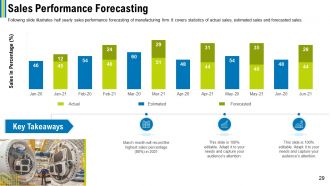
Slide 29: This slide presents the Sales Performance Forecasting. It illustrates the half-yearly sales performance forecasting of a manufacturing firm.
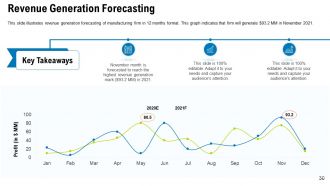
Slide 30: This slide presents the Revenue Generation Forecasting. It illustrates revenue generation forecasting of manufacturing firms in 12 months format.
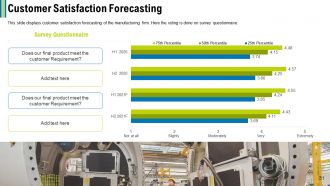
Slide 31: This slide presents the Customer Satisfaction Forecasting. It displays customer satisfaction forecasting of the manufacturing firm.
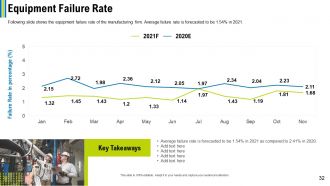
Slide 32: This slide presents the Equipment Failure Rate. It shows the equipment failure rate of the manufacturing firm.
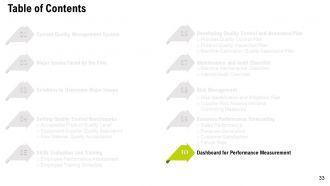
Slide 33: This is a table of content slide showing the Dashboard for Performance Measurement.
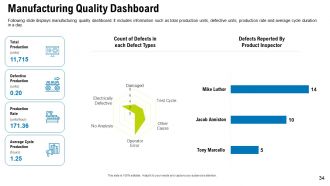
Slide 34: This slide presents the Manufacturing Quality Dashboard. It displays a manufacturing quality dashboard. It includes information such as total production units, defective units, production rate, and average cycle duration in a day.
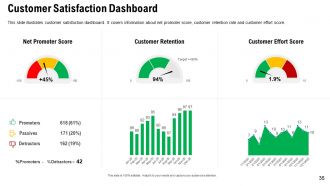
Slide 35: This slide presents the Customer Satisfaction Dashboard. It illustrates the customer satisfaction dashboard. It covers information about net promoter score, customer retention rate, and customer
Slide 36: This is the Improving Product Quality in Manufacturing Icons Slide.
Slide 37: This slide introduces the Additional Slides.
Slide 38: This slide provides the Mission for the entire company. This includes the vision, the mission, and the goal.
Slide 39: This slide shows the members of the company team with their name, designation, and photo.
Slide 40: This slide contains the information about the company aka the ‘About Us’ section. This includes the Value Clients, the Target Audience, and Preferred by Many.
Slide 41: This slide contains Post It Notes that can be used to express any brief thoughts or ideas.
Slide 42: This is the Our Goal slide.
Slide 43: This is a slide with a 30 60 90 Days Plan to set goals for these important intervals.
Slide 44: This is the Mind Map slide to brainstorm ideas with.
Slide 45: This slide is a Roadmap template to showcase the stages of a project, for example.
Slide 46: This slide is a Timeline template to showcase the progress of the steps of a project with time.
Slide 47: This is a Thank You slide where details such as the address, contact number, email address are added.
Improving product quality in manufacturing powerpoint presentation slides with all 47 slides:
Use our Improving Product Quality In Manufacturing Powerpoint Presentation Slides to effectively help you save your valuable time. They are readymade to fit into any presentation structure.




FAQs for Improving product quality in manufacturing
Track defect rate and first-pass yield first - those two will tell you everything you need to know right away. Defect rate shows how many products bomb before shipping. First-pass yield is what percentage makes it through without needing rework, which saves you money. Customer complaints and returns are obvious but super important since they show how quality actually performs in the real world. Oh, and cycle time for your quality processes too - slow inspections can really mess up your whole flow. Start with those first two though, they'll give you the biggest bang for your buck.
Honestly, you'll want to set up different ways to collect feedback first - surveys, reviews, support tickets, customer interviews. The volume gets crazy fast though, so don't try to tackle everything at once. Group similar feedback into buckets like usability problems or missing features. Focus on what comes up most often and what's actually hurting customer satisfaction. Get your product, engineering, and customer success people in a room regularly to spot patterns together. Here's the part most teams mess up - you have to circle back with customers who gave feedback. Show them you actually listened and did something about it.
Dude, training is huge for product quality. Your team needs to know the right procedures and how to catch problems before they get worse. I've actually seen companies slash their rework costs by like 30-40% just from solid training programs - it's pretty wild. When people understand what they're doing, they take more ownership too. Don't make it a one-time workshop thing though, keep it regular. Focus on whatever your biggest quality headaches are right now and build training around those specific issues. Short bursts work better than marathon sessions anyway.
Honestly, IoT sensors are a game-changer for tracking quality stuff in real-time. Those AI cameras? They catch defects way better than we do - kinda crazy how good they've gotten. I'd start with automated monitoring that flags issues before they blow up your costs. Machine learning for predictive maintenance is smart too since broken equipment = quality problems. The dashboard thing is clutch for spotting trends across different parts of your line. Oh, and don't try to do everything at once - pick one production line first, see how it goes, then expand from there. Way less overwhelming that way.
Honestly, I'd hit three big things: prevention, detection, and keeping your process tight. Don't just check quality at the end - that's way too late. Set up checks throughout so you catch problems before they snowball. Statistical process control sounds boring but it's actually super helpful for spotting trends. Train your people well and - this is key - give them the power to shut things down if something looks off. When defects happen, dig deep into the root cause instead of just slapping a band-aid on it. Oh, and start with a Pareto analysis to figure out what's causing the most headaches first.
Honestly, cross-functional teams are where you'll catch the most quality issues. Think about it - when your engineers actually talk to customer service people, they hear real problems users are having. Marketing folks finally get why certain features take forever to build. It breaks down those department walls that usually keep everyone focused on their own little metrics. Knowledge starts flowing naturally instead of staying stuck in one corner of the company. Oh and the perspectives thing is huge - you spot stuff working in silos that you'd totally miss otherwise. Try mixing at least three different departments on your next project.
Get everyone together first and walk through what happened step by step - you need all the perspectives, not just one version. Then do the "5 Whys" thing where you keep asking why until you hit the real problem. Most teams stop way too early, which is honestly why they keep having the same issues pop up again. Write down everything you find, even the stuff you rule out. Don't blame people though - it's almost always a process thing that broke down. Once you figure out the actual root cause, fix it and then watch to make sure it sticks.
Look, a good quality system is like having a business cheat code. Catches problems before they blow up into expensive messes. Your customers stay happy, keep coming back, and actually leave decent reviews instead of trashing you online. Operations get way smoother too - honestly, most teams are just winging it without clear standards. You'll stop hemorrhaging money on returns and constant crisis mode. Trust me, nothing kills profit margins faster than scrambling to fix stuff that shouldn't have broken. The whole thing builds customer trust, which obviously means more sales. Figure out where your biggest quality disasters happen first - that's your starting point.
So Six Sigma is this data-driven method for cutting out defects and making your processes more consistent. There's a framework called DMAIC that walks you through defining problems, measuring them, analyzing root causes, then improving and controlling the process. Pretty systematic stuff. What I like about it is you're not just putting band-aids on issues - you're actually preventing them from popping up again. Everything gets tracked with real metrics, so you can see if it's working. Some places go overboard with it (my old boss was obsessed), but honestly? When teams use it right, waste drops and customers are way happier. I'd say pick one small process first.
Honestly, don't cheap out on materials or skip testing - that'll bite you later. Instead, look at your actual processes and see where you're hemorrhaging money on redos and waste. Automation helps tons if you can swing it, and proper training upfront saves you from dealing with screwups down the line. Build solid relationships with suppliers who won't screw you over on pricing while still delivering decent quality. I'd start by mapping out everything you're currently doing - you'll probably find some obvious money pits. Think of quality as putting money in the bank, not burning it.
Dude, vendor quality management is like your safety net for keeping defects out of your final product. You've gotta stay on top of your suppliers with audits and regular check-ins - I've watched companies slash their defect rates by 60% just from tightening vendor specs. Most suppliers won't keep up standards without someone breathing down their necks, honestly. Map out your most critical vendors first and set clear quality metrics with them. Trust me, you'll thank yourself later when you're not dealing with nightmare quality issues down the line. It's way easier to prevent problems than fix them after.
So standards and certifications are basically your blueprint for what quality should look like. ISO 9001 is probably the big one you'll hear about, plus whatever specific ones your industry uses. They're super helpful because thousands of companies have already figured out the hard stuff - saves you from reinventing the wheel, you know? The whole certification thing makes you document everything properly (which honestly is annoying but necessary). You'll want to figure out which standards actually matter for your field first. Then just compare what you're doing now against those requirements. That'll show you exactly where you need to improve your QA processes.
So basically, you're already collecting data - just start there! Track your defect rates and customer complaints to catch patterns before they blow up. I've found it's way better to fix stuff based on real numbers instead of just guessing what's wrong. Set up some dashboards to watch your key metrics in real-time. The predictive stuff is pretty neat too - you can actually see when quality might tank based on what happened before. Root cause analysis on your data will show you exactly why things are breaking. Focus on whatever's causing the biggest headaches first.
Honestly, the worst part is people just hate change - they're so used to doing things their way. Data's another nightmare because you never have enough good info to actually make smart calls. Resources are always tight, quality standards are fuzzy, and departments barely talk to each other. Oh, and don't get me started on leadership wanting miracles overnight when this stuff takes forever. Here's what I'd do though: pick one small process first. Get a couple wins under your belt so people actually trust you. Make sure the important people are on board before you try anything bigger - learned that one the hard way.
You know what actually fixes quality problems? Getting people to talk to each other. Transparency kills those stupid departmental silos - when teams share data openly and listen to feedback, suddenly everyone's working toward the same goals. Can't tell you how many projects I've watched crash because engineering and QA were basically enemies. Cross-functional meetings help catch issues early, plus shared dashboards keep everyone on the same page. Honestly, just start with weekly sync meetings - sounds boring but you'll see problems get solved way faster. Clear escalation paths don't hurt either.
-
Professional and unique presentations.
-
Use of different colors is good. It's simple and attractive.
-
Easily Editable.
-
Out of the box and creative design.
-
Wonderful templates design to use in business meetings.
-
Amazing product with appealing content and design.
-
Thanks for all your great templates they have saved me lots of time and accelerate my presentations. Great product, keep them up!
-
Easily Understandable slides.
-
Innovative and attractive designs.