Manufacturing Process Automation Maturity Model
Try Before you Buy Download Free Sample Product
Audience
Editable
of Time
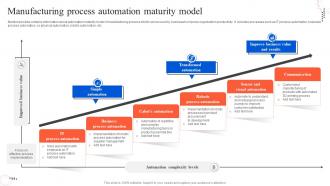
Mentioned slide contains information about automation maturity model of manufacturing process which can be used by business to improve organization productivity. It includes processes such as IT process automation, business process automation, co physical automation, robotic automation, etc.
People who downloaded this PowerPoint presentation also viewed the following :
Manufacturing Process Automation Maturity Model with all 6 slides:
Use our Manufacturing Process Automation Maturity Model to effectively help you save your valuable time. They are readymade to fit into any presentation structure.
FAQs for Manufacturing Process
Key benefits of automation for small businesses include reduced operational costs, improved accuracy, enhanced customer service, streamlined workflows, and increased productivity. These technologies enable small enterprises to compete more effectively by minimizing manual errors, accelerating response times, and optimizing resource allocation, ultimately delivering scalable growth and operational efficiency previously available only to larger organizations.
Automation enhances operational efficiency by streamlining repetitive tasks, reducing human error, and accelerating process completion across industries. In manufacturing, automated assembly lines minimize production time, while banks use automated loan processing and hospitals leverage robotic surgery systems, ultimately delivering faster services, lower operational costs, and improved customer experiences.
Artificial intelligence serves as the brain of modern automation solutions, enabling systems to learn, adapt, and make intelligent decisions rather than simply following pre-programmed rules. Through machine learning and predictive analytics, AI-powered automation streamlines operations in banking fraud detection, manufacturing quality control, and healthcare diagnostics, ultimately delivering faster decision-making, reduced operational costs, and enhanced accuracy across industries.
Common automation implementation challenges include resistance to change, integration complexities with legacy systems, insufficient employee training, unclear ROI metrics, and inadequate change management strategies. While these obstacles can seem daunting initially, organizations increasingly find that phased rollouts, comprehensive staff development, and strategic planning ultimately deliver enhanced operational efficiency and competitive advantage across sectors.
Automation transforms workforce dynamics by eliminating repetitive tasks, creating demand for higher-skilled positions, and reshaping traditional job functions across industries. While manufacturing and financial services see significant role evolution, automation enables employees to focus on strategic decision-making, creative problem-solving, and customer relationship management, ultimately enhancing productivity and job satisfaction.
Essential project management automation tools include workflow automation platforms, task scheduling software, resource allocation systems, automated reporting dashboards, and integration APIs. These technologies streamline operations by eliminating manual processes, reducing human error, and enabling real-time visibility across projects, with many organizations finding that strategic automation delivers faster project delivery and significantly improved resource efficiency.
Businesses balance automation and personalized customer service by implementing hybrid approaches that leverage AI for routine inquiries while reserving human agents for complex, high-value interactions. Strategic automation handles initial customer screening, basic support tickets, and data collection, while human representatives focus on relationship building, problem-solving, and nuanced communications, ultimately delivering faster response times and deeper customer connections.
Increasing workplace automation presents both enhanced security capabilities and new vulnerability challenges, including expanded attack surfaces, data privacy concerns, system interdependencies, and the need for robust cybersecurity protocols. While automated systems can strengthen threat detection and response through AI-powered monitoring, organizations must address potential risks through strategic security frameworks, ultimately delivering more resilient operations when properly implemented.
Automation contributes to sustainability by optimizing resource consumption, reducing waste through precision controls, and minimizing energy usage across industrial processes. Through smart manufacturing systems and automated monitoring, organizations streamline operations while significantly decreasing their environmental footprint, with many companies finding that automated processes deliver both cost savings and measurable progress toward carbon neutrality goals.
Companies should track metrics including cost reduction percentages, process completion times, error rates, employee productivity gains, and customer satisfaction scores. These measurements enable organizations to assess operational efficiency improvements, resource reallocation success, and ROI across departments, with many finding that combining financial and operational metrics delivers comprehensive insights into automation's strategic impact.
Automation integration succeeds through phased implementation, starting with non-critical processes, conducting thorough workflow mapping, and maintaining parallel systems during transitions. Organizations like manufacturing plants and financial institutions often begin with document processing or data entry tasks, gradually expanding to complex operations while training teams continuously, ultimately achieving seamless integration without operational disruption.
Manufacturing, healthcare, financial services, retail, and logistics are leading automation adoption due to their high-volume, repetitive processes and competitive pressures. These industries leverage automation to streamline operations, reduce costs, and enhance accuracy, with manufacturers using robotic assembly lines and banks deploying AI for fraud detection, ultimately delivering faster services and significant operational efficiency.
Consumer expectations drive automation implementation by demanding faster service delivery, 24/7 availability, personalized experiences, and consistent quality across all touchpoints. Organizations in retail, banking, and hospitality increasingly deploy chatbots, self-service kiosks, and automated processing systems to meet these demands, ultimately delivering reduced wait times and enhanced customer satisfaction while maintaining competitive advantage.
Emerging automation trends include artificial intelligence integration, robotic process automation expansion, edge computing deployment, autonomous systems development, and human-machine collaboration enhancement. These technologies streamline operations by reducing manual tasks, accelerating decision-making, and improving accuracy across manufacturing, healthcare, and financial services, with many organizations finding that strategic automation delivers significant competitive advantages and operational efficiency.
Companies ensure flexible automation strategies by implementing modular systems, adopting cloud-based platforms, establishing regular review cycles, and maintaining human oversight capabilities. Through scalable architectures and continuous monitoring, organizations in manufacturing, financial services, and retail can quickly adapt to market changes, integrate new technologies, and modify workflows, ultimately delivering sustained competitive advantage while minimizing disruption costs.
-
Like always a great experience with you guys. Always there on the drop of hat to help.
-
My presentations were a bit amateur before I found SlideTeam’s designs. I’ve been able to find slides for nearly every topic I’ve had to present. Thanks, Slideteam!