Operation Management Flow Chart For Manufacturing Industry
Try Before you Buy Download Free Sample Product
Audience
Editable
of Time
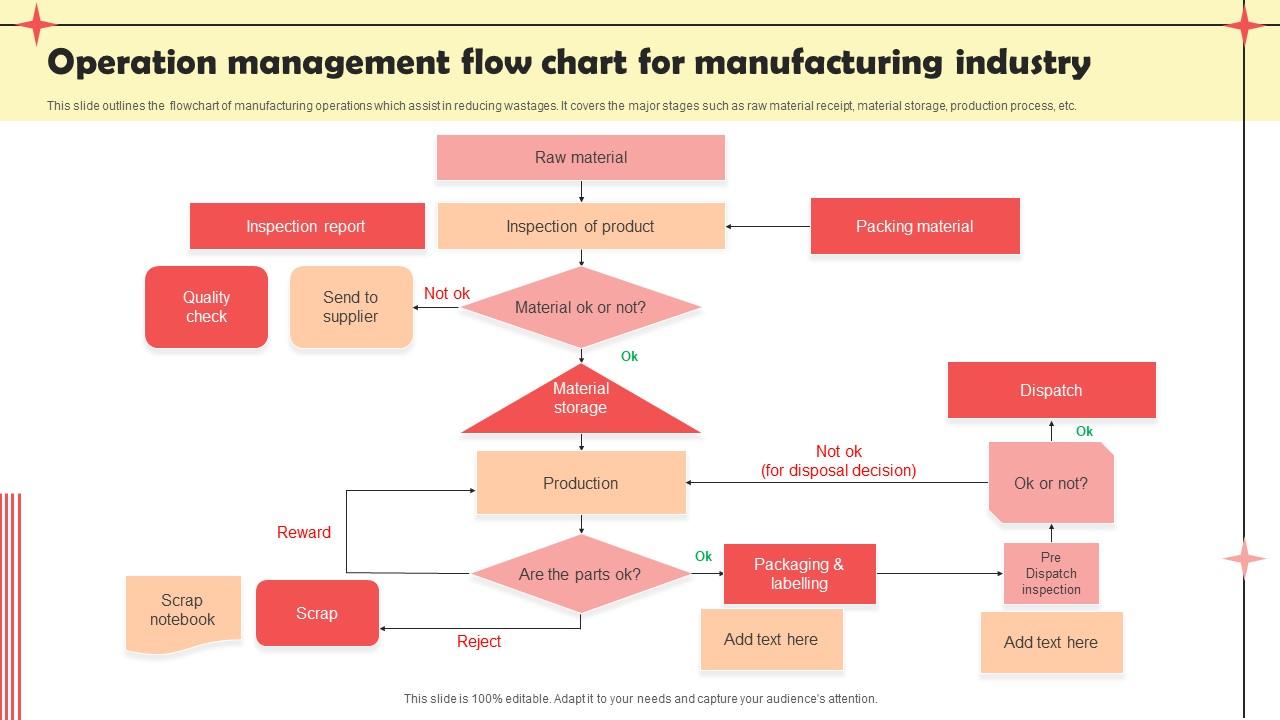
This slide outlines the flowchart of manufacturing operations which assist in reducing wastages. It covers the major stages such as raw material receipt, material storage, production process, etc.
People who downloaded this PowerPoint presentation also viewed the following :
Operation Management Flow Chart For Manufacturing Industry with all 6 slides:
Use our Operation Management Flow Chart For Manufacturing Industry to effectively help you save your valuable time. They are readymade to fit into any presentation structure.
FAQs for Operation Management Flow Chart
So there's basically five things you gotta nail: capacity planning, supply chain stuff, quality control, workflow optimization, and inventory management. Most of the time when things go wrong, it's because one of these is broken and then everything else falls apart - like dominoes, you know? Track your cycle times, defect rates, cost per unit. That kind of thing. I'd honestly just figure out which area sucks the most right now and fix that first. No point trying to tackle everything at once, you'll just burn out.
Honestly, lean management is just about cutting out all the BS that doesn't actually help your customers. Your processes get way faster and cheaper because you're only doing stuff that matters. Think of it like cleaning out your closet - if it's not useful, toss it. The cool part is everyone on your team becomes a problem-solver, constantly finding ways to make things smoother. Plus people actually like their jobs more when they're not dealing with pointless tasks all day. My advice? Don't try to fix everything at once though. Pick that one process that makes everyone want to scream and start there.
Dude, AI can seriously change how you run things. It handles the boring stuff - inventory tracking, forecasting, quality checks. No more human screwups on repetitive tasks. Real-time data insights are honestly game-changing for spotting supply chain issues before they hit. Plus you'll make decisions way faster than the old-school methods. Here's the thing though - don't go crazy trying to automate everything at once. That's a recipe for chaos. Start with whatever's driving you nuts the most and test one solution there first. Once that's working, then expand.
So your supply chain is literally the foundation of everything else you're doing operationally. When suppliers mess up, your whole business suffers - customers get mad, costs spiral, you know the drill. The thing is, you can't just pick any supply chain approach. Has to match what you're actually trying to accomplish. Going for rock-bottom prices? Speed? Flexibility? Your supply chain better support that goal or you're toast. Honestly, most companies don't even realize how disconnected their supply decisions are from their bigger operational strategy. Start by mapping what you've got now against where you want to be.
Pick 3-4 metrics that actually matter to your business goals first - don't get lost in the data weeds. The usual suspects work well: productivity ratios, cycle times, defect rates, customer satisfaction. Honestly, I'd avoid getting too fancy at the start. Compare your numbers against industry benchmarks or just track your own improvements over time. Set up some kind of dashboard that refreshes regularly so you can catch problems early. Oh, and throughput times plus cost per unit are solid ones too if you're tracking efficiency. The key is spotting trends before they bite you.
Honestly, people hate change - even when what they're doing sucks. Your team will push back hard on new systems. Productivity tanks while everyone's figuring things out, which is super annoying when you've got deadlines breathing down your neck. Plus you'll need money upfront for training and new tools. Oh, and workflows get messy during transitions - that's just unavoidable. Best thing you can do? Be crystal clear about WHY you're changing things. Don't just dump new processes on people without context. And yeah, brace yourself for some chaos initially.
So sustainability basically flips your whole decision-making process on its head. Now you're juggling carbon footprint, waste reduction, energy costs - all that green stuff alongside your usual metrics. Vendor selection gets way more complicated when you're checking if they're actually ethical. Production methods, packaging, even where you put facilities - everything runs through this sustainability filter now. Honestly, it's kind of overwhelming at first. But once you bake these criteria into your regular evaluation process, it becomes second nature instead of something you scramble to add later.
TQM focuses on building quality into every single step instead of just catching mistakes at the end. Everyone gets involved - from the people actually doing the work to the suits upstairs. Honestly, it sounds super straightforward but most companies mess up the execution. The whole point is creating a culture where people genuinely want to get things right the first time. You'll see less waste, happier customers, and way fewer headaches down the road. My advice? Pick one small process to start with and get your team actually excited about it before you try expanding everywhere.
So basically, you get to see what's actually happening in your business instead of just guessing. Like, you'll notice patterns - maybe one supplier is always late or a specific production line keeps breaking down. Super helpful for catching problems before they blow up. I started with just tracking inventory (seemed easiest) and honestly got a bit obsessed with all the insights you can pull. You can even predict when equipment needs maintenance, which saves you from those nightmare emergency repairs. The forecasting stuff for demand is pretty solid too. Just pick one area first though - don't try to analyze everything at once.
So for demand forecasting, you've got a few routes. Time series is solid if you have decent historical data - basically finds patterns in your past sales. Then there's causal modeling where you throw in outside stuff like economic factors or marketing spend. Customer surveys can work but honestly, people lie half the time. Machine learning's getting huge now since it handles messy data really well. Oh, and market research is always an option too. I'd probably start simple with time series first. Get comfortable with that, then add the fancier stuff later.
Manufacturing is basically making physical stuff you can touch and stack in warehouses. Services? Totally different beast - you're creating experiences that happen in real-time. With manufacturing, you've got way more control since processes are standardized and predictable. Services depend heavily on whoever's dealing with your customer that day, which honestly makes them harder to manage. You can't store a haircut or consultation like you would inventory. Quality's all over the map because every interaction is different. Oh, and customers aren't just receiving the end product - they're literally part of the process as it's happening. Bottom line: if you're running a service business, your frontline people make or break you.
Honestly, start with demand forecasting using your historical data - it's way more accurate than guessing. Set up automatic reorder points so you're not scrambling when stuff runs low. ABC analysis is clutch here: watch your expensive inventory like a hawk, but don't stress as much about the cheap stuff. JIT ordering rocks if your suppliers are solid, though I'd still keep buffer stock for anything critical because weird stuff happens. Oh, and ditch those massive yearly counts - cycle counting throughout the year is so much better. Get automated reorder alerts running first though, that'll fix like 80% of your headaches right there.
Build backup plans before you actually need them - most people learn this the hard way. Get alternative suppliers lined up, cross-train your team so anyone can jump into different roles, and keep some emergency cash stashed away. I'd start by figuring out your three biggest weak spots operationally. Run "what if" scenarios every few months - sounds boring but it's saved my ass before. Make sure you've got clear communication with key people and someone who can make quick decisions when everything's falling apart. Honestly, just pick one vulnerable area and tackle it this week.
Honestly, globalization totally flipped ops management on its head. Now you're juggling suppliers across like 12 time zones and drowning in different regulations for each country. Yeah, global sourcing gets you better costs, but the coordination headaches are real. Quality control? Good luck managing that when every supplier has different standards - the paperwork nightmare alone will make you question your career choices. Market problems in Asia suddenly mess up your entire forecast too. My advice? Build solid relationships with your key suppliers and get some decent supply chain tracking software. Those visibility tools actually work.
Dude, HR and operations are basically best friends - you can't really do one without the other. They handle all the people stuff that keeps your operations running: finding the right talent, training everyone up, scheduling shifts. When you're dealing with capacity problems or trying to figure out workforce planning, HR's got your back. Here's the thing though - and I learned this the hard way - if your employees are miserable, your whole operation tanks. HR keeps people engaged and actually wanting to show up to work. So yeah, definitely buddy up with your HR team because they're the ones who'll help you optimize everything through your people.
-
A beautiful, professional design paired with high-quality images and content that is sure to impress. It is a must-use PPT template in my opinion.Â
-
The PPTs are extremely simple to modify. Thank you for providing the slides that are ready to be used. They assist me in saving a lot of time.