

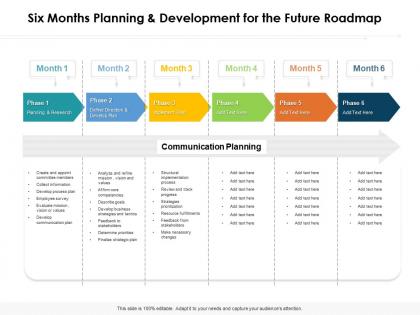
Six months planning and development for the future roadmap




Try Before you Buy Download Free Sample Product
 Impress Your
 Audience
 100%
100% Editable
 Save Hours
 of Time


Visualize your work plan and communicate your ideas impactfully with our pre designed Six Months Planning And Development For The Future Roadmap. Showcase the detailed overview of the project, the key deliverables, and the milestones to be achieved with the help of our fully customizable PowerPoint layout. You can easily emphasize on the project goals and discuss all the activities involved in an easy to comprehend manner by utilizing our professionally designed PPT theme. This roadmap PowerPoint layout is a perfect strategic planning tool that can help in keeping the project on track. With our attractive PowerPoint theme, you can articulate the workflow, track the work progress, and have a clear vision of the goal to be achieved. Download this versatile Six Months Planning And Development For The Future Roadmap and save your hours of work.
People who downloaded this PowerPoint presentation also viewed the following :
Six months planning and development for the future roadmap with all 2 slides:
Use our Six Months Planning And Development For The Future Roadmap to effectively help you save your valuable time. They are readymade to fit into any presentation structure.

FAQs for Six months planning and development for
Look, you need five things for a decent business roadmap. Clear goals that actually match where your company's going - sounds obvious but you'd be surprised. Then realistic timelines with monthly or quarterly checkpoints. Resource planning is huge too (budget, people, tools) - honestly this is where most people screw up. Track your progress with metrics you can actually measure. Oh, and build in flexibility because markets change and you'll need to pivot. I'd start with your 12-month vision first, then work backwards to figure out what steps get you there. Way easier than trying to plan forward from zero.
Talk to your customers, sales team, engineering, and leadership first - figure out what's actually broken and what opportunities you're missing. Map everything against your business goals and what you can realistically handle. I'm obsessed with impact vs effort matrices (way less painful than drowning in spreadsheets). Focus on customer value, revenue potential, and how it fits your company's direction. Technical debt and dependencies will bite you if you ignore them. Run your final list by a couple people you trust before diving in. Oh, and set up quarterly check-ins because things always change faster than you expect.
Market research is like your GPS for roadmap planning - shows you where customer needs are going and what gaps you can fill. Use it to validate your assumptions and prioritize features users actually care about. I've watched so many teams build roadmaps on pure gut instinct and totally whiff. Research helps separate what people say they want from what they'll spend money on. Don't just do one-off surveys though - that's kinda pointless. You need continuous research feeding into your quarterly reviews. It's also great for spotting trends before your competitors catch on.
Yeah, definitely factor in tech trends when planning your roadmap. Your users will expect certain things based on what's happening out there – AI features, mobile experiences, whatever new platform just dropped. But don't chase every trend that pops up. I learned that the hard way! Pick the ones that actually make sense for your goals and what your users need. Set up reviews every quarter to separate real momentum from just noise. Some trends stick around, others vanish faster than you'd think. Then tweak your roadmap based on what you find.
Honestly, regular workshops are a lifesaver - get everyone in a room to hammer out success metrics first thing. RACI matrices sound boring but they actually prevent so much drama about who owns what. Visual roadmaps help too, just skip the tech speak that makes people's eyes glaze over. I'd do monthly check-ins because things change fast and you want to catch problems early. Oh, and document everything transparently - people get way less cranky when they feel like they're in the loop. When stakeholders aren't surprised by decisions, alignment becomes much easier.
Look, bare minimum you want quarterly reviews, but monthly's honestly better if you're in a fast-moving space. Those quarterly sessions are for the big pivots and timeline shifts. Monthly ones catch the smaller stuff before it snowballs into real problems. I've seen teams that actually stick to this schedule - they're so much better at rolling with market changes when things get weird. But here's the thing: you gotta actually be willing to change direction when the numbers say you should. Don't just go through the motions. Block those calendar slots now before you forget!
Honestly, the worst mistake is setting crazy unrealistic timelines. Everything will take way longer than you think - like, always add buffer time. Also don't get super detailed about stuff that's months away since requirements change constantly anyway. Talk to your actual users regularly instead of guessing what they want (this one's huge). And stop copying competitors blindly - what works for them might be totally wrong for your situation. Oh, and review your roadmap quarterly with real data, not just whatever feels right at the moment.
Honestly, visual templates are a game-changer for roadmaps. People's eyes just glaze over when they see another bullet-point heavy slide. Swimlane diagrams or simple timelines let stakeholders instantly see what's happening when and how everything connects. Short sentences work. But you can also guide people through your story more naturally when you use visual hierarchy to highlight the big milestones. Templates keep your presentations looking consistent too, which definitely helps with credibility - though I've seen some pretty ugly branded templates that kinda defeat the purpose. Just grab a basic timeline template and customize it with your colors.
Start by spotting risks early and building them right into your roadmap. We got burned on a Q3 launch when a vendor issue we totally saw coming still wrecked everything—classic mistake of not having a backup plan ready. Give each major uncertainty a probability score so everyone knows what might shift. High-risk stuff needs extra buffer time, no question. Always have Plan B mapped out for your must-have deliverables. Oh, and update your risk assessment monthly because things move crazy fast. What looks minor today could easily torpedo next month's timeline if you're not paying attention.
Look at both leading and lagging indicators - that's where you'll get the real picture. Track your feature delivery speed, how long initiatives actually take to ship, and customer satisfaction scores. Adoption rates matter too. Revenue impact is the big one though - did what you built actually change anything? I'm weirdly obsessed with measuring scope creep since it shows how bad your initial estimates were (guilty as charged). Don't go overboard with metrics. Pick 3-5 that match your goals, throw them in a simple dashboard, and review monthly. More than that gets messy fast.
Honestly, just build in way more buffer time than you think you need - like, seriously overestimate. Keep everything high-level focused on outcomes rather than getting stuck in the weeds with specific features. When things inevitably change (because they always do), you won't be scrambling to rewrite everything. I'd say review it monthly or quarterly depending on your space. The trick is setting up decision points where you can pivot based on new info, then telling stakeholders upfront that these flex spots exist. Nobody likes surprises when you have to shift direction.
Honestly, timelines are what separate real plans from daydreaming. You need those concrete dates to actually get stuff done - otherwise you're just making a fancy to-do list that sits there forever. They let you catch problems before they blow up and keep everyone on the same page about deadlines. Stakeholders eat this up too because it shows you're not winging it. Build in some buffer time though (trust me on this one), and check your progress monthly. I learned this the hard way after missing way too many self-imposed deadlines. Short deadlines keep momentum going.
Honestly, start by actually listening to what your customers are telling you through surveys, support tickets, and interviews. Look for patterns - don't just chase whatever the loudest person is screaming about (learned that one the hard way). Group feedback by how often it comes up and how big the impact would be. Then test those ideas with other users before you waste time building something nobody wants. Oh, and definitely close the loop - show people their suggestions made it into your roadmap. Quick win: spend this week going through your current feedback and find the top 3 things that keep coming up.
Honestly, Productboard and Roadmunk are pretty solid if you want something built specifically for roadmaps - they're great with stakeholder stuff. But if you're already using Notion or Airtable, just stick with those for simpler roadmaps. I've seen some ridiculously good-looking ones made in basic Notion, no joke. Lucidchart works well for timeline-heavy projects. Figma's another option if your team knows design tools. Here's the thing though - pick whatever your team will actually use every day instead of chasing the shiniest tool. You can always upgrade later once you figure out what you really need.
Your roadmap shouldn't look like a boring Excel sheet that makes people's eyes glaze over. Use icons, colors, user flows - whatever helps tell the actual story of where you're going and why anyone should care. I've watched so many roadmaps bomb because they were just feature lists with dates. Nobody gets excited about that stuff. Colors and visuals make complex info way easier to digest, plus people actually remember it. Figure out your main story beats first. Then pick visual elements that show why each milestone actually matters to users.
No Reviews