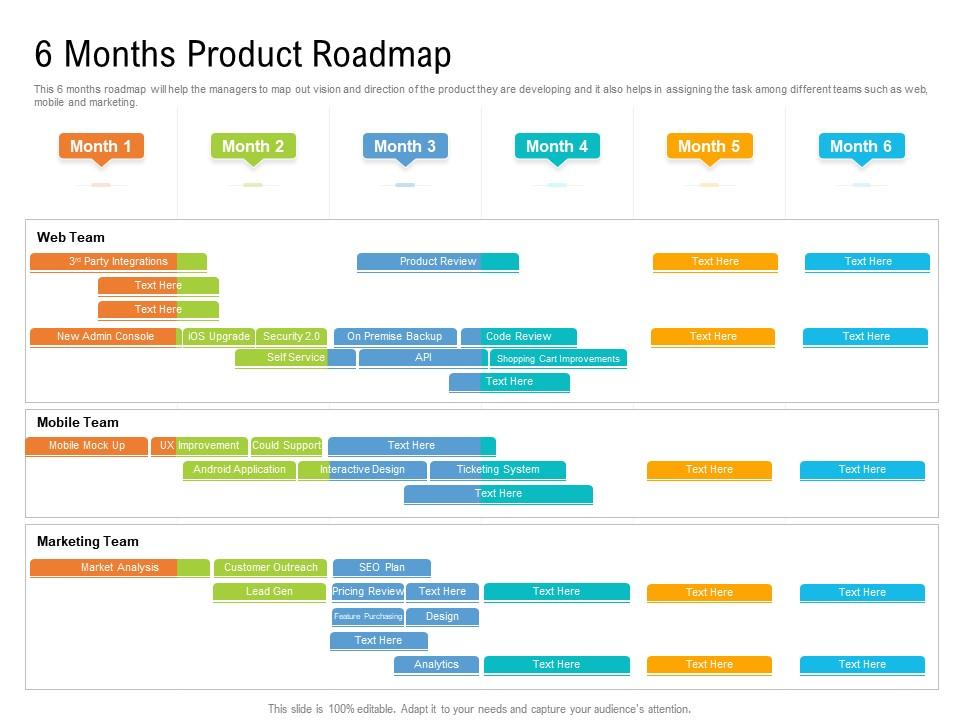
6 months product roadmap timeline powerpoint template
Try Before you Buy Download Free Sample Product
Audience
Editable
of Time
Our 6 Months Product Roadmap Timeline Powerpoint Template are topically designed to provide an attractive backdrop to any subject. Use them to look like a presentation pro.
People who downloaded this PowerPoint presentation also viewed the following :
6 months product roadmap timeline powerpoint template with all 2 slides:
Use our 6 Months Product Roadmap Timeline Powerpoint Template to effectively help you save your valuable time. They are readymade to fit into any presentation structure.
FAQs for 6 months product roadmap
So for your roadmap template, definitely include timeline/phases, features, strategic goals, success metrics, and resource needs. Dependencies and risks are huge - I learned that the hard way on my last project when everything fell apart because we didn't think through blockers. Don't forget stakeholder ownership for each piece and review checkpoints. Honestly, the visual part is make-or-break since you'll have engineers and C-suite folks all looking at the same thing. I'd start quarterly and keep it simple at first, then you can get fancier once everyone's used to it.
Honestly, roadmap templates are game-changers because they stop everyone from working off totally different assumptions. Your eng team thinks feature A is priority one while marketing's already planning the launch for feature B - it's chaos without alignment. Getting all your team leads in a room to actually sign off on the same document fixes like 80% of those "wait, what are we building first?" arguments. Use it in every cross-functional meeting too. I know it sounds boring, but having that single reference point where everyone can see the what, when, and why keeps decisions way more focused. Trust me on this one.
So I'd focus on three main things: customer impact, business value, and how much dev work it'll take. Quick wins are your best friend - high impact stuff that won't crush your engineering team. Trust me, the shiny features are always tempting but usually not worth it. RICE scoring works great (Reach, Impact, Confidence, Effort) or just do a simple impact vs effort grid. Also factor in your bigger strategy and what competitors are up to. List everything out and score it - you'll be shocked how obvious the right priorities become once you see the numbers.
So basically, match your roadmap template to how much you actually know. Early stage? Stick to quarterly chunks with big themes - anything past 6 months is just fantasy anyway. Don't get too detailed yet. Once you've got some traction, you can stretch timelines and dig into specifics like dependencies and resources. Mature products can handle the full yearly roadmap with all the sprint planning bells and whistles. I learned this the hard way after making super detailed 12-month plans for a brand new product that pivoted three times. Keep it simple until you're not guessing anymore.
Color coding is your best friend here - different colors for themes, priorities, whatever makes sense for your team. Timeline bars or swimlanes are clutch for showing when stuff actually happens. I've seen way too many roadmaps that are just beautiful disasters without clear timelines. Throw in some icons and progress indicators so people can see feature status instantly. Don't cram everything together either - white space matters more than you'd think. Keep fonts readable (obvs). Honestly? Start simple with a basic template, then layer on visual stuff until your team goes "oh, now I get it." Works every time.
Honestly, just do short feedback sessions every couple weeks - like 30 minutes tops. I'd use Miro or shared docs so people can comment when they have time instead of dragging everyone into another meeting (because we all have too many already). The trick is being super clear about what's actually changeable versus what's already set in stone. Don't let people think everything's up for debate when half the roadmap is locked due to dependencies or whatever. Oh, and definitely set expectations upfront about how fast you'll respond and who makes the final calls.
Honestly, user research is what keeps your roadmap from being total fantasy. Without it, you're just guessing at what people want instead of knowing what actually matters to them. Real pain points become obvious, and you can prioritize features that'll actually move the needle. I've watched teams build entire roadmaps on assumptions - spoiler alert, it doesn't end well. The best part? When stakeholders push their random ideas, you've got solid data to back up your decisions. Keep tying everything back to those user insights, and don't forget to refresh your research regularly or you'll drift off course again.
Honestly? At least every quarter, but don't get too hung up on the schedule. When customers are screaming about something or a competitor drops a bomb, you gotta pivot fast. Same goes for tech roadblocks or if leadership suddenly changes direction. I do quick monthly gut-checks (nothing fancy) then deeper dives quarterly. The whole point is flexibility - your roadmap should breathe with what's actually happening. Market shifts happen fast these days, so waiting around for some official review cycle is kinda pointless. Just keep it alive and responsive to real data.
Honestly, I'd go with **Productboard** or **Aha!** first - they're built specifically for this stuff and have decent template libraries. **Miro** is amazing if your team likes visual boards (I'm kind of obsessed with their roadmap layouts tbh). **Figma** works well too for design-heavy teams. If you want something simpler, **Notion** has some solid templates that don't overcomplicate things. Hell, even Google Slides can work when you're just starting out. The real trick is picking whatever your team won't abandon after two weeks. Start with what they already know, then switch later if you need more features.
Honestly, roadmap templates are game-changers for seeing how your daily work actually connects to the big strategy stuff. When random requests come flying at you (and they always do), you can just point to your roadmap and be like "nope, doesn't fit." Makes saying no so much easier. You'll catch resource conflicts before they blow up, plus stakeholders get why you're making certain trade-offs. Start by looking at what you're doing now versus your actual goals. I bet you'll find some weird gaps that make you go "huh, why aren't we doing anything about this?"
Don't treat your roadmap like it's carved in stone - huge mistake. I'd avoid cramming too many features in there or getting crazy specific with dates past a quarter out. Priorities change constantly, trust me on this one. The "feature factory" trap is real too - just throwing in random requests without connecting them to actual customer problems. Build in buffer time because things always take longer than expected. Use it to guide conversations, not replace talking to people. Oh and review monthly or it becomes useless pretty fast.
Startup roadmaps? Keep them loose and short-term since you're basically throwing spaghetti at the wall to see what sticks. Focus on quick experiments and be ready to pivot when things don't work out. Enterprise is totally different - you need months of planning because everything's complicated. There's compliance stuff, integrations that'll make you cry, and getting buy-in from like 15 different teams. For startups, track learning metrics over revenue at first. Enterprise roadmaps need all the boring stuff: resource planning, risk docs, dependency mapping. Honestly, just ask yourself if you're still figuring out what to build or if you're ready to scale what's already working.
Honestly, start with the basics - feature delivery rate and timeline adherence. Customer satisfaction scores are huge too. Budget variance will save your butt when leadership starts asking questions (trust me on this one). Also track how many people actually use your new features - adoption rates tell you if you're building the right stuff. I'd throw in stakeholder alignment and pivot frequency because roadmaps never go exactly as planned. Customer feedback sentiment gives you the real deal about priorities. Don't go crazy though. Pick 3-4 metrics that actually matter to your team and stick with those consistently.
Honestly, templates are a game-changer for this stuff. You fill out the sections once and clients instantly get your timelines and priorities without you having to explain everything over email. Way better than those messy bullet point lists we used to send, right? The visual format helps people see dependencies at a glance. Your stakeholders get familiar with the layout after seeing it a few times across projects. Oh, and definitely make different versions - executives want the high-level view, but your implementation teams need all the nitty-gritty details.
Honestly, timelines are what separate real roadmaps from fancy wish lists. They make everyone accountable and show stakeholders what's actually realistic - no more "when will this be done?" every five minutes. Dependencies between teams become way clearer too (and trust me, there's always a million of them). You'll spot resource issues and bottlenecks before they bite you. My take? Start broad with quarters, not exact dates. Gets too messy otherwise. Then drill down to specifics as you're closer to shipping. Way less stressful that way.
-
Awesome use of colors and designs in product templates.
-
Very unique, user-friendly presentation interface.
-
Excellent work done on template design and graphics.
-
Top Quality presentations that are easily editable.
-
Commendable slides with attractive designs. Extremely pleased with the fact that they are easy to modify. Great work!
-
Understandable and informative presentation.
-
Excellent work done on template design and graphics.
-
Design layout is very impressive.
-
Great designs, really helpful.
-
Professional and unique presentations.