


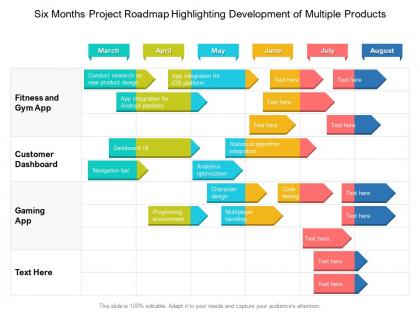
Six months project roadmap highlighting development of multiple products




Try Before you Buy Download Free Sample Product
 Impress Your
 Audience
 100%
100% Editable
 Save Hours
 of Time


A cohesive work plan is essential for achieving the desired target. Communicate your vision and lay a firm ground in front of your audience with our PowerPoint layout. Align your project milestones, budgets, deliverables, deadlines, and all the requisite information for a dynamic presentation by employing this amazingly designed Six Months Project Roadmap Highlighting Development Of Multiple Products. Maximize team efficiency and streamline a work plan efficiently by introducing our ready made roadmap PowerPoint theme. You can quickly establish coordination between different activities across the organization and present an insight to your colleagues by utilizing this useful business tool. Color code specific tasks, prioritize, and keep a close eye on the deadlines with the help of our eye catchy PowerPoint template. Download our Six Months Project Roadmap Highlighting Development Of Multiple Products for excelling at productive management.
People who downloaded this PowerPoint presentation also viewed the following :
Six months project roadmap highlighting development of multiple products with all 2 slides:
Use our Six Months Project Roadmap Highlighting Development Of Multiple Products to effectively help you save your valuable time. They are readymade to fit into any presentation structure.

FAQs for Six months project roadmap highlighting development
Effective project roadmaps include clear milestones, defined timelines, resource allocation plans, risk assessments, and stakeholder communication frameworks. These components work together by establishing accountability, streamlining decision-making, and maintaining alignment across teams, with many organizations finding that well-structured roadmaps ultimately deliver faster project completion and enhanced operational efficiency.
A project roadmap aligns with business strategy by mapping project milestones to strategic objectives, ensuring resource allocation supports priority initiatives, and establishing clear timelines that deliver competitive advantage. Through strategic alignment frameworks, organizations streamline decision-making, enhance cross-functional collaboration, and accelerate goal achievement, with many enterprises finding that integrated roadmaps significantly improve project success rates and business outcomes.
Project roadmaps should include timeline visualizations, milestone markers, dependency arrows, progress indicators, and resource allocation charts. These elements work together by providing clear project phases, highlighting critical deadlines, and showing task relationships, with many organizations finding that visual clarity enhances stakeholder alignment and enables more effective project tracking.
Timelines serve as the foundational framework for project roadmaps, dictating milestone sequencing, resource allocation phases, and dependency management across project lifecycles. They enable project managers to structure deliverables strategically, coordinate cross-functional teams effectively, and maintain stakeholder alignment, with many organizations finding that well-defined timelines ultimately enhance project predictability and delivery success rates.
Common pitfalls include unrealistic timelines, lack of stakeholder input, insufficient resource planning, poor milestone definition, and inadequate risk assessment. These roadmap challenges can derail projects by creating unrealistic expectations, missed deadlines, and resource conflicts, with many organizations finding that collaborative planning and regular reviews ultimately deliver more accurate timelines and successful project outcomes.
A project roadmap facilitates stakeholder communication by providing visual clarity on timelines, milestones, and dependencies, creating a shared understanding of project progression and priorities. This transparency enables more productive discussions, reduces miscommunication, and helps stakeholders align their expectations, with many organizations finding that roadmaps significantly improve meeting efficiency and decision-making speed.
Effective project roadmap tools include Microsoft Project, Asana, Trello, Monday.com, and Smartsheet, each offering timeline visualization, milestone tracking, and team collaboration features. These platforms streamline project planning by enabling resource allocation, progress monitoring, and stakeholder communication, with many organizations finding that integrated dashboards ultimately deliver enhanced transparency and faster project delivery across departments.
Project roadmaps should be updated regularly throughout the project lifecycle, typically every 2-4 weeks or at key milestone points, depending on project complexity and stakeholder needs. This iterative approach enables project managers to incorporate new requirements, address emerging risks, and maintain alignment with business objectives, while ensuring teams stay informed of priority shifts and resource adjustments that ultimately enhance project delivery success.
Project roadmap success metrics include milestone completion rates, budget variance, timeline adherence, stakeholder satisfaction scores, and resource utilization efficiency. These tracking mechanisms enable organizations by providing real-time visibility into progress, identifying potential bottlenecks early, and facilitating data-driven adjustments, with many project managers finding that comprehensive metrics ultimately deliver improved predictability and enhanced stakeholder confidence.
Agile methodologies integrate into project roadmaps through iterative sprint planning, flexible milestone adjustments, continuous stakeholder feedback loops, and adaptive resource allocation based on evolving priorities. This strategic combination enables organizations to maintain long-term vision while responding to market changes, with many software development teams and financial services finding that agile roadmaps deliver faster time-to-market and enhanced customer responsiveness.
Teams ensure roadmap flexibility by implementing regular review cycles, maintaining buffer time for adjustments, using agile methodologies, and establishing clear change management processes. Through iterative planning and stakeholder feedback loops, organizations can adapt to market shifts, resource changes, and evolving requirements while maintaining project momentum, with many finding that quarterly roadmap reassessments enable swift pivots without compromising strategic objectives.
Risk management serves as a foundational element in project roadmap development, enabling teams to identify potential obstacles, assess their impact on timelines and resources, and build mitigation strategies directly into project phases. Through proactive risk assessment, organizations can create more resilient roadmaps with contingency plans, alternative pathways, and realistic buffer periods, ultimately delivering projects on schedule while minimizing costly disruptions and maintaining stakeholder confidence.
A project roadmap aids resource allocation and budgeting by providing timeline visibility, milestone dependencies, and capacity planning frameworks that enable strategic resource distribution across project phases. Through clear deliverable mapping and progress tracking, organizations streamline budget forecasting, minimize resource conflicts, and optimize workforce deployment, ultimately delivering improved cost control and operational efficiency.
Tesla's Model 3 production roadmap, Apple's iPhone development cycles, and Microsoft's cloud transformation initiative demonstrate successful project roadmaps through clear milestone sequencing, stakeholder alignment, and adaptive timeline management. These companies streamline complex product launches by establishing measurable phases, transparent communication protocols, and strategic resource allocation, ultimately delivering market-leading innovations while maintaining competitive advantage in increasingly dynamic technology landscapes.
Team member feedback enhances project roadmaps by identifying potential bottlenecks, resource gaps, and timeline adjustments before they become critical issues. Through regular input sessions and progress reviews, project managers can recalibrate priorities, optimize resource allocation, and adapt to changing requirements, ultimately delivering more realistic timelines and improved project outcomes.
No Reviews