


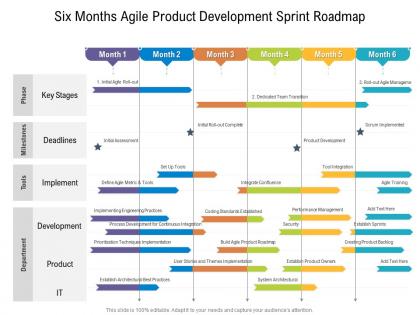
Six months agile product development sprint roadmap




Try Before you Buy Download Free Sample Product
 Impress Your
 Audience
 100%
100% Editable
 Save Hours
 of Time


A cohesive work plan is essential for achieving the desired target. Communicate your vision and lay a firm ground in front of your audience with our PowerPoint layout. Align your project milestones, budgets, deliverables, deadlines, and all the requisite information for a dynamic presentation by employing this amazingly designed Six Months Agile Product Development Sprint Roadmap. Maximize team efficiency and streamline a work plan efficiently by introducing our ready made roadmap PowerPoint theme. You can quickly establish coordination between different activities across the organization and present an insight to your colleagues by utilizing this useful business tool. Color code specific tasks, prioritize, and keep a close eye on the deadlines with the help of our eye catchy PowerPoint template. Download our Six Months Agile Product Development Sprint Roadmap for excelling at productive management.
People who downloaded this PowerPoint presentation also viewed the following :
Six months agile product development sprint roadmap with all 2 slides:
Use our Six Months Agile Product Development Sprint Roadmap to effectively help you save your valuable time. They are readymade to fit into any presentation structure.
FAQs for Six months agile product
Start with your big business goals, then chunk everything into themes that actually support them. Honestly, I used to dive straight into features and it was a mess every time. Stick to quarters instead of sprints for timing - way less stressful. Focus on what you want to achieve, not the exact stuff you'll build. Dependencies are huge too since they'll definitely shift things around. Make it visual because you'll be tweaking this thing constantly as priorities change. Oh, and keep outcomes measurable so you can actually tell if it's working.
Connect every roadmap item to real business goals - revenue numbers, customer happiness scores, whatever matters most to your company. I'd suggest quarterly check-ins with stakeholders because honestly, it's way too easy to get caught up building shiny features that sound amazing but don't actually help anyone. Your roadmap shouldn't be this sacred document that never changes. Business priorities shift constantly, so yours should too. Before greenlighting any big project, just ask yourself: "Will this actually move our numbers?" If you can't give a solid answer, maybe reconsider it.
Look, forget just counting deliveries - that's basically meaningless. What actually matters? Customer satisfaction scores and whether features get adopted after launch. Revenue impact and cost savings tell the real story. Hit your release windows consistently? That's huge for credibility. User engagement beats velocity charts every single time, trust me on this one. I'd also survey your team regularly about roadmap confidence - unhappy devs usually mean bigger problems. Balance the quick wins (sprint goals, team speed) with longer-term stuff like business results. Start with maybe 3-4 metrics that match what your company actually cares about. Don't track everything or you'll drown in data.
Honestly, I'd say every 2-4 weeks works well - just sync it up with your sprints. Do a quick check at the end of each one to see if anything major shifted. Monthly reviews are pretty standard, but some teams go sprint by sprint if things move fast. The whole agile thing falls apart if your roadmap gets outdated, you know? Find whatever rhythm works without making it feel like another boring meeting to sit through. Oh, and definitely start monthly then tweak from there - you'll figure out pretty quick if you need more or less frequent updates based on how crazy your environment gets.
Think of stakeholders as your roadmap's steering committee. They've got the vision and priorities you need. Get them into quarterly planning sessions because honestly, they understand the business way better than we do. I've watched teams build roadmaps solo and then act shocked when leadership shoots them down! Your product owner handles most of the back-and-forth, but pull stakeholders into sprint reviews too. The real trick? Balance what they want with what's actually possible tech-wise. Oh, and keep communication flowing both directions - can't stress that enough.
Try MoSCoW (Must/Should/Could/Won't) or weighted scoring - both work pretty well. First step is getting everyone to agree on what "value" actually means, which honestly is half the battle. ROI and customer feedback are your best friends here. I'd also look at technical dependencies because nothing's worse than planning something that can't actually get built yet. Keep your criteria transparent and don't be afraid to shuffle things around. Priorities change constantly anyway. The whole "strategic alignment" thing matters too, but sometimes you just gotta go with what makes sense for your team's bandwidth.
Honestly, if you're already using Jira, just grab Advanced Roadmaps - it's pretty solid. ProductPlan and Roadmunk look way cleaner though, since they're built specifically for this stuff. Miro's great for those messy collaborative sessions where everyone's throwing ideas around. Don't sleep on Trello either - I've seen teams do amazing things with just a well-organized board. The real trick? Pick whatever your team will actually keep updated. I can't tell you how many fancy roadmaps I've seen turn into digital graveyards after like three weeks.
Look, agile roadmaps work because they're designed to bend without breaking. Keep things high-level - focus on themes and outcomes instead of locking yourself into specific features or hard dates. When the market shifts or customers surprise you with feedback, just reprioritize your backlog and tweak the next few sprints. Way smarter than those old waterfall plans that died the second you hit print, honestly. Review your roadmap monthly or quarterly - whatever works for your team's rhythm. Be upfront with stakeholders when you pivot. Think of it as a living doc, not some sacred contract you can't touch.
Story mapping sessions are your best bet - get everyone physically arranging user journeys together. Dot voting works amazingly well for priorities, way better than you'd think for something so simple. Try affinity mapping to group similar ideas and spot patterns. Regular roadmap reviews with stakeholders are crucial (don't just build alone in a corner). Honestly, collaborative workshops beat email threads every time. Keep everything visual and interactive so people can actually contribute instead of just nodding along. The visual part really helps everyone see how their ideas fit together.
So basically, Agile roadmaps are way more flexible - they're like living documents that you can actually change when reality hits. Traditional ones? Total opposite. They lock you into specific dates and features months ahead of time, which honestly is kind of delusional because when does that ever go according to plan? With Agile, you're constantly shifting priorities based on what users actually want and how the business evolves. Instead of obsessing over hitting exact deadlines, you focus on getting real results. The best part is you can pivot fast when you discover something new or the market changes, rather than stubbornly following some outdated plan that makes zero sense anymore.
Don't get too granular with your roadmap - that's the biggest mistake I see. Specific dates beyond a quarter out? Forget it, everything's way too uncertain. Stakeholders will try turning it into some binding contract, which totally defeats the point of being agile. Build it with your dev team and customers, not locked away in a room somewhere. Focus on what you're trying to achieve rather than specific features. Mine gets reviewed monthly because things change fast. Oh, and honestly? If it's not evolving as you learn stuff, you're probably doing it wrong.
Think of your roadmap like a telescope - crystal clear long-term vision, but flexible short-term moves. Quarter by quarter, break down that big picture. Then your sprints can ladder up while you stay responsive to what users actually tell you. Monthly reviews are clutch here - does your current work still fit the bigger goal? If not, pivot. I've watched way too many teams get trapped following outdated plans just because "it's on the roadmap." Your vision stays fixed as your North Star, but honestly? The path there is gonna zigzag no matter what.
Color coding is your best friend here - different themes, priorities, teams all get their own colors so people can scan quickly. Swimlanes work great too for organizing by product area or timeline. Honestly, anything visual beats boring text blocks. Progress bars and charts are way more engaging than paragraphs. Icons help show feature types or status at a glance. Size things differently to create hierarchy - bigger stuff catches attention first. Oh, and definitely include mockups or screenshots when you can. Abstract ideas become real when people can actually see what you're building, plus it gets everyone more excited about the end result.
Honestly, culture is huge for roadmap success. Teams with strict hierarchies? Good luck getting honest feedback about blockers or crazy deadlines - people just won't speak up. Risk-averse places absolutely hate the uncertainty that comes with adaptive planning (learned this the hard way). But teams that love experimenting and have psychological safety? They're perfect for iterative updates. Check how your team handles ambiguity and makes decisions first. Oh, and their communication style matters too. Figure out where the biggest friction points are before you even start planning anything.
Skip the technical jargon - executives hate that stuff. I bombed a sprint review once because everyone's eyes just glazed over. Instead, show them visual timelines and simple charts they can actually follow. Customer journey maps work great too. Demo sessions are your best friend. Let stakeholders play with the actual features, not just hear about them. Always connect roadmap items back to real business problems or goals. Like, don't just say "we're refactoring the API" - explain how it'll make checkout faster for customers. That's what they care about.
No Reviews