


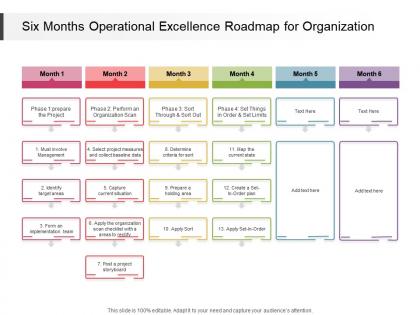
Six months operational excellence roadmap for organization




Try Before you Buy Download Free Sample Product
 Impress Your
 Audience
 100%
100% Editable
 Save Hours
 of Time


A cohesive work plan is essential for achieving the desired target. Communicate your vision and lay a firm ground in front of your audience with our PowerPoint layout. Align your project milestones, budgets, deliverables, deadlines, and all the requisite information for a dynamic presentation by employing this amazingly designed Six Months Operational Excellence Roadmap For Organization. Maximize team efficiency and streamline a work plan efficiently by introducing our ready made roadmap PowerPoint theme. You can quickly establish coordination between different activities across the organization and present an insight to your colleagues by utilizing this useful business tool. Color code specific tasks, prioritize, and keep a close eye on the deadlines with the help of our eye catchy PowerPoint template. Download our Six Months Operational Excellence Roadmap For Organization for excelling at productive management.
People who downloaded this PowerPoint presentation also viewed the following :
Six months operational excellence roadmap for organization with all 2 slides:
Use our Six Months Operational Excellence Roadmap For Organization to effectively help you save your valuable time. They are readymade to fit into any presentation structure.
FAQs for Six months operational excellence
Okay, so you need four things to make this actually work. Get your baseline metrics first - revenue per employee, defect rates, cycle times, whatever matters for your business. Then figure out your target state with real numbers, not vague goals. Map the gaps between where you are and where you want to be. This part sucks because you have to be brutally honest about what's broken (and trust me, there's always more than you think). Finally, prioritize your fixes based on impact and how doable they are. Quick wins first to build momentum, then tackle the big structural stuff.
First thing - map your OpEx stuff directly to whatever your main business goals are. Customer satisfaction? Then work on processes that actually touch customers. Don't just chase efficiency for efficiency's sake. You'll need those strategy and ops teams talking regularly because honestly, they drift apart so fast it's ridiculous. Quarterly reviews work well to keep everything aligned with where the business is actually going. The metrics part is crucial - tie operational improvements to real business outcomes, not just "we got 5% faster." Treat OpEx like it's helping you win, not just saving pennies.
Track both leading and lagging indicators - that's the sweet spot. Operational stuff like cycle time, defect rates, first-pass yield, and customer satisfaction are solid choices. Don't forget financials: cost per unit, revenue per employee, operational margin improvements. Employee engagement is massive though - seriously, if your team's not invested, you're screwed. Safety metrics too if that applies to your setup. Here's the thing: pick maybe 5-7 max that actually connect to your big goals. I've seen companies drown in data trying to measure everything. Start with what's easy to baseline first, then expand from there.
Honestly, culture will make or break your operational stuff. When teams have that blame-first vibe, nobody wants to speak up about problems - they're too scared of getting in trouble. But psychological safety? Game changer. People actually start hunting down inefficiencies and throwing out ideas. Here's the annoying part though - cultural changes take forever compared to just tweaking processes. I'd start by doing what you want others to do, then make a big deal when someone flags an issue. Those small wins add up. Trust me, the mindset shift is harder than any system you'll implement.
Start with what you already have, honestly. For mapping out processes, Visio or Lucidchart work great. Tableau and Power BI are solid for spotting bottlenecks in your data - though Power BI can be a pain to learn at first. You'll need project management stuff like Asana or Monday.com to actually track your improvements. Communication is huge - Slack or Teams for sure. Oh, and don't forget documentation platforms like Confluence or Notion. I always end up wishing I'd documented things better. Don't stress about the perfect setup though. Build it out as you figure out what's actually broken.
Honestly, you've gotta get people to feel like they own the change instead of just having it dumped on them. Let them help spot problems and build solutions - they know the job way better than management thinks anyway. Always explain WHY you're doing something, make noise about small wins, and actually listen when they give feedback. Most of these improvement projects tank because leaders just bark orders from above. Give people room to try stuff (with some boundaries obviously), train them so they don't feel lost, and call out good work publicly. The whole thing needs to feel like "we're figuring this out together" not "here's what corporate wants now."
Honestly, leadership makes or breaks this stuff. If they're not buying in, you'll just be spinning your wheels while everyone goes back to putting out fires. Your leaders have to actually walk the walk - not just talk about improvement but invest in training and tools. They need to paint a clear picture of where you're headed. Celebrating the wins matters too, and being honest when things don't work out. Here's the thing though - most leaders don't realize operational excellence isn't some fluffy concept. It hits your profits and keeps customers happy. Once they get that connection, everything changes.
Start by mapping out your processes to spot where things get stuck. Honestly, just ask your team what makes them want to scream - those are your biggest problems right there. Grab data on how long stuff takes, error rates, complaints. Then score each fix idea: high impact but easy to do? Perfect. Save the massive overhauls for later. Your frontline people know where the real issues are, so actually listen to them. Pick one process, test your changes, see what works. Oh, and don't try fixing everything at once - that's how you burn everyone out.
Honestly, the hardest part is getting leadership to actually care - and then keeping everyone from throwing their random projects into the mix. People will push back hard because it feels like more work on an already packed schedule. Can't blame them there. Quick wins are your best friend though. Start tiny, show some real results, then build from there. You've gotta be super clear about boundaries upfront or it'll spiral fast. Here's the thing - don't just hand people a roadmap and expect them to love it. Get them involved in making it. Find a couple people in each team who actually get excited about this stuff and let them help you sell it.
Think of continuous improvement as what stops your team from getting stuck in "we've always done it this way" mode. Build regular check-ins where everyone can actually suggest changes - not just when things break. Pick one process this week and ask your team for three tweaks they'd make. Honestly, the best improvements usually come from the people doing the work every day. Make it systematic though, not just random complaints in the break room. Short cycles work better than waiting months to review anything. You want people constantly thinking "how do we make this less annoying?"
Don't treat continuous improvement like some big project you launch once. Make it part of what your team does every day. Train people regularly and let them actually fix problems when they spot them - that's where the magic happens. Track clear metrics and review them often, but honestly? The biggest screw-up I see is companies thinking they can just implement something and walk away. Get feedback from customers and employees so you catch stuff early. Oh, and start small - pick one process this quarter and build a steady improvement routine around it. You'll see results way faster than trying to fix everything at once.
Honestly, cross-functional stuff is a game changer because it stops departments from working in their own bubbles. You'll catch problems way earlier when everyone's actually talking to each other - no more "oh crap, why didn't anyone tell us?" situations. Each team sees different pieces of what's broken too. Like marketing notices customer complaints that ops totally missed, or IT spots tech issues before you build your whole plan around something that won't work. I swear, most project disasters happen because teams don't communicate until it's too late. Set up regular check-ins so people can flag problems before they explode.
Look, digital transformation basically flips operational excellence on its head. Instead of just tweaking what you've got, you're rebuilding from scratch. Manual improvements? Out the window. Now it's all about automation and real-time data - which honestly feels like drinking from a fire hose at first. My advice? Don't get caught up in shiny new tools just because they exist. Start with whatever's driving you crazy right now and find tech that actually fixes it. The smart move is building digital stuff that makes your current processes better, not throwing everything away and starting over.
Don't just do one-off training sessions - make it ongoing and actually connect it to what you're trying to achieve. Figure out where people are struggling first, then create learning that mixes real training with actual hands-on work and mentoring. I've watched so many companies waste money on generic stuff that everyone forgets immediately. Focus on problem-solving, process improvement, and getting teams to work together better - that's what actually moves the needle. Your managers need to coach, not just dump tasks on people. Oh, and check in regularly to see if it's working or if you're just throwing money away.
Toyota's Production System is probably the best example - completely changed how manufacturing works worldwide. Amazon's warehouses are insane for logistics efficiency. GE did Six Sigma really well until they basically ditched it for some reason. Southwest figured out aviation by keeping things simple - just point-to-point flights with super fast turnarounds. There's tons of other examples too once you notice them. My advice? Don't try to copy everything they do. Just pick one company that's similar to your situation and steal their main ideas. Way more realistic than trying to reinvent the wheel.
No Reviews