

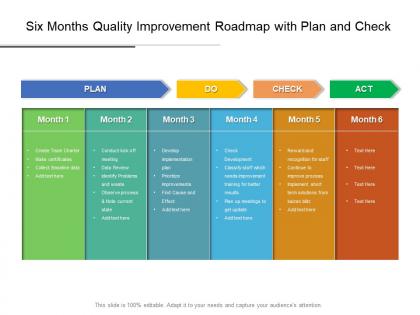
Six months quality improvement roadmap with plan and check




Try Before you Buy Download Free Sample Product
 Impress Your
 Audience
 100%
100% Editable
 Save Hours
 of Time


A cohesive work plan is essential for achieving the desired target. Communicate your vision and lay a firm ground in front of your audience with our PowerPoint layout. Align your project milestones, budgets, deliverables, deadlines, and all the requisite information for a dynamic presentation by employing this amazingly designed Six Months Quality Improvement Roadmap With Plan And Check. Maximize team efficiency and streamline a work plan efficiently by introducing our ready made roadmap PowerPoint theme. You can quickly establish coordination between different activities across the organization and present an insight to your colleagues by utilizing this useful business tool. Color code specific tasks, prioritize, and keep a close eye on the deadlines with the help of our eye catchy PowerPoint template. Download our Six Months Quality Improvement Roadmap With Plan And Check for excelling at productive management.
People who downloaded this PowerPoint presentation also viewed the following :
Six months quality improvement roadmap with plan and check with all 2 slides:
Give your audience a fulfilling experience. They will find our Six Months Quality Improvement Roadmap With Plan And Check elevating.
FAQs for Six months quality improvement roadmap with
First thing - figure out where you actually stand right now with metrics and what's broken. Set real goals with deadlines that won't make everyone hate you. Getting leadership on board is absolutely critical (I've seen so many initiatives die without it). Make sure someone owns each piece or it'll just drift. Build in checkpoints to track progress and pivot when things go sideways. Budget for the resources you'll need upfront - people, tools, whatever. Oh, and create feedback loops so you know if your changes are actually working. That last part's huge but gets overlooked constantly.
Map your quality goals straight to whatever your company's actually trying to achieve. Customer satisfaction matters? Focus on cutting defects and fixing service issues. Get leadership involved from day one - they need to see how quality work connects to real business wins. Most companies screw this up by keeping quality in its own little bubble, which is honestly just dumb. Match your metrics and deadlines to the strategic plan. Your quality teams should totally get how their daily work moves the needle for the whole company. Cross-functional meetings keep everyone on the same page and moving forward.
Track both results and process stuff. Results show if you're actually getting better - customer satisfaction, defect rates, resolution times. Process metrics tell you if your improvement work is even happening - training completions, team adoption rates. Most people (including me) totally overdo it with metrics initially. Pick 3-5 that connect to your goals. Can you reliably get the data? Review monthly. Here's the thing - choose metrics your team can actually control. Otherwise everyone just gets pissed off watching numbers they can't influence.
Don't make stakeholder engagement an afterthought - weave it into every phase. Map out who matters first: patients, staff, leadership, community folks. Then actually talk to them! Kick-off meetings for input, regular check-ins, feedback sessions where you can pivot if needed. So many projects crash and burn because people go radio silent midway through (learned that one the hard way). You can't just send updates and call it good. Actually use what they tell you. Set up some kind of regular communication rhythm - doesn't have to be fancy - and stick with it religiously.
Think of data analytics like your GPS for quality stuff - shows you where problems are and tracks if fixes actually work. Pick 3-5 key metrics that matter to your goals first. Then set up regular check-ins to watch the trends. Honestly, going off gut feelings is a disaster waiting to happen - I've seen teams waste months on "improvements" that made things worse. The numbers help you figure out which fires to put out first based on what'll have the biggest impact. Without decent data, you're basically throwing darts blindfolded and hoping something sticks.
You need to work both angles at once - grab the easy wins while building for later. Find those obvious fixes first (usually training issues or simple process changes) because your team needs to see results fast. The boring foundation work is honestly where the magic happens though. While you're celebrating those quick victories, quietly invest in the systems and culture stuff that takes forever to show up. Make sure your short-term moves actually support what you're building long-term, not fight against it. Timeline everything so those early wins help pay for the bigger investments down the road.
Ugh, honestly the worst part is dealing with people who hate change - even when the current process is totally broken. Your biggest headache will be getting leadership on board early, plus teams that want to fix everything at once (recipe for disaster). Clear goals? Good luck with that. Resources and communication between departments are usually a mess too. Oh, and if your data systems suck, collecting anything useful becomes impossible. Here's what actually works: pick one small thing to improve first. Get a quick win so people see it's worth it. Don't even think about going big without exec support though.
You've gotta walk the walk first - ask for feedback yourself and actually use it. Celebrate when people point out problems, even if their solutions are kinda meh. Make it safe to speak up without getting blamed. Honestly, most "continuous improvement" programs are total BS because nobody gets time to actually improve anything. Don't just dump it on their regular workload. Here's what works: ask your team what process pisses them off most. Then fix that one thing together. Small wins build momentum, and people will start believing you're serious about change.
Honestly, start with Slack or Teams for daily stuff - way easier than endless email chains. Asana's solid for tracking who's doing what and when. But here's the thing that actually changed everything for us: Miro for brainstorming sessions. Sounds cheesy but it's legit amazing when everyone can draw on the same board. Obviously you'll need video calls for the heavy conversations, and Google Drive works fine for sharing docs. Don't go crazy adding everything at once though. Pick what your team already knows, then maybe add one new thing if there's a real gap.
I'd say quarterly at bare minimum, but monthly is way better if things move fast at your company. Those quarterly deep dives are crucial - that's when you actually reassess what's working and what totally flopped. Monthly check-ins catch problems before they snowball into disasters. Honestly, some teams I know do quick updates every two weeks during busy phases, which seems like overkill but whatever works. The main thing is just being consistent about it - pick whatever schedule you won't blow off and actually build it into your routine.
Honestly, skip the PowerPoint death march and just throw them into hands-on workshops with real problems. Way more effective. Mix it up though - some people learn better with quick reference cards, others need that peer mentoring thing. Online modules work too if they can go at their own speed. The buddy system is clutch - pair newbies with someone who actually gets this stuff. Regular check-ins help, and definitely celebrate the wins when teams nail it. I swear, nothing beats the "figure it out yourself" method because that's when it actually sticks. Oh, and maybe throw in some snacks during training - always helps with morale.
Honestly, don't just collect feedback randomly - you need to bake it into your regular process. Multiple ways work: surveys, focus groups, suggestion boxes, or just chatting with patients during visits. Here's where most places screw up though - they never close the loop. Build a system where feedback gets sorted, ranked by impact, then handed off to teams with actual deadlines. Oh and this part's huge: tell patients what you changed because of their suggestions. That's what keeps people giving you input and proves you're not just going through the motions.
Regulatory stuff is basically your non-negotiable boundaries - the must-haves that shape everything else. I'd prioritize compliance initiatives first, which can feel limiting but honestly gives you a solid framework. Think guardrails, not roadblocks. Your timeline needs buffer time for all that validation and documentation too (ugh, so much paperwork). Map out which standards hit each improvement area early on. That way you're building compliance checkpoints right into your milestones instead of panicking later. Trust me on this one.
Honestly, tech can totally transform your QI stuff. Start with data analytics - it'll catch patterns you'd miss otherwise. Automation handles the boring repetitive tasks and cuts down on mistakes. Real-time dashboards are pretty sweet too, like having your own quality command center (sounds dramatic but it's true). Project management tools keep everyone on track. The coolest part? AI can actually predict problems before they happen. My advice - don't try everything at once. Pick whatever's bugging you most and tackle that first.
You should definitely look at Toyota - they basically wrote the book on this stuff. Virginia Mason Medical Center copied their approach and cut medical errors big time while saving money. Boeing's 737 line is another solid example, though honestly I'm more impressed with the healthcare one since that's life or death. The common thread? They all made tiny, trackable improvements instead of trying to fix everything at once. Pick one messy process you deal with and just map out what's happening now versus what you actually want. Start there.
No Reviews