


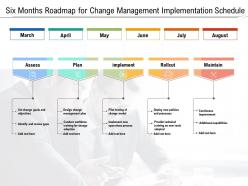
Six months roadmap for change management implementation schedule





Try Before you Buy Download Free Sample Product
 Impress Your
 Audience
 100%
100% Editable
 Save Hours
 of Time


Utilize our pre build Six Months Roadmap For Change Management Implementation Schedule to present your plan of action in the most effective way. Reduce the paperwork and showcase how different activities are linked to each other by incorporating this attention grabbing PowerPoint theme. This completely editable roadmap PPT layout is suitable to fit all your needs and to have a structured outline of the entire process flow using color coding. Provide guidelines to your teammates about the progression process by employing our PPT theme. Team members can easily be designated into teams by accessing the work milestones to be accomplished within the timeframe. You can easily modify the PowerPoint slide according to real time situations. Download our stunning Six Months Roadmap For Change Management Implementation Schedule, and you are good to go to prove your expertise in strategic planning.
People who downloaded this PowerPoint presentation also viewed the following :
Six months roadmap for change management implementation schedule with all 2 slides:
Give your audience a fulfilling experience. They will find our Six Months Roadmap For Change Management Implementation Schedule elevating.
FAQs for Six months roadmap for change
You'll want these five things: stakeholder assessment, communication plan, training strategy, resistance management, and success metrics. Most people totally botch the first step - figuring out who's impacted and how they'll react. Don't be one of them. Build your communication timeline next, then map out what skills people need. Plan for pushback because trust me, it's coming. Define how you'll track progress too. The real trick? Getting the sequence right so everything connects. Oh, and grab a basic template first - way easier than starting from scratch. Customize it for whatever change you're dealing with.
Before jumping into any roadmap stuff, do a change readiness check first. Survey your team about their bandwidth and how they've handled transitions before. Also look at the bigger picture - do you have leadership backing? What resources are available? Honestly, some teams just hate change more than others, so factor that in too. Check if there's already a bunch of other changes happening simultaneously (that usually makes things messier). Once you know where everyone stands, you can adjust your timing and approach. Makes everything way less painful.
Dude, you absolutely need stakeholders from the start - they're like your co-pilots for the whole thing. Get them involved right away to figure out what changes actually matter and how to prioritize stuff. They'll catch roadblocks you'd totally miss otherwise and give you the political backing to make things happen. Here's the thing though - if they're not bought in early, you're screwed when it comes to getting people to actually adopt whatever you're building. Map out who has influence, who gets impacted, and who controls the budget. Then bring them in as real partners, not just people you send updates to occasionally.
Oh man, don't try to map out every single detail from day one - you'll go crazy when things inevitably shift around. Get your key people on board early or they'll torpedo your whole plan later (trust me on this). Timelines? Be realistic, not optimistic. I used to think I could do everything in half the time... spoiler alert: I couldn't. Communication is huge throughout, not just kickoff meetings and final presentations. Start with your big rocks and main stakeholders first. Fill in the smaller stuff as you figure it out.
Honestly, communication is everything here. Don't just do the big scary announcement meetings - people hate those anyway. Mix it up with regular check-ins, quick team huddles, coffee chats, whatever works. Make it feel like an actual conversation where you're listening too. Ask what they think, share updates (even when stuff goes wrong), and celebrate the small wins. Town halls are good but so are casual email updates. The goal is making people feel heard, not just informed. Oh and definitely map out your communication plan early - like right now before things get crazy with implementation. Trust me on this one.
You gotta measure both the numbers stuff and the feelings stuff, honestly. Track adoption rates, how fast people get up to speed, productivity, and turnover - those are your hard metrics. Surveys help you catch engagement and resistance levels before they blow up. Oh, and definitely do a baseline measurement first or you'll have no clue if things are actually getting better. Change readiness assessments are super useful too - I've seen too many projects crash because nobody saw the roadblocks coming. Just pick 3-5 metrics that actually matter for your situation and stick with them throughout.
Look, first figure out how your company actually works - are they super cautious or more go-with-the-flow? Conservative places want tons of documentation and formal sign-offs before anything happens. Agile teams? They're cool with quick changes and less paperwork. If you're dealing with a top-heavy hierarchy, you'll need that executive buy-in and clear chain of command stuff. More collaborative cultures do better with workshops where everyone gets a voice. Oh, and some companies are just ridiculously slow at making decisions - it's frustrating but you gotta adapt your approach to match how they naturally operate.
Honestly, just pick a few tools that your team will actually use - that's the biggest mistake I see people make. Something like Asana or Monday works great for tracking timelines and who's doing what. Slack keeps everyone talking (maybe too much sometimes lol). For the tricky people stuff, which is where most roadmaps crash and burn, try SurveyMonkey to check if anyone's freaking out about changes. PowerPoint still works fine for boring stakeholder meetings. Don't go crazy with like 10 different platforms - stick to 2-3 max or you'll just confuse everyone.
Honestly, most change fails because leaders think one big announcement does the trick - spoiler alert: it doesn't. Your team needs to hear the "why" behind changes over and over. Create space where people can actually voice concerns without getting their heads bitten off. I've seen this so many times - leaders disappear right when things get messy. Don't do that. Be visible during the chaos. Acknowledge that change sucks sometimes, but celebrate those small wins too. Oh, and give them real training, not some half-baked PowerPoint. Set up regular check-ins to see how they're actually handling everything.
Honestly, you've gotta get people involved before they start pushing back. Bring them into the planning early so they actually feel like it's their thing too. Tell them WHY you're making changes - and keep telling them, because people forget. Find those team members everyone listens to and get them on board first. I've watched so many changes crash and burn because leadership just dropped announcements without explanation. Such a waste. Run feedback sessions, do Q&As, whatever it takes to hear their concerns. Don't forget proper training - nobody wants to feel lost. Oh, and celebrate the small stuff along the way! Map out who might resist and figure out how to approach each group differently.
Look, your change roadmap has to actually connect to what the business is trying to accomplish - otherwise you're just moving pieces around for no reason. I've watched so many companies create these elaborate plans that don't move the needle on anything meaningful. Before adding stuff to your roadmap, ask yourself: does this actually help us hit revenue targets or cut costs or whatever the main goals are? Map out how your people and processes need to shift to support those bigger strategic moves. It's basically turning strategy into action, but way too many orgs skip that connection entirely.
Start training early but ditch the boring PowerPoint marathons - make it hands-on. People learn differently, so mix it up with workshops, quick reference guides, peer mentoring. Communication is massive here. Don't go dark during the chaos (I've watched so many projects crash because of this). Keep everyone in the loop about what's happening and why. Set up feedback channels so you actually know what's broken. Find your change champions first - they're worth their weight in gold for helping teammates adapt. Office hours the first few weeks after launch are a lifesaver too.
Build those feedback loops right into your roadmap from the start - don't just tack them on later. Every 2-3 weeks, check in with your key people and actually listen to what they're saying. Honestly, I've watched so many teams fall in love with their original plan and completely miss the obvious stuff. Make it safe for people to tell you about roadblocks they're hitting. When you do get feedback, act on it visibly so people know you're not just collecting input for show. Oh, and schedule those first sessions this week before you forget.
Think of documentation as your change management lifeline. It tracks all your decisions and keeps everyone on the same page - super helpful when someone new jumps in halfway through or your boss suddenly forgets why you're doing this whole thing. Capture the reasoning, timeline, who's doing what, and what you learned along the way. Honestly, I've seen too many projects crash because nobody wrote anything down. Start with something simple like a shared Google doc that people will actually use. Don't make it fancy or it'll just collect digital dust.
Look back at what actually worked - those stakeholder workshops that cut down pushback, phased rollouts that didn't blow up in your face. Then dig into the disasters too. Maybe you rushed training or totally whiffed on how long adoption would take. I started doing this "keep/stop/start" thing after big changes and honestly it's saved my butt so many times. Write down where timelines went sideways, when communication failed, resistance patterns. Sounds nerdy but this stuff becomes your early warning system. You'll spot risks faster and build better buffers into future roadmaps.
No Reviews