


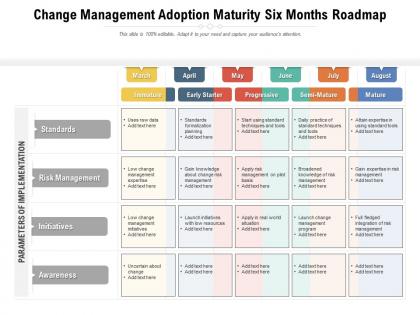
Change management adoption maturity six months roadmap




Try Before you Buy Download Free Sample Product
 Impress Your
 Audience
 100%
100% Editable
 Save Hours
 of Time


A well thought out action plan makes execution easier and increases the possibility of success significantly. Ensure hitting all the milestones within the deadlines by introducing our fully customizable Change Management Adoption Maturity Six Months Roadmap. Streamline the work related information, budget, timeframe, key deliverable, landmarks, and major steps involved, all in one place to give an organized overview of the project by utilizing our PowerPoint theme. Minimize time lag and increase work efficiency by providing insight into the process with our comprehensively researched roadmap PowerPoint layout. Color coding helps in highlighting the process and grabs the attention of the audience. Download our handy Change Management Adoption Maturity Six Months Roadmap to identify the possible problem areas in a much shorter time and propose solutions. Have a productive brainstorming session with your workforce by utilizing our action plan visualization tool.
People who downloaded this PowerPoint presentation also viewed the following :
Change management adoption maturity six months roadmap with all 2 slides:
Use our Change Management Adoption Maturity Six Months Roadmap to effectively help you save your valuable time. They are readymade to fit into any presentation structure.
FAQs for Change management adoption maturity
So there are basically five stages: Ad Hoc (you're just winging it), Developing (starting to get some structure), Defined (actual documented processes), Managed (tracking metrics), and Optimizing (always improving stuff). Look at your change success rate and whether people actually use your standardized tools. Most companies think they're way more mature than they really are - it's kinda funny honestly. Here's what I'd do: audit your last few big changes. Did you follow the same approach each time? Measure what happened? That'll show you where you really stand instead of where you think you are.
Honestly, you've got some solid options here. Prosci's Change Management Maturity Model is probably the most popular - it's a 5-level scale that's pretty straightforward. Kotter's 8-Step Process works well too, and ADKAR assessments are perfect if you want to zero in on individual readiness. Here's the thing though - I've watched way too many teams get stuck overthinking which tool to use when literally any of these will give you good insights. Just pick one and start with a basic self-assessment to see where you stand today. You can always get fancier with your measurements down the road.
Look, your company culture is basically the ceiling for how advanced your change management can get. I've watched so many places try to jam sophisticated change processes into cultures that just aren't there yet - it never works. Risk-averse, siloed cultures? You're stuck at basic levels no matter what fancy frameworks you roll out. But when you've got psychological safety and people actually want to experiment and learn, that's when the magic happens. Your change capabilities will naturally get more sophisticated. Start by being brutally honest about your culture, then build practices that fit where you are now while slowly nudging things forward.
Honestly, your leaders are make-or-break here. If they're not visibly bought in, people will smell the BS from miles away. I've watched so many initiatives crash because executives kept changing their minds or just paid lip service to the whole thing. Your senior team needs to actually walk the walk - model the behavior, explain the why behind changes, and give people real resources for training. Not just throw it over the fence and hope for the best. Get at least one executive to properly champion something first. Once people see genuine commitment at the top, it'll spread down through the ranks naturally.
Honestly, employee engagement can totally make or break your change projects. When you're just starting out, you're basically screwed without a few passionate champions pushing things along. But here's the thing - as you get better at this stuff, those engaged people become your secret weapon for spreading changes everywhere and catching issues early. The real magic happens when you build systems to keep people excited throughout the whole process, not just during the fancy launch meeting. Oh, and definitely check who's actually engaged before you start anything big. It'll save you so much headache later.
Here's what's worked for me - start with clear roles and consistent communication templates. Training programs matter too, but honestly most companies totally blow the measurement piece. You need real metrics tracking adoption rates. Build change champions everywhere, not just at the top. Feedback loops are huge so you can learn from mistakes. Don't just slap change management onto failing projects - make it core to how you operate. Start small with pilots to show it actually works first. That way you've got proof when you scale up.
Honestly, tech makes change management way less painful. Analytics platforms show you adoption rates and who's resisting stuff in real-time - no more guessing games. Digital tools help with consistent communication across teams, plus project management software keeps everyone on track with deadlines. There's even AI surveys that can spot change fatigue before people burn out, which is actually pretty neat. My advice? Pick one or two tools that fix your biggest headaches first. Don't go crazy trying to implement everything at once - that never works out well. Build up your toolkit as you get better at the whole process.
Honestly, the biggest pain point is getting leadership buy-in for the long haul. Executives love quick wins but building real change maturity? That takes forever. Your teams will probably struggle with departments doing things completely differently, and when stress hits (which it always does), people just go back to what they know. Oh, and good luck getting budget for proper training and tools - resource constraints are brutal. The worst part though is when people see change work as just another task on top of their "real" job. My advice? Get your leaders aligned on where you're heading long-term and celebrate every small win you can find.
Honestly, the whole stakeholder thing becomes way easier once you get better at change management. Right now you're probably scrambling to deal with pushback after it happens - been there! But here's what changes: you'll start spotting the key players early and actually building real relationships with them. They stop being roadblocks and become your allies. The coolest part? Eventually they'll come to you first when something feels off, instead of you finding out when it's already a mess. My advice? Map out who matters now and start investing in those connections before you actually need their help.
Track the hard numbers first - adoption rates, how fast people get up to speed, turnover during transitions. But honestly? The soft stuff is where you catch problems early. Survey people about confidence levels and how they actually feel about the changes. I've watched companies nail their budgets but completely miss that half their team was ready to quit. ROI matters obviously, just don't make it the only thing you're watching. Oh and set your baselines before you start anything - learned that one the hard way.
Honestly, you've gotta build feedback loops into your change process - that's where the magic happens. Do post-project reviews to capture what worked (and what totally bombed), then create some kind of shared repository so teams aren't reinventing the wheel. I get it, tracking metrics like adoption rates sounds mind-numbing, but it'll show you exactly where to focus next time. Smart organizations rotate their change champions between projects too. Knowledge spreads way more naturally that way. Start small though - grab one recent initiative and do a real retrospective this week.
Look, companies that get really good at handling change bounce back way faster from disasters - like 30-40% quicker recovery times. Makes total sense though, right? When your team already knows how to roll with punches, they don't freak out when stuff hits the fan. It's basically like building up your organization's immune system. People develop the right mindset and processes, so project success rates go through the roof. My advice? Figure out where you currently stand with change management, then start building those skills now before you actually need them. Way easier than scrambling later.
Honestly, get your team some solid foundation training first - PROSCI or Kotter are both good. But here's the thing: soft skills matter way more than the technical stuff, which surprises people. Pair experienced change agents with newbies for mentoring. Real projects beat classroom theory every time. Case studies and simulations help too, but nothing replaces actually doing the work. Oh, and set up peer sessions where people can share what's bombing vs. what's actually working. You'll be amazed what people learn from each other's mistakes.
Look, you've gotta meet yourself where you actually are, not where you think you should be. If you're just starting out, keep it simple - get leadership on board and tie each change directly to business goals. Don't get fancy yet. Once you've got some experience under your belt, then you can build those sophisticated frameworks mapping everything to strategic priorities. The mature orgs? They're doing all the predictive analytics stuff. Honestly, most companies try to skip ahead too fast. Start with an audit of what you're currently doing against your business objectives. Find the biggest gaps first and work from there.
Honestly, external benchmarks are like getting a second opinion - they show you where you actually are versus where you think you are. PROSCI's maturity model or ADKAR assessments give you solid frameworks to measure against proven practices. It's basically like using GPS when you're lost. You can't plot your route without knowing your starting point, right? These tools help spot gaps in leadership buy-in, how well you communicate, resistance issues - all that stuff. I'd just pick one framework that makes sense and do a brutally honest assessment with your team. Don't sugarcoat it.
-
Enough space for editing and adding your own content.
-
Great designs, Easily Editable.