


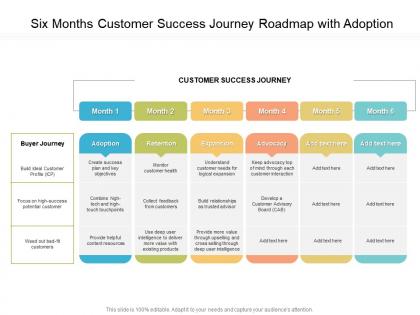
Six months customer success journey roadmap with adoption




Try Before you Buy Download Free Sample Product
 Impress Your
 Audience
 100%
100% Editable
 Save Hours
 of Time


Visualize your work plan and communicate your ideas impactfully with our pre designed Six Months Customer Success Journey Roadmap With Adoption. Showcase the detailed overview of the project, the key deliverables, and the milestones to be achieved with the help of our fully customizable PowerPoint layout. You can easily emphasize on the project goals and discuss all the activities involved in an easy to comprehend manner by utilizing our professionally designed PPT theme. This roadmap PowerPoint layout is a perfect strategic planning tool that can help in keeping the project on track. With our attractive PowerPoint theme, you can articulate the workflow, track the work progress, and have a clear vision of the goal to be achieved. Download this versatile Six Months Customer Success Journey Roadmap With Adoption and save your hours of work.
People who downloaded this PowerPoint presentation also viewed the following :
Six months customer success journey roadmap with adoption with all 2 slides:
Use our Six Months Customer Success Journey Roadmap With Adoption to effectively help you save your valuable time. They are readymade to fit into any presentation structure.

FAQs for Six months customer success journey
Focus on four pieces: onboarding flows, health scores, touchpoints, and growth spots. Map out your customer stages first and define what winning looks like at each one. Health scoring is where teams usually screw up - you want predictive stuff, not just "they logged in yesterday." Build your outreach schedule around that data. Honestly, the visual part is huge because your team needs to instantly see where everyone sits. Then identify when customers are ready for upsells based on how they're actually using your product and getting value from it.
Honestly, analytics completely changes the customer success game - no more guessing what's working. Track how people actually use your product and you'll spot the ones about to bail way before they do. Plus you can find upsell chances your competition totally misses. The predictive side is insane, like knowing someone needs help before they even hit a wall. Actually measuring if your CS work moves the needle beats crossing your fingers and hoping. I'd start simple - throw together some health scores with whatever data you've got, maybe some basic dashboards. Way better than winging it completely.
Three metrics actually matter: Net Revenue Retention, Customer Health Score, and Time to Value. NRR shows if existing customers are growing with you (executives obsess over this one). Customer Health Score combines usage data, support tickets, and engagement - basically predicts who's about to churn. Time to Value tracks how fast new customers see real results. Track these weekly but ignore vanity stuff like total logins. I learned this the hard way when we spent months optimizing the wrong things. Focus on what actually predicts renewals and expansion revenue.
Honestly, segmentation changes your whole roadmap game. You can't use the same playbook for enterprise clients who expect hand-holding versus SMB customers wanting to figure things out themselves. Different segments = different pain points and success markers. We made this mistake once - took our high-touch enterprise approach and applied it to smaller accounts. Total disaster, completely overwhelmed them. Now I map each segment to specific journey stages first. Then build separate tracks based on how each group actually wants to work with you. Makes way more sense than forcing everyone through identical steps.
Honestly, customer feedback is everything for your roadmap. Without it you're just throwing stuff at the wall and hoping something sticks. Set up surveys, hop on calls with users, dig into your usage data - whatever it takes to hear what they're actually thinking. Then use those insights to figure out what'll actually help with retention. Short feedback loops work best in my experience. Oh and definitely tell customers when you build something they asked for - they love knowing their voice mattered. It's like closing the circle, you know?
Oh man, you're gonna love this - automation handles all the boring repetitive tasks so you can actually focus on your customers. Set up health scoring to catch risky accounts early. CRM integrations track every touchpoint automatically. I swear the time you'll save is insane! Gainsight and ChurnZero are solid picks - they'll ping you when usage drops or renewals are coming up. Just make sure whatever you choose plays nice with your current tools. Otherwise you're creating more headaches for yourself, which defeats the whole point.
You need to map out that signup-to-value journey super clearly. Get people those quick wins right away - I can't stress this enough. Most companies totally bomb this and lose everyone in the first week because they make it way too complicated. Break everything into small milestones instead of one giant overwhelming thing. For your bigger accounts, give them dedicated success people. Everyone else gets good self-serve stuff. Oh, and track where people get stuck so you can jump in and help. Once they hit that "holy crap this actually works" moment, keeping them becomes so much easier.
Dude, working with other departments is a game changer for keeping customers happy. You'll get heads up on accounts going south, bugs get fixed way faster, and you actually know what features people want. Sales always has the drama, Product has the roadmap, Support knows where things break. I swear it saves me like 3 hours a day not having to hunt people down for answers. Set up weekly check-ins with Product and maybe a Slack channel for urgent stuff. Start with whoever touches your customers most - that's usually Sales and Support in my experience.
Honestly, the worst thing you can do is focus on features instead of actual outcomes. I've watched teams build these gorgeous roadmaps that turn into paperweights after like 3 months because nobody updates them. Don't pack everything into crazy timelines either - that never works. Skip customer input and you're basically guessing what matters. Tie everything back to real customer results, not just your internal numbers. Oh and definitely don't treat it like gospel once it's done. Quarterly check-ins help keep things realistic and relevant.
Dude, those success stories are pure gold for figuring out what actually works. Look at your top wins and find the patterns - which onboarding steps hit different? What features made people stick around? I'm obsessed with this stuff because it shows you blind spots you never saw coming. Map out your 5 biggest success stories this week. Document the specific moves that got them there, not just the happy endings. You can use all that to fix your customer journey, figure out product priorities, even nail down who your dream customers really are. Trust me on this one.
Honestly, a solid Customer Success roadmap can bump your retention up 15-25% - pretty huge numbers. Instead of just scrambling when customers complain, you'll spot the red flags early and actually fix stuff before people bail. It's like having a game plan instead of just hoping things work out (which never does, let's be real). Map out where your customers typically drop off first - that's where you'll get the biggest wins. The whole point is hitting those key moments and consistently showing customers they're getting value. Way better than playing defense all the time.
Look, you can't just slap sales and marketing alignment onto your roadmap later - build it in from the start. Map out where all three teams actually touch the customer journey: handoffs, lead scoring, lifecycle stages. Most roadmaps crash and burn here because everyone's doing their own thing in separate corners. Define who owns what, but create feedback loops so teams actually talk to each other. Those regular cross-team meetings? They're annoying but necessary for reviewing metrics and pivoting when needed. Honestly, just block time this week with your sales and marketing people to nail down your top 3 integration points.
So here's what I'd do - start with customer lifecycle mapping, data analysis, and communication skills. Don't make the mistake most companies do by rushing into it too fast. Your team needs way more prep time than you think, honestly. Begin with workshops on spotting churn signals and customer health indicators. Then get them hands-on with your CS platform and analytics tools. Role-playing scenarios are clutch for practicing tough conversations - trust me on this one. Soft skills matter just as much as the technical stuff. Block out two full weeks minimum before they touch real accounts.
Dude, social media analytics is seriously underrated for CS work. Track mentions and hashtags to spot which customers are struggling vs loving your product. Most teams totally sleep on this data, which is crazy to me. You'll catch churn risks early when people start complaining online. Plus you can find your biggest fans who are already hyping you up organically - those are your goldmine advocates right there. Oh, and you'll see exactly which features people hate or love most. Just set up monitoring for your company name across the main platforms first.
Your CS roadmap can't be set-and-forget, it needs constant tweaking. I'd review it quarterly at minimum - honestly, monthly is even better if you can swing it. Look at your health scores, support tickets, churn data. When customers keep hitting the same roadblocks, that's where you add new touchpoints. Business model shifts? Time to adjust your success metrics. Customer preferences change and your engagement has to follow. We started doing monthly team reviews last year and it's been a game changer. Oh, and don't ignore those weird patterns in the data - they usually mean something.
No Reviews