


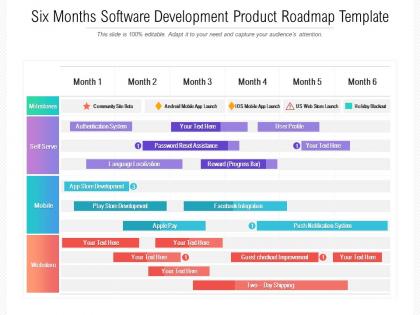
Six months software development product roadmap template




Try Before you Buy Download Free Sample Product
 Impress Your
 Audience
 100%
100% Editable
 Save Hours
 of Time


The success rate of business plans is hugely dependent on the plan of action, and this editable Six Months Software Development Product Roadmap Template rightly serves the purpose. Encapsulate all the information related to the project in a well structured manner to obtain maximum efficiency by incorporating our stunning PowerPoint theme. State the critical deliverable, steps involved, time frame, workforce allocation, and lots more in an easy to understand manner by utilizing this pre designed roadmap PowerPoint layout. You can also prioritize your tasks and discuss the problem areas with your colleagues by incorporating this tailor made PPT layout. Empower your work plan by employing this professionally designed PPT theme. Entrepreneurs can download Six Months Software Development Product Roadmap Template as a beneficial communication tool that facilitates in collaborating with different tasks and achieve targets.
People who downloaded this PowerPoint presentation also viewed the following :
Six months software development product roadmap template with all 2 slides:
Use our Six Months Software Development Product Roadmap Template to effectively help you save your valuable time. They are readymade to fit into any presentation structure.
FAQs for Six months software development
Okay so basically you've got planning, analysis, design, implementation, testing, and deployment. Names change depending on your team though. First you gather requirements and figure out what you're actually building. Then design the architecture and UX stuff. Coding comes next - that's the fun part honestly. Testing should be thorough but let's be real, sometimes deadlines happen. Finally you deploy to production. Whether you're doing waterfall, agile, or whatever your company's obsessed with this month, don't skip the planning phase. I learned that the hard way lol.
Honestly, just rank stuff by user impact and business value first. That's what actually matters. I always do this effort vs impact matrix thing - sounds fancy but it's just a simple chart that stops everyone from arguing about priorities later. Look at technical dependencies too since some features need others to work. Your team's capacity matters obviously, plus any real deadlines from higher-ups. Oh and definitely leave buffer time because there's always some "emergency" feature request that comes out of nowhere mid-sprint. Get your whole team involved when you're deciding - they catch stuff I miss all the time.
Look, most software projects do better with Agile - probably Scrum. You'll get feedback constantly and can change direction when things inevitably shift. Waterfall only works if requirements are set in stone, which... yeah, good luck with that in software development. For maintenance stuff or teams that get pulled in different directions a lot, Kanban's actually pretty solid. Really comes down to how much uncertainty you're dealing with and how your team communicates. I'd just start with basic Scrum sprints and tweak it as you figure out what clicks for your situation.
Honestly, start by setting clear goals with everyone involved before you even write a line of code - saves so much headache later. Track the basics like timeline and budget, plus whether you actually delivered what was promised. User adoption is huge though - I've seen "perfect" apps flop because nobody wanted them. Bug rates and performance matter too, obviously. Customer satisfaction scores give you the real story about whether people are happy with what you built. The trick is checking these regularly instead of waiting until the end and crossing your fingers. Oh, and don't just rely on technical metrics - business impact is what actually matters to stakeholders.
Honestly, customer feedback is everything when you're deciding what to build next. Pull it from support tickets, user interviews, feature requests - wherever people are actually telling you what sucks or what they need. Sometimes you'll get distracted by the loudest voices though, and those aren't always your real users. Track which requests keep coming up over and over. That's your goldmine right there. Balance what customers want with where you're trying to go as a product. No point building amazing features nobody asked for, you know?
Honestly, treat tech debt like any other task - make actual tickets for it and estimate the work. I learned this the hard way after ignoring "small" issues for months (spoiler: they weren't small anymore). Dedicate maybe 20% of each sprint to cleaning stuff up, or do whole cleanup sprints sometimes. The trick is making sure your stakeholders can see this debt exists - otherwise they'll never understand why features take longer. Start by going through your code and sorting debt by how much it'll hurt vs. how hard it is to fix.
Honestly, just grab Jira or Trello for project stuff - Linear's pretty clean too if you want something newer. Git is like... yeah, you need that for version control, no question. Slack beats email chains any day for team chat. Oh and get Sentry set up early for bug tracking, trust me on that one. Figma's clutch if designers are involved. Here's the thing though - don't go crazy adding every tool you see. Pick what your team will actually stick with. We made that mistake once and ended up with like 8 different apps nobody used. Start basic, add more later when you're not drowning.
Honestly, cross-functional teams are a game changer for breaking down those stupid silos. Instead of devs, designers, and QA working separately, everyone collaborates from the start. Feedback happens way faster too – no more throwing work over the fence and waiting forever. Your product manager can approve that tiny UI tweak instantly instead of you sitting around for days. Different perspectives catch problems early, which saves so much headache later. I'd say start small though, maybe just one person from each team on your next sprint. You'll be surprised how much smoother everything runs when people actually talk to each other.
Don't treat QA like something you tack on at the end - that's where everything goes wrong. Build it into your whole development flow instead. Automated tests are your best friend here: unit tests, integration tests, end-to-end stuff that runs every time someone changes code. Code reviews will save your sanity (trust me on this one). Pair programming catches bugs before they multiply like rabbits. Oh, and set up a QA environment that actually looks like production - can't tell you how many times I've seen that bite people. Start small though, maybe just unit tests, then build from there.
Don't bolt DevOps onto your roadmap at the end - that's a recipe for chaos. Build it into each sprint from day one. Figure out where CI/CD and automated testing belong in your milestones. Infrastructure-as-code too. I've watched so many teams skip this step and then panic when deployment day comes. Map your pipeline needs early and budget time for monitoring setup. Oh, and check if your team actually knows this stuff - nothing worse than assuming everyone's on board. Treat DevOps like it's part of building features, not some separate thing you'll "get to later."
Dude, AI coding tools are getting insanely good right now - definitely worth checking out if you haven't already. Low-code platforms are everywhere too, though sometimes I wonder if we're just building our own replacements lol. Cloud-native stuff and microservices aren't going anywhere, and everyone's finally figuring out that security needs to be built in from the start instead of patched on later. Edge computing's heating up as well. Honestly? Just pick whichever one fits what you're already working on and mess around with it. Maybe grab an AI assistant and see what the hype's about.
Break your project into phases first - prioritize features by user impact and what actually drives business results. Budget-wise, put about 60-70% toward core dev work, 20% for testing/QA, and save the rest for when things inevitably go sideways (they always do). Track your burn rate every week. If you're running over, cut scope instead of pushing deadlines - stakeholders hate scope creep but they really hate missed launches. Junior devs are cheaper but need more hand-holding from seniors, so factor that in. Oh, and communicate budget updates constantly. Nobody likes financial surprises.
Honestly, you really need to document your roadmap or you'll regret it later. I learned this the hard way - you end up repeating the same explanations constantly when people forget context. Six months from now when you're onboarding someone new, you'll be so glad you wrote down why you made certain decisions. Plus stakeholders can actually track progress instead of bugging you every week. Scope changes become less of a nightmare too. Don't overthink it though - just start with a shared doc listing key milestones and your reasoning. Way better than keeping everything in your head.
Honestly, your roadmap needs to be super flexible from day one - like, don't get married to your original plan. Market changes are gonna blindside you (trust me on this), so set up monthly check-ins where you can pivot quickly. Kill features that aren't working. I'd focus on protecting your main value prop while everything else stays negotiable. The worst thing is scrambling when stuff hits the fan. Regular stakeholder meetings help you make these tough calls fast instead of overthinking it.
Hey! So coding skills are obviously key - languages, databases, Git (seriously can't work without it), testing stuff. But the soft skills? Game changer. Communication matters since you're always working together. Problem-solving and being flexible when requirements shift overnight - which they will, trust me. Analytical thinking helps catch those sneaky bugs hiding everywhere. Oh, and basic project management so people actually get timelines. I'd honestly start by figuring out what gaps your team has right now, then build learning plans around that.
No Reviews