


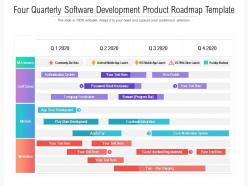
Four quarterly software development product roadmap template





Try Before you Buy Download Free Sample Product
 Impress Your
 Audience
 100%
100% Editable
 Save Hours
 of Time


A well thought out action plan makes execution easier and increases the possibility of success significantly. Ensure hitting all the milestones within the deadlines by introducing our fully customizable Four Quarterly Software Development Product Roadmap Template. Streamline the work related information, budget, timeframe, key deliverable, landmarks, and major steps involved, all in one place to give an organized overview of the project by utilizing our PowerPoint theme. Minimize time lag and increase work efficiency by providing insight into the process with our comprehensively researched roadmap PowerPoint layout. Color coding helps in highlighting the process and grabs the attention of the audience. Download our handy Four Quarterly Software Development Product Roadmap Template to identify the possible problem areas in a much shorter time and propose solutions. Have a productive brainstorming session with your workforce by utilizing our action plan visualization tool.
People who downloaded this PowerPoint presentation also viewed the following :
Four quarterly software development product roadmap template with all 2 slides:
Give your audience a fulfilling experience. They will find our Four Quarterly Software Development Product Roadmap Template elevating.
FAQs for Four quarterly software development
So early on, just focus on getting good at one language and understanding data structures - Git too, obviously. Once you hit mid-level though, that's when it gets fun. System design becomes your thing, plus you'll start doing code reviews and helping newer devs. Database optimization is weirdly satisfying once you get into it. Senior level is more about the big picture stuff - making technical calls, talking to other teams, actually caring about business outcomes. Honestly, the trick is never stopping coding even as you build up those people skills. I'd say pick one thing each quarter to really focus on improving.
So break your roadmap into those 2-4 week sprints instead of planning everything months out. Keep it flexible - honestly, I've watched so many teams treat their roadmap like it's written in stone when everything changes weekly anyway. Focus on your MVP features first, then iterate based on actual user feedback. Regular retrospectives are clutch for adjusting course. The whole thing should feel like a living document that adapts with you. Oh, and prioritize getting working software out over sticking to some original plan that's probably already outdated. Start small and pivot as you learn what actually works.
User feedback is like your north star - tells you what's working and what isn't. I'd collect it at every big milestone, not just when you're done (learned that the hard way). Quick surveys work great, or just hop on calls with your power users. Document everything so you can spot trends later. Honestly? I've watched teams burn months on features nobody asked for because they waited too long to get input. Don't be those people. Even informal feedback beats flying blind.
Dude, the AI stuff is moving crazy fast right now. You're gonna see way more automated code generation and smart testing tools becoming normal. These AI assistants will write your boring boilerplate code and catch bugs you'd totally miss. Pretty nuts honestly. Start messing around with AI coding tools now - trust me on this one. When you're designing new systems, you'll need to think about integrating ML models from the get-go since everything's becoming AI-first. Oh and the predictive debugging features? Game changer. Don't wait or you'll be scrambling to catch up later.
Oh man, timeline optimism is the killer - I'm guilty of this too. Always think something will take 2 weeks when it's really a month, you know? Cramming features into releases is another trap. Buffer time is your friend because weird stuff always breaks. Also don't get so granular with your roadmap that updating it becomes this massive headache every time priorities change. The user input thing though - that's huge. Talk to actual people early or you'll build features that sound cool but nobody uses. Monthly reviews help you stay sane and pivot when reality hits.
Focus on stuff that'll actually matter to users and won't take forever to build - that's where the magic happens. Get your stakeholders involved so you know what really drives business results. Honestly, I've wasted so much time on features that seemed cool but nobody actually wanted (learned that the hard way). Make a simple scoring system for impact vs effort. Some features have to come first because others depend on them, so map that out too. Don't be scared to say no to requests that don't fit your main goals. Check in weekly and adjust.
Get yourself Jira, Linear, or Notion - something to actually track your roadmap. Break features into tasks, set deadlines, see what's done vs planned. GitHub/GitLab too, obviously. But here's the thing - I've watched teams get so obsessed with updating these tools they barely code anymore. Pick whatever your team will consistently use without fighting you on it. Start basic with something that clicks for your workflow. My old team tried like 3 different systems before settling on the simplest one. You can always make it fancier later once everyone's in the habit of using it.
Basically DevOps tears down those walls between dev and ops teams so everyone owns the whole process together. You'll get automated testing, continuous integration, plus monitoring dashboards that actually show what's going on. Honestly, it's a total game-changer once people stop thinking deployment is someone else's headache. The trick is building feedback loops so problems surface fast and everyone sees how their changes affect things. Oh, and start small - try shared incident response first or get teams doing cross-reviews. Builds that collaborative habit without overwhelming anyone.
Honestly, you want a mix of delivery, quality, and business stuff to see what's actually happening. Velocity and cycle time show if you're moving fast enough. Bug counts and customer satisfaction tell you if your code sucks or not. Business metrics like user adoption or revenue are gold if you can get them - though that's sometimes easier said than done. Code review turnaround time is weirdly revealing about team dysfunction. Don't go crazy though. Pick 3-4 things that actually matter for your project and track them from the start. Review weekly with your team so you catch problems before they blow up.
Look, whatever language you pick basically shapes everything else - your team, timeline, what tools you can use. Python's great for getting an MVP out fast, but you might hit performance issues down the road. Rust has this crazy learning curve but scales way better long-term. With JavaScript you stay in one ecosystem for full-stack, which is honestly pretty nice. I've watched teams try to switch languages halfway through... total nightmare. My advice? Go with what your team actually knows, think about where you want to be in two years, and ignore whatever's hyped on Twitter right now.
Honestly, think of technical debt like your credit card - ignoring it just makes everything worse later. I'd start by actually tracking what's broken or messy in your codebase (sounds boring but you can't fix what you don't see). Reserve about 15-20% of your sprint time for cleanup work, otherwise it'll never happen when crunch time hits. Get your team to agree on coding standards upfront and stick to code reviews - saves so much headache down the road. Oh, and document the messy stuff as you go with comments about what needs fixing.
Don't lock yourself into a crazy detailed 12-month plan - that's just asking for trouble. Work in shorter chunks instead and schedule regular check-ins to pivot when the market shifts. I've watched so many teams crash and burn with rigid roadmaps that couldn't bend. Honestly, your roadmap should feel more like a rough sketch than a contract. Keep your must-have features at the top but leave wiggle room for unexpected opportunities. Monthly reviews work great - just sit down and actually reassess what matters most. Don't be precious about shuffling priorities around when customer feedback or market changes demand it.
Dude, CI/CD is a game changer - it automates all your testing and deployment stuff so you're not manually pushing code like it's 2010. Bugs get caught super early since everything's tested automatically with each commit. No more sweaty palms wondering if production will explode. Your team ships features way faster too because there's no deployment bottleneck slowing everyone down. I'd start simple with basic automated tests and builds, then add fancier deployment stuff once you get the hang of it. Trust me, once you experience this workflow you'll never want to go back.
So basically, security makes you do way more upfront planning than you'd normally want to. Threat modeling can't wait until later - you gotta tackle that early. Same with building security patterns into your architecture from day one. Super annoying but trust me, it beats scrambling to add security later (been there, not fun). Budget extra time for pen testing too, especially if you're dealing with compliance stuff. Oh and treat security like any other feature - just throw those stories right in your backlog. Makes the whole process less painful.
Honestly, just keep your docs simple and actually useful. Write for whoever's reading - if it's devs, skip the fluff and explain *why* you made certain decisions. I've worked on way too many projects where documentation becomes this huge thing nobody updates. Stick it close to your code (README files, inline comments, whatever). Use real examples. Less is definitely more here. Update as you build instead of leaving everything for the end - trust me on this one. Main question: would this help someone (including future you) figure things out later?
No Reviews