


Quarterly roadmap for product development project planning




Try Before you Buy Download Free Sample Product
 Impress Your
 Audience
 100%
100% Editable
 Save Hours
 of Time


The success rate of business plans is hugely dependent on the plan of action, and this editable Quarterly Roadmap For Product Development Project Planning rightly serves the purpose. Encapsulate all the information related to the project in a well structured manner to obtain maximum efficiency by incorporating our stunning PowerPoint theme. State the critical deliverable, steps involved, time frame, workforce allocation, and lots more in an easy to understand manner by utilizing this pre designed roadmap PowerPoint layout. You can also prioritize your tasks and discuss the problem areas with your colleagues by incorporating this tailor made PPT layout. Empower your work plan by employing this professionally designed PPT theme. Entrepreneurs can download Quarterly Roadmap For Product Development Project Planning as a beneficial communication tool that facilitates in collaborating with different tasks and achieve targets.
People who downloaded this PowerPoint presentation also viewed the following :
Content of this Powerpoint Presentation
Description:
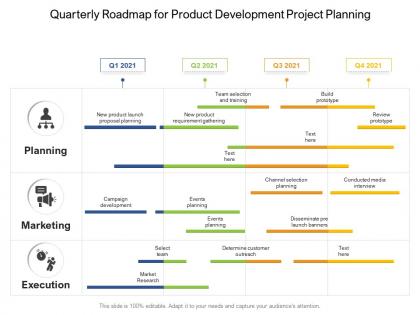
The image depicts a PowerPoint slide titled "Quarterly Roadmap for Product Development Project Planning". It illustrates a timeline divided into four quarters of the year 2021, each representing a different phase in the product development process:
Q1 2021:
Planning phase with "New product launch proposal planning".
Q2 2021:
Continuation of planning with "New product requirement gathering" and "Team selection and training".
Q3 2021:
Marketing activities including "Campaign development" and "Events planning". Execution tasks such as "Market Research" and "Select team" are also noted.
Q4 2021:
Final stages of the product development with "Build prototype" followed by "Review prototype" under planning. Marketing includes "Channel selection planning" and "Disseminating pre-launch banners". Execution lists "Determine customer outreach" and "Conducted media interview".
Each task is color-coded to categorize it under Planning, Marketing, or Execution. The slide also contains the statement, "This slide is 100% editable. Adapt it to your needs and capture your audience's attention." indicating that the information can be customized for specific project needs.
Use Cases:
This type of slide can be utilized across various industries for strategic planning and project management purposes:
1. Technology:
Use: Mapping out software or hardware development timelines.
Presenter: Product Manager
Audience: Development Team, Stakeholders
2. Pharmaceuticals:
Use: Scheduling drug development and market launch activities.
Presenter: Project Lead
Audience: R&D Team, Marketing Department
3. Consumer Goods:
Use: Planning for the launch of a new consumer product.
Presenter: Brand Manager
Audience: Marketing Team, Sales Force
4. Automotive:
Use: Outlining the design and launch schedule for new vehicle models.
Presenter: Project Coordinator
Audience: Engineering Division, Marketing Team
5. Retail:
Use: Developing a plan for the rollout of a new store or product line.
Presenter: Retail Operations Manager
Audience: Retail Staff, Management
6. Real Estate:
Use: Structuring the phases of a new property development project.
Presenter: Development Manager
Audience: Investors, Marketing Agencies
7. Energy:
Use: Planning the stages for launching a new energy product or service.
Presenter: Energy Project Manager
Audience: Product Development Team, Business Partners
Quarterly roadmap for product development project planning with all 2 slides:
Give your audience a fulfilling experience. They will find our Quarterly Roadmap For Product Development Project Planning elevating.

FAQs for Quarterly roadmap for product
Okay so definitely cover your main quarterly goals and any big projects with realistic timelines. Resource needs matter too - like how much your team can actually handle. Dependencies and potential roadblocks are huge, trust me on this one. Quick wins are golden because stakeholders eat that stuff up. Connect it all back to company objectives so it doesn't look random. Simple metrics work best, and yeah leave room for questions. Oh and send a preview to key people first! Last thing you want is getting hit with some weird question you didn't prep for. Learned that the hard way.
Honestly, visuals are a game-changer for roadmaps. Instead of boring bullet points, use timelines and color-coding so people can actually see what's happening. Gantt charts work great for showing dependencies, or try swimlanes if you've got different teams involved. I swear, stakeholders will glaze over dense text blocks every time. Simple milestone markers help too - makes it super obvious what's urgent vs. what can wait. Miro's pretty solid for this stuff, though even a decent PowerPoint timeline beats walls of text. Your team will actually pay attention instead of pretending to read it.
Track both leading and lagging stuff - you need the full picture. Leading shows if you're on track (sprint velocity, feature completion). Lagging tells you if you actually hit targets (revenue, customer satisfaction). Pick 2-3 metrics per goal that actually connect to business results. I've watched way too many teams get obsessed with meaningless vanity numbers - total waste of time. Check progress monthly instead of waiting until quarter-end. That way you can pivot if things go sideways. Short feedback loops are everything.
Honestly, just start with what'll actually move the needle for your main goals this quarter - revenue, customer happiness, whatever matters most. That impact vs effort matrix thing works great here. High impact + low effort = do it first, duh. Check what your team can actually handle though. No point planning something huge if everyone's already drowning. Dependencies matter too - some stuff just has to wait for other things to finish first. Oh, and definitely leave room for those random urgent requests that always pop up. Trust me on that one. Get your team leads' input before you lock anything down.
Look, stakeholder feedback is what saves your roadmap from being total garbage. I learned this the hard way at my last job - we built stuff nobody wanted because we didn't ask first. Get input from customers, sales, support teams early in planning. Use their feedback to figure out what actually matters vs your pet features. Regular check-ins work way better than waiting until the end and panicking. Trust me, it's worth the extra meetings upfront.
Check your roadmap weekly if possible, monthly at bare minimum. Stuff changes way too fast to ignore it for months. I've watched teams religiously follow roadmaps that became totally irrelevant - it's painful to see. Weekly reviews let you catch small tweaks before they become big problems. Major changes though? Those need stakeholder buy-in. Block time on your calendar or it'll never happen (trust me on this one). Document what changed and why. Future you will thank you when someone asks "wait, why did we pivot on X again?"
Honestly, Miro's been my go-to lately - super visual and everyone can jump in to edit at once. Figma works great too if you're already using it for design stuff. Notion's solid for the more text-heavy roadmaps, especially when you need to link everything together. I know this sounds basic, but Google Slides actually crushes it for quarterly overviews. Seen some surprisingly slick ones. ProductPlan and Roadmunk are built specifically for roadmaps, though they might be overkill unless you're doing this constantly. My advice? Just start with whatever tool your team's already comfortable with. Way easier to get people actually using it that way.
So basically take your big annual goals and chop them into 3-month pieces. Figure out what you can actually handle each quarter - don't be overly ambitious here, trust me. Look at what depends on what and prioritize from there. Each quarter should build on the last one, not just be random busy work. I like mapping out major milestones across all four quarters so you can see the connections. Oh and definitely review quarterly because things change and you'll need to adjust. The whole point is making progress toward that bigger picture without burning out.
Honestly, most people bite off way more than they can chew in three months. You'll just end up looking bad when you can't deliver half of it. Don't get lost in the weeds either - roadmaps are for big picture stuff, not your daily task list. Buffer time is crucial because something always goes sideways (learned this the hard way). Talk to other teams early or you'll discover some annoying dependency at the worst possible moment. Start with your must-haves vs nice-to-haves, then be brutal about cutting the fluff. Three months goes by faster than you think.
Honestly, I just do check-ins every two weeks where everyone reports their numbers. Make sure your goals are actually measurable though - like specific metrics, not wishy-washy stuff that nobody can track. We use a shared dashboard so people can see how everyone's doing (peer pressure works wonders). Each person talks about what they committed to and what's blocking them. When someone hits their targets, we actually celebrate it. Miss something? Quick review of what went wrong. Oh and don't go crazy with too many metrics - maybe 2-3 per goal max or you'll drown in data.
Talk about outcomes first - what problems you're solving and the business impact. Skip the technical stuff. I'd start with your biggest wins and the metrics they actually care about. Use red/yellow/green visuals so they can scan it quickly. Trust me, I bombed hard once by diving into implementation details for like 20 minutes. Structure it around business problems, not just feature lists. Put dependencies and risks right up front - execs really hate surprises later. If you need decisions or resources from them, be super specific about what you're asking for at the end.
Honestly, quarterly roadmaps are total lifesavers for keeping teams in sync. Everyone can see what's happening and when across departments. Dependencies become way more obvious - like marketing needing that feature ready before their campaign drops, or sales getting new pricing sheets before their big pitch. No more scrambling when someone's like "oh wait, I needed this yesterday." Each department just throws their major milestones onto one shared timeline, and boom - you've got your coordination hub. I swear it cuts down on so much chaos. Way better than playing email tag trying to figure out who needs what when.
Honestly, just be super upfront about it right away. Hit your usual channels - email, Slack, whatever - but don't just say "timeline's pushed back." People freak out when you do that. Explain WHY things changed first, then get into the details. Show them a before/after visual if you can - saves everyone from squinting at confusing explanations. Oh, and definitely call out what this means for other teams' stuff. The biggest thing though? Give people space to ask questions. They're gonna have them anyway, so might as well get ahead of it.
Honestly, you've gotta bake flexibility into your roadmap from day one. I always hold back like 20% of my team's capacity as a buffer - something unexpected will definitely pop up. When stuff hits the fan, don't just add more to your pile. Instead, look at what you can trade off against your current goals. We do check-ins every couple weeks to see if we need to pivot. The tricky part is being upfront with stakeholders about what you're dropping when urgent things come up. Oh, and write this stuff down! You'll spot patterns that help you plan better next time.
Honestly, dig into your old roadmaps - they're gold mines for spotting patterns. The stuff that always gets pushed back? Usually because we missed dependencies or didn't realize how swamped the team would be. God, some of those early timelines make me laugh now, we were so naive! Track what actually made a difference vs what just felt urgent at the time. Here's what helped me: after each quarter, jot down how wrong your assumptions were. Sounds brutal but it makes you way better at predicting realistic timelines going forward.
No Reviews