


Creating a quarterly technology roadmap with different products




Try Before you Buy Download Free Sample Product
 Impress Your
 Audience
 100%
100% Editable
 Save Hours
 of Time


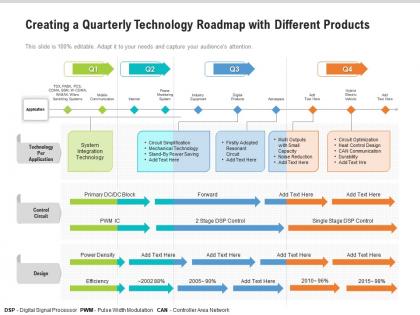
Utilize our pre build Creating A Quarterly Technology Roadmap With Different Products to present your plan of action in the most effective way. Reduce the paperwork and showcase how different activities are linked to each other by incorporating this attention grabbing PowerPoint theme. This completely editable roadmap PPT layout is suitable to fit all your needs and to have a structured outline of the entire process flow using color coding. Provide guidelines to your teammates about the progression process by employing our PPT theme. Team members can easily be designated into teams by accessing the work milestones to be accomplished within the timeframe. You can easily modify the PowerPoint slide according to real time situations. Download our stunning Creating A Quarterly Technology Roadmap With Different Products, and you are good to go to prove your expertise in strategic planning.
People who downloaded this PowerPoint presentation also viewed the following :
Creating a quarterly technology roadmap with different products with all 2 slides:
Use our Creating A Quarterly Technology Roadmap With Different Products to effectively help you save your valuable time. They are readymade to fit into any presentation structure.

FAQs for Creating a quarterly technology roadmap
So for your tech roadmap, start by figuring out what you've got right now - current systems, capabilities, all that stuff. Map out where you want to be in like 6 months or a year with actual dates. Then spot the gaps between those two points. Once you know what's missing, plan out the projects that'll get you there. Don't make it some boring document though - use charts or diagrams because honestly, who has time to read paragraphs? Also build in review points every quarter or so since tech moves crazy fast and you'll probably need to pivot anyway.
Honestly, the biggest mistake I see is teams getting obsessed with whatever new tech is trending instead of asking "does this actually help our business?" Start with your company's goals first. Expanding into new markets? Then prioritize tools that support growth, not the flashy stuff that won't move the needle. Get your business people involved from day one - don't let IT plan in isolation. Your roadmap needs to be flexible too. Set up quarterly check-ins so you can pivot when priorities change. Oh, and treat it like a living document that actually evolves with your strategy, not something you write once and forget about.
Here's what I'd do: score each project on revenue impact, how well it fits your strategy, and whether it's actually doable tech-wise. Make a quick matrix - business value vs effort needed. Dependencies will screw you over if you ignore them (learned that the hard way). Also check if your team can actually handle it with their current skills. Being ruthless about cutting "good" ideas is honestly the hardest part. Get your stakeholders involved in the scoring so they can't complain later. Review it every quarter or things drift.
Honestly, I'd say check it quarterly and do big updates once a year. But it really depends on your industry - like if you're in AI or fintech, maybe monthly since everything moves crazy fast. More stable stuff? Every 6 months is totally fine. Just make sure you're having regular team check-ins to catch when priorities shift or new tech pops up. Budget changes can mess things up too. Whatever you do, don't let it collect dust for a whole year - I've seen too many roadmaps turn into fancy paperwork that nobody actually uses.
Track delivery stuff first - milestone completion, timeline hits, resource accuracy. But honestly? Hitting deadlines means nothing if you're building garbage. Business metrics matter way more: revenue impact, customer adoption, efficiency gains. Are you actually fixing what's broken? Team happiness scores too because burned-out teams kill roadmaps fast. I learned that one the hard way at my last job. Pick 3-4 metrics your stakeholders care about most. Review quarterly, don't obsess daily.
Get your stakeholders involved from day one - customers, internal teams, execs, the whole crew. Surveys and interviews are fine, but honestly workshops are where the magic happens because people spark off each other's ideas. Don't just ask what features they want though. Dig into their actual pain points and where they see opportunities down the road. Here's the tough part: you can't make everyone happy, so be upfront about how you'll prioritize conflicting feedback. Keep checking in regularly to make sure you're still on track and pivot when needed.
Honestly, market research is a game-changer because it shows you what customers actually want instead of what you're guessing they want. You can figure out which features to prioritize first and catch trends early. Plus you won't waste time building random stuff nobody uses - which happens more than you'd think! I've watched whole teams change direction for months after getting good user data. The trick is using it to plan your development timeline, not just backing up decisions you already made. Oh and keep pulling in new insights during roadmap meetings so you're always building the right stuff.
Honestly, I'd do quarterly reviews minimum - maybe even monthly if things are moving fast in your space. Look for tech that actually fixes problems you already have instead of just chasing the latest buzzword. Though I get it, sometimes the new stuff is just too cool to ignore lol. Set up a separate experimental track so you're not constantly derailing your main roadmap. Get a small team together to keep tabs on what's coming and figure out where it might actually fit. The trick is being smart about when and how you integrate new tech rather than just slapping it onto existing systems.
Honestly, the two biggest mistakes I see are over-planning way too far ahead and treating roadmaps like they're carved in marble. Why spend weeks mapping out Q3 next year when everything will probably change by then? Short bursts work better. Also - and this one drives me nuts - teams build these beautiful roadmaps in a vacuum without talking to customers or even checking if they can actually deliver the stuff. Get your stakeholders involved from day one. Focus on what you're trying to achieve, not just shipping features. Then keep tweaking it as you learn new things.
Look, a tech roadmap is basically your game plan for not wasting money on random stuff. You get to see which projects actually matter for your bigger goals and when you'll need the budget/people for them. No more scrambling when something urgent pops up - you've already thought it through. Plus you can spot where teams might be doing the same work twice (happens more than you'd think). Short version: it stops you from flying blind with tech spending. I'd start by just listing what you're working on now and seeing how it connects to what the business actually wants.
Honestly, if you've got budget go with ProductPlan or Aha! - they're made for this stuff and sharing is painless. No budget? PowerPoint works totally fine, or even Google Sheets (I've seen killer roadmaps in spreadsheets, no joke). Look for templates that map your tech stack - infrastructure, platforms, apps - across different timeframes. My main thing is just pick whatever your team can actually get into and edit without being a pain. Don't overthink the tool choice. Getting your content solid and stakeholders on board matters way more than having some fancy platform.
Honestly, the biggest thing is not getting too detailed with your long-term stuff. Do quarterly check-ins to see if your roadmap still makes sense with whatever's happening in the market or with new tech. Later milestones should be kinda loose - broader goals instead of super specific technical requirements. I've watched so many teams paint themselves into corners because they mapped out every little detail 18 months ahead! That never works out. Better to nail down your principles and what you want to achieve, then figure out the "how" later. Oh and make sure your team sees roadmap changes as smart moves, not screw-ups.
Mix timeline visuals with some layered charts - makes everything way more digestible. Gantt charts are perfect for dependencies and milestones. Swim lanes work well when you're juggling different product lines or teams. Color coding is honestly a game changer, helps people scan stuff quickly. Oh, and definitely add icons or simple infographics to break up walls of text (nobody wants to read paragraphs). If you're doing UI changes, before/after mockups are clutch. The whole point is keeping it visual enough that stakeholders won't zone out halfway through your presentation.
So roadmaps basically stop you from getting distracted by every cool new thing that pops up. They show you exactly what gaps exist between your current setup and where you wanna be - that's where the real innovation happens. Your teams actually work together instead of stepping on each other's toes (trust me, I've watched companies waste months this way). You can time things better and spend money smarter too. Honestly, just start by looking at what tech you have now versus your business goals. The biggest gaps? Those are your innovation goldmines.
Okay so this is huge - you've gotta match your message to whoever's listening. Executives? They want business impact, ROI, timelines. Skip the tech stuff completely or you'll lose them (learned this one the hard way lol). Engineering teams are the opposite - they need all the specs and dependencies. Product managers are weird because they want both the strategy AND the implementation details. Here's the thing though - everyone has different risk tolerance too. Some people plan months ahead, others live quarter to quarter. Figure out who you're talking to first, then shape your roadmap around what they actually care about.
-
I discovered this website through a google search, the services matched my needs perfectly and the pricing was very reasonable. I was thrilled with the product and the customer service. I will definitely use their slides again for my presentations and recommend them to other colleagues.