


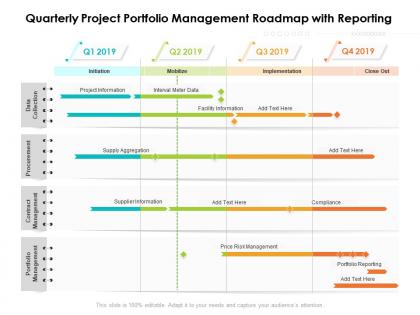
Quarterly project portfolio management roadmap with reporting




Try Before you Buy Download Free Sample Product
 Impress Your
 Audience
 100%
100% Editable
 Save Hours
 of Time


Visualize your work plan and communicate your ideas impactfully with our pre designed Quarterly Project Portfolio Management Roadmap With Reporting. Showcase the detailed overview of the project, the key deliverables, and the milestones to be achieved with the help of our fully customizable PowerPoint layout. You can easily emphasize on the project goals and discuss all the activities involved in an easy to comprehend manner by utilizing our professionally designed PPT theme. This roadmap PowerPoint layout is a perfect strategic planning tool that can help in keeping the project on track. With our attractive PowerPoint theme, you can articulate the workflow, track the work progress, and have a clear vision of the goal to be achieved. Download this versatile Quarterly Project Portfolio Management Roadmap With Reporting and save your hours of work.
People who downloaded this PowerPoint presentation also viewed the following :
Quarterly project portfolio management roadmap with reporting with all 2 slides:
Use our Quarterly Project Portfolio Management Roadmap With Reporting to effectively help you save your valuable time. They are readymade to fit into any presentation structure.
FAQs for Quarterly project portfolio management
Honestly, start with getting your governance sorted out - like who's actually making decisions and how. Everything else is way easier once that's clear. You'll need good criteria for picking projects (otherwise you end up with random stuff). Resource allocation is huge too because teams always get stretched too thin. Don't forget performance monitoring and general resource management. The key thing? Make sure these pieces actually work together instead of being totally disconnected. I've seen so many companies where each part does its own thing and nothing makes sense. Get the decision-making structure right first, then build from there.
So most companies use a scoring system where they rate projects on stuff like strategic fit, ROI, risk, and how many resources you need. Calculate your NPV, payback period, IRR - the usual suspects. Here's the thing though: sometimes a project with crappy returns still gets the green light if it's strategically important for down the road. Consistency is huge - you can't change your criteria halfway through or everything gets messy. I'd start by figuring out what "winning" actually looks like for your company, then build your scoring around that. Makes the whole process way cleaner.
Honestly, you can't do portfolio management without talking to people constantly. Map out your key stakeholders first - sponsors, execs, business units. Set up regular check-ins because priorities shift way more than you'd think. These folks control the purse strings, so when they say a project's dead, it's dead (learned that one the hard way). The whole point is staying aligned with what the business actually wants, not what looks good on paper. Without their input, you're just guessing which projects matter. Trust me, it's better to overcommunicate than miss something important.
Honestly, PPM tools are game-changers because you can finally see all your projects in one spot instead of juggling random spreadsheets. You'll be able to compare everything using actual metrics - ROI, strategic fit, risk levels, that kind of stuff. The real magic happens when you can model scenarios like "what if we pull Sarah off this project for the urgent one?" Resource conflicts become way more obvious before they blow up. I'd say just start by getting everything mapped out in whatever tool you pick - even that basic step will make your decisions so much clearer. Trust me on this one.
Track ROI and NPV obviously, but also watch resource utilization and time-to-market. Strategic alignment scores matter too. Pipeline health is honestly my favorite metric - seeing how projects flow through each stage tells you so much. Risk-adjusted returns are clutch, plus you want balance across business units and innovation types. But here's the thing - pick maybe 5-7 metrics max that actually influence decisions. Nobody needs a fancy dashboard that just sits there looking pretty. Start with whatever keeps your execs up at night, then add from there.
Look, risk management basically touches everything in your portfolio - you're constantly weighing risks across projects to make better calls. During project selection, assess each one's risk profile. Then keep tabs on how those risks shift and affect your whole portfolio balance. Honestly, it's a lot like managing stocks (which can be a headache). Use that risk data to prioritize resources and decide what to kill or speed up. Don't dump everything into high-risk stuff - that's just asking for trouble. Start with standardizing how you measure risks across projects.
Honestly, the biggest headaches are resource conflicts and not knowing what's actually happening across your projects. Plus everyone's priorities are all over the place - classic corporate chaos. Start with solid governance and clear criteria for picking projects. Standardized reporting is a lifesaver (seriously, you'll thank yourself later). Regular reviews help you figure out which projects to axe vs keep going. But here's the thing - get executive buy-in first. Without leadership backing you, this whole thing becomes just another process people roll their eyes at.
First thing - nail down what you're actually trying to achieve strategically. Then build scoring criteria that tie projects back to those goals. Honestly, this is where most teams get too soft. If something doesn't clearly support a priority, why are you doing it? Score each project on alignment, resources needed, and expected impact using the same framework every time. Quarterly reviews are clutch because your strategy will shift. Kill the duds during these sessions and move that money to projects that'll actually move the needle. Oh, and make the whole selection process transparent - people get way less pissy about decisions when they understand the reasoning.
Start by figuring out what skills you actually have available across all your projects - sounds obvious but most people skip this step. Resource leveling helps smooth out those crazy busy periods, and critical chain scheduling builds constraints right into your timeline from the start. I'd definitely recommend creating shared pools of specialists instead of locking people into single teams. Way more flexible that way. A decent resource management tool will save you tons of headaches compared to wrestling with spreadsheets all day. Just plan on reviewing and tweaking things regularly since priorities change constantly. Maybe audit what you've got going on this week?
So agile basically flips portfolio management on its head - you stop planning everything years ahead and start making decisions based on what's actually happening. Market changes? Customer feedback shifts? You pivot. It felt pretty messy when I first switched from the old rigid approach, not gonna lie. Instead of finishing predetermined projects, you're constantly delivering small wins across your whole portfolio. Think quarterly reviews instead of those painful annual planning sessions. Way more flexibility to either pivot hard or just kill projects that aren't working. Oh, and you'll probably reassess priorities like... constantly.
Think of portfolio governance as your project selection rulebook - keeps everyone from going rogue with decisions. Without it? Total disaster. I've watched companies turn into battlegrounds where whoever yells loudest gets their project funded, which is... not ideal. Good governance means you've got clear criteria for evaluating projects, actual approval processes, and someone's accountable when things go sideways. Your projects end up supporting real business goals instead of just Susan from marketing's brilliant idea that came to her in a dream. Honestly, just start by writing down how you currently pick projects - you'll spot the holes pretty quick.
Honestly, market trends will mess with your project priorities constantly. Customer wants change overnight, new tech pops up, and suddenly that "critical" project from six months ago is worthless. Build in flexibility so you can pivot fast - and don't get attached to failing projects, just kill them. I learned this the hard way lol. Set up monthly reviews where you're scanning for market shifts and asking "does this still make sense?" Resource allocation becomes this constant juggling act. You'll need to move quickly or you're toast.
Set up weekly team check-ins and monthly portfolio reviews - consistency is key here. Use the same templates so everyone's tracking stuff the same way. I've watched too many projects crash because teams were using totally different metrics and nobody could figure out what was actually happening. Get your escalation paths sorted early. Portfolio managers need to be the ones connecting everything together. Oh, and create some shared space where people can flag dependencies before they become disasters - don't wait for formal meetings to surface that stuff.
So portfolio management is like having a dashboard for all your projects - you can see everything at once. Resource conflicts become obvious before they blow up. Dependencies? You'll catch those early too. The best part is it forces teams to actually talk to each other, which honestly solves like 90% of coordination issues. When everyone can see what's happening across projects, collaboration just starts happening naturally. I'd map out your current projects first and look for overlaps - you might find some weird redundancies you didn't know existed.
Honestly, the whole project management space is getting crazy right now. Machine learning can predict risks before they happen and suggest where to move resources around. Cloud platforms make it super easy for teams to work together no matter where they are. Everything connects now too - your financial stuff, agile tools, all of it feeds into one dashboard. The visual side has gotten really good at showing portfolio trends instantly. Oh, and those integration APIs are a game changer. My advice? Start looking at AI-powered tools soon because doing this stuff manually is basically dead.
No Reviews