


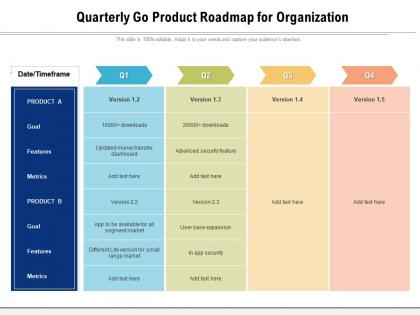
Quarterly go product roadmap for organization




Try Before you Buy Download Free Sample Product
 Impress Your
 Audience
 100%
100% Editable
 Save Hours
 of Time


Visualize your work plan and communicate your ideas impactfully with our pre designed Quarterly Go Product Roadmap For Organization. Showcase the detailed overview of the project, the key deliverables, and the milestones to be achieved with the help of our fully customizable PowerPoint layout. You can easily emphasize on the project goals and discuss all the activities involved in an easy to comprehend manner by utilizing our professionally designed PPT theme. This roadmap PowerPoint layout is a perfect strategic planning tool that can help in keeping the project on track. With our attractive PowerPoint theme, you can articulate the workflow, track the work progress, and have a clear vision of the goal to be achieved. Download this versatile Quarterly Go Product Roadmap For Organization and save your hours of work.
People who downloaded this PowerPoint presentation also viewed the following :
Quarterly go product roadmap for organization with all 2 slides:
Use our Quarterly Go Product Roadmap For Organization to effectively help you save your valuable time. They are readymade to fit into any presentation structure.
FAQs for Quarterly go product
Okay so definitely hit the basics first - last quarter's wins and losses (be real about what sucked), this quarter's priorities with actual dates, and what you're planning next. Throw in your key metrics too. Honestly? Always add a risks slide because execs eat that stuff up - they want to know what might go sideways. Connect everything back to business goals or they'll zone out. Keep it visual and punchy. Oh and end with next steps! People need to walk away knowing who's doing what, otherwise you'll get those annoying follow-up emails asking what they're supposed to do now.
Honestly, just map every feature back to your top 3-4 business goals for the year. Revenue growth, customer retention, whatever matters most. I used to work with this team that kept building "cool" stuff that literally nobody cared about from a business perspective - huge waste of time. Be ruthless about cutting anything that doesn't tie to those priorities. Score each roadmap item on actual business impact before you commit to it. The hard part isn't the mapping, it's saying no to all the shiny objects that'll distract you.
Honestly, ProductPlan and Roadmunk are my go-tos for quarterly stuff - super easy drag and drop between quarters. Aha! is solid but way overpriced unless you've got budget to burn. If you need tons of team input, Miro or FigJam work great for the collaborative mess that roadmapping usually becomes. Don't sleep on a good Google Sheet or Notion setup either, especially if your roadmap's pretty straightforward. The real trick? Pick whatever your team will actually keep updated. I've seen fancy tools gather dust while teams stick with their janky spreadsheets.
Honestly, I just score stuff on three things: business impact, user value, and how hard it'll be to build. Get sales, support, and engineering to weigh in - trust me on this one. Simple 1-5 scale works great, then multiply and rank everything. Also factor in your team's bandwidth and any feature dependencies. Pick the top ones that actually fit your sprint. Oh, and always save like 20% buffer space because random urgent crap will definitely come up. Learned that the hard way lol.
Track both delivery stuff and actual impact - that's key. Delivery means feature completion rates, timeline accuracy, and how much scope creeps up on you. Impact is whether users actually adopt your features, plus the KPIs that matter for your product goals and customer satisfaction. I've watched teams get obsessed with shipping on time while completely missing whether anyone gives a damn about what they built. Stick to 3-4 metrics tops or you'll just drown in numbers. Weekly dashboard reviews with your team work great - keeps everyone honest without overdoing it.
Check your roadmap monthly for little stuff, but do the big reviews quarterly. That timing hits the sweet spot - you're not constantly second-guessing yourself, but you won't miss major shifts either. Honestly, I've watched teams drive themselves crazy reviewing every two weeks. Can't get anything done that way! Quarterly gives you time to actually build something meaningful. Just make sure you're tracking customer feedback between those bigger reviews. Oh, and set up recurring meetings now so it becomes automatic. Trust me on this one - reactive planning is a nightmare you don't want.
Customer feedback and market research are literally the foundation of our roadmap. We dig into support tickets, user surveys, competitive analysis - all that stuff - to spot gaps and pain points. Without it? We'd just build what sounds cool to us, which never works out. Your team needs to review this monthly and use it to validate or completely change direction on features. Oh and here's the thing people mess up - you can't just collect feedback and call it a day. Connect it directly to roadmap decisions or you're wasting everyone's time.
Honestly, cross-functional teams are a game changer for roadmaps. You get the real deal from different departments instead of product just winging it. Engineering warns you about that messy technical debt. Sales tells you what customers won't stop asking for. Support? They'll point out the bugs making users lose their minds. When you loop these people into quarterly planning, they spot problems before they blow up your timeline. Plus they help you focus on stuff that actually matters. I learned this the hard way last year - wish I'd started sooner! Try bringing key folks to your next roadmap review and see what happens.
Honestly, the worst thing you can do is cram your roadmap like you're playing Tetris. Everything takes longer than you think it will. Then you're stuck scrambling to ship half-baked stuff by quarter-end. Also don't be super vague - saying "improve user experience" is basically useless. Nobody knows what that actually means. Oh, and team dependencies will absolutely wreck you if you don't map them out first. I learned that one the hard way. Leave buffer time for random fires that pop up. Plan for maybe 70% capacity max and get specific about what "done" looks like.
Honestly, think of it like building blocks where each quarter has to actually matter right now AND push you toward the big picture. I do this 70/30 split - most of your time on stuff that fixes real customer problems or makes money, then 30% on the boring foundation work nobody sees but you'll need later. The hard part? Making sure those quick wins aren't just shiny features that demo well but don't connect to anything meaningful. Oh and definitely check in monthly because urgent requests will absolutely derail everything if you're not careful.
Honestly, you gotta get people involved in building the roadmap instead of just dumping it on them. Run those collaborative sessions where everyone - engineers, designers, whoever - can actually speak up about concerns or throw out better ideas. I've watched roadmaps crash and burn when they felt like orders from corporate. Nobody wants that. Be upfront about why Feature X got cut this quarter, show the trade-offs. Check in regularly since things always change anyway. Your team will actually care about hitting goals when they helped set them in the first place.
Honestly, you've gotta speak different languages to different people. Execs want the big picture - ROI, timelines, business wins. Your dev team? They need all the technical specs and implementation details. I learned this after watching too many executives zone out during my feature demos lol. Visual roadmaps work way better than boring bullet points. Don't try cramming everyone into one meeting - separate sessions save your sanity. Be real about what could go wrong or cause delays. Nobody likes surprises later. Always shoot over a summary afterward with dates and action items so people don't forget everything you just said.
Color coding is a lifesaver - group stuff by priority or theme so people can actually scan it quickly. Icons help too, especially for different product areas. Progress bars are honestly my new obsession because they show initiative status instantly. Timeline visuals crush text-heavy slides every time. If you've got screenshots or mockups, throw those in. Don't make fonts tiny or cram everything together. Oh, and test your colors for accessibility - learned that the hard way when someone couldn't read my beautiful purple text. Always have a black and white backup ready.
Honestly, new tech is constantly making me question if my roadmap even makes sense anymore. Every quarter I'm checking if some shiny new tool could unlock features we never thought of - or worse, make our planned stuff totally irrelevant. AI is doing this to literally everyone right now, it's wild. The trick is not getting so distracted by cool new tech that you abandon what you've already committed to. I spend maybe 20% of my planning time just exploring what might disrupt our next few quarters. Better to see it coming than get blindsided, you know?
Honestly, bi-weekly standups work great plus those monthly deeper dives where you actually show progress visually. Share the messy stuff too - delays, changes, whatever went sideways and why. Nobody believes those "everything's perfect" updates anyway, right? Set up dashboards in your project tool so people can check things between meetings. But here's the thing - make it feel like a conversation, not just you reporting out. Ask what they think about upcoming priorities. Gets everyone more invested instead of just sitting there nodding along.
No Reviews