


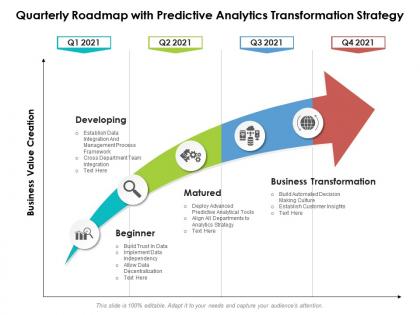
Quarterly roadmap with predictive analytics transformation strategy




Try Before you Buy Download Free Sample Product
 Impress Your
 Audience
 100%
100% Editable
 Save Hours
 of Time


Visualize your work plan and communicate your ideas impactfully with our pre designed Quarterly Roadmap With Predictive Analytics Transformation Strategy. Showcase the detailed overview of the project, the key deliverables, and the milestones to be achieved with the help of our fully customizable PowerPoint layout. You can easily emphasize on the project goals and discuss all the activities involved in an easy to comprehend manner by utilizing our professionally designed PPT theme. This roadmap PowerPoint layout is a perfect strategic planning tool that can help in keeping the project on track. With our attractive PowerPoint theme, you can articulate the workflow, track the work progress, and have a clear vision of the goal to be achieved. Download this versatile Quarterly Roadmap With Predictive Analytics Transformation Strategy and save your hours of work.
People who downloaded this PowerPoint presentation also viewed the following :
Quarterly roadmap with predictive analytics transformation strategy with all 2 slides:
Use our Quarterly Roadmap With Predictive Analytics Transformation Strategy to effectively help you save your valuable time. They are readymade to fit into any presentation structure.
FAQs for Quarterly roadmap with predictive
Honestly, start with one specific problem you can actually solve fast and prove it works. Four things matter most: solid business goals, clean data (seriously, bad data will tank everything), decent tools, and people who get both the tech AND business sides. Data quality is everything - if it's messy going in, your results will be useless. Don't build pretty charts nobody looks at. Find someone who can translate between your data nerds and business folks - that's where most projects die. Once you nail that first win, then you can expand from there.
First thing - figure out what you're actually trying to predict, then work backwards to find data that matters. Don't just grab whatever's sitting in your CRM or transaction logs because it's there. Look for stuff that actually connects to your goals, even if it means digging into external sources like market data or demographic info. Honestly, I've watched so many teams waste months on convenient data that tells them nothing useful. Quality beats quantity every time here. Clean datasets will save you way more headaches than massive messy ones. Oh, and test everything small first before you go all-in.
Honestly, data quality is everything when it comes to predictive models. Your algorithms could be brilliant, but if the data feeding them is trash? You're gonna get garbage results. It's that simple. Bad data means bad predictions, and that leads to expensive mistakes down the road. I learned this the hard way at my last job - we spent weeks wondering why our forecasts were so off until we realized half our data sources were inconsistent. Clean, accurate data makes all the difference. Set up regular audits of your data sources and invest in good cleansing processes early on. Trust me, it's way better than fixing problems later.
Look, every industry has its own weird quirks when it comes to data. Healthcare? You're dealing with patient outcomes and tons of regulatory stuff. Retail is all customer behavior and those crazy seasonal spikes. Finance is completely different - they care about risk and catching fraudsters. Here's what I'd do: figure out what actually drives success in your field first. Like, manufacturing teams obsess over when machines might break down, so they'll use time-series way differently than marketers trying to predict who's gonna bail. The trick is matching your approach to what genuinely matters in your space, not just copying some generic playbook.
Honestly, the data mess is way worse than you'd expect - incomplete stuff everywhere, formats that make no sense, systems that hate each other. Leadership will fight you because they don't get it yet. Good luck finding people who actually know how to build these models without breaking the bank. Legacy systems? Total integration nightmare. I'd say pick one simple use case first, something that'll show results fast. Once you prove it actually makes money, then you can expand. Trust me, trying to do everything at once is a disaster waiting to happen.
Honestly, you'll need to do both - building up your current team while bringing in some fresh talent. Figure out what technical skills you're actually missing first. Then get your existing people trained up through courses or conferences (skip the boring vendor ones though). Meanwhile, hire specialists for the big gaps you can't realistically fill internally. One thing that works really well is pairing your data people with your domain experts - they learn from each other. Oh, and start with small pilot projects so your team can actually learn while they're building something useful. Way less pressure that way.
Okay so first things first - set up data lineage tracking and get your access controls sorted by role. Quality standards matter way more than people think, so nail those down early. Document literally everything because trust me, you'll be cursing yourself in 6 months trying to figure out what past-you was thinking. Automated validation checks are a lifesaver for your training data. Version control both your data AND models - this isn't optional. Monitor for drift and performance drops constantly. Start simple with governance though, don't go crazy with some massive framework right off the bat.
Dude, predictive analytics is way cooler than basic demographics. You can actually find customer segments based on behavior patterns - like spotting people who might quit your service or budget customers ready to spend more. Way better than just sorting by age, honestly. The algorithms catch stuff you'd totally miss doing it manually. Plus you can time your messaging perfectly. Oh and don't try to boil the ocean - just pick one goal first, like stopping people from leaving or getting them to upgrade. Then build everything around that specific thing you're trying to fix.
Start with the basics - precision, recall, and F1-score. ROC-AUC works great for classification stuff too. But here's the thing: don't obsess over getting perfect numbers if they don't translate to real results. Business metrics are honestly just as crucial. Are you actually saving money or making customers happier? Track model drift because your data's gonna change over time (learned that one the hard way). Pick maybe 2-3 metrics that match what your company cares about. I've seen people get lost tracking like 15 different things and it becomes useless noise.
Honestly, I'd start with historical data to build your baseline models - that's where you'll see the real patterns over time. Then just feed in real-time stuff to keep everything current. Most people overthink this, but a hybrid approach works best. Retrain periodically with the historical data, but use real-time inputs for your day-to-day calls. Oh, and figure out what actually needs real-time updates first. Some metrics don't change that fast anyway, so you're probably wasting resources if you're updating everything constantly.
Okay so three main things to worry about: bias, transparency, and consent. Bias is probably the scariest one - your models can make existing prejudices way worse, which sucks when it's affecting people's actual lives. Be upfront about how your predictions work and let people understand decisions that hit them personally. Don't use data without proper consent, and spell out what you're predicting. Oh and definitely audit your models regularly to catch unfair outcomes across different groups. Honestly though, the biggest mistake is trying to add ethics at the end - bake it in from the start or you'll regret it later.
ML finds crazy complex patterns in your data that you'd never catch doing it manually. Your traditional stats models are pretty limited compared to what neural networks can pull off - they actually learn and improve as they see more data. Honestly, the accuracy boost alone makes it worth trying. These algorithms can handle huge datasets and spot weird non-linear connections between stuff. Don't overthink it though. Just pick one area where you're already making predictions and test ML there first. See what happens, then expand from there if it works out.
So predictive analytics is basically pattern recognition for risk - it looks at your old data to spot what might go wrong next. You can catch customers who'll probably default, equipment about to break, sketchy transactions before they become real problems. Honestly, it's way more reliable than just guessing based on gut feeling. The trick is keeping your data clean and consistent so the models actually learn something useful. I'd say pick one area you're already watching closely and start there - gives you something concrete to show for it pretty quickly.
Honestly, the biggest thing is getting your leadership to actually use the data they're asking for - can't tell you how many times I've seen execs request fancy dashboards then completely ignore them. Train everyone, not just your data team, so they don't feel lost looking at charts. Start small with easy wins that solve problems people actually care about. Oh, and don't punish teams when predictions aren't perfect - reward the curiosity instead. We do these "data story" sessions where people share cool stuff they found. Makes it way less intimidating and more collaborative, you know?
Dude, AutoML is changing everything - suddenly anyone can build predictive models without being a data science wizard. Real-time streaming is taking over too, which honestly makes way more sense than waiting around for batch jobs to finish. Edge computing's blowing up because companies want predictions happening right where data gets created. Plus explainable AI is finally trendy since people got tired of trusting mysterious black boxes. You should mess around with AutoML tools if you haven't yet. Also think about what you're currently running in batches that could go real-time instead. Those moves will put you ahead of most people.
No Reviews