


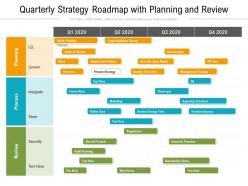
Quarterly strategy roadmap with planning and review





Try Before you Buy Download Free Sample Product
 Impress Your
 Audience
 100%
100% Editable
 Save Hours
 of Time


A cohesive work plan is essential for achieving the desired target. Communicate your vision and lay a firm ground in front of your audience with our PowerPoint layout. Align your project milestones, budgets, deliverables, deadlines, and all the requisite information for a dynamic presentation by employing this amazingly designed Quarterly Strategy Roadmap With Planning And Review. Maximize team efficiency and streamline a work plan efficiently by introducing our ready made roadmap PowerPoint theme. You can quickly establish coordination between different activities across the organization and present an insight to your colleagues by utilizing this useful business tool. Color code specific tasks, prioritize, and keep a close eye on the deadlines with the help of our eye catchy PowerPoint template. Download our Quarterly Strategy Roadmap With Planning And Review for excelling at productive management.
People who downloaded this PowerPoint presentation also viewed the following :
Quarterly strategy roadmap with planning and review with all 2 slides:
Use our Quarterly Strategy Roadmap With Planning And Review to effectively help you save your valuable time. They are readymade to fit into any presentation structure.
FAQs for Quarterly strategy roadmap with
Key components of an effective strategy roadmap include clear objectives, defined timelines, resource allocation plans, milestone markers, and performance metrics. These elements work together by aligning teams around shared goals, establishing accountability through measurable outcomes, and enabling adaptive planning, with many organizations finding that well-structured roadmaps enhance execution speed and strategic clarity.
A strategy roadmap aligns organizational goals with departmental objectives by creating visual connections between high-level strategic priorities and specific departmental initiatives, establishing clear timelines, and defining measurable outcomes for each functional area. Through this strategic alignment framework, departments in organizations like manufacturing companies and financial services firms can coordinate resource allocation, eliminate conflicting priorities, and track progress toward shared objectives, ultimately delivering enhanced operational efficiency and accelerated goal achievement across the entire organization.
Strategy roadmaps should include timeline indicators, milestone markers, key performance metrics, visual progress bars, and color-coded priority levels to enhance clarity and comprehension. These elements streamline communication by providing clear progression pathways, defined success measurements, and intuitive navigation systems, with many organizations finding that well-designed visual frameworks ultimately deliver stronger stakeholder alignment and faster strategic execution.
Strategy roadmaps should be reviewed quarterly for progress tracking and updated annually for comprehensive strategic realignment, with additional reviews triggered by major market shifts or organizational changes. Through regular assessment cycles, organizations can adapt to evolving business environments, adjust resource allocation, and maintain competitive positioning, with many companies finding that flexible roadmap management ultimately delivers enhanced operational agility and strategic responsiveness.
Common pitfalls include setting unrealistic timelines, lacking stakeholder input, ignoring resource constraints, failing to align with business objectives, and creating overly rigid plans without flexibility. These challenges often result from insufficient market research, poor communication across departments, and inadequate contingency planning, with many organizations finding that regular reviews and adaptive frameworks ultimately deliver more sustainable strategic outcomes.
Stakeholder feedback can be integrated through regular consultation sessions, structured surveys, advisory committees, cross-functional workshops, and iterative review cycles. These engagement mechanisms enable organizations to align strategic priorities with stakeholder expectations, identify potential roadblocks early, and enhance buy-in across departments, ultimately delivering more robust strategies and smoother implementation processes.
Data analysis plays a crucial role in shaping strategy roadmaps by providing evidence-based insights for decision-making, identifying market trends, assessing competitive positioning, and validating strategic assumptions through quantitative research. Through comprehensive data evaluation, organizations streamline resource allocation, minimize risks, and enhance strategic accuracy, with many companies finding that data-driven roadmaps deliver significantly better outcomes and competitive advantage.
Organizations measure strategy roadmap success through key performance indicators, milestone tracking, financial metrics, customer satisfaction scores, and operational efficiency benchmarks. These measurement frameworks enable businesses to assess progress quarterly or annually, with many companies finding that regular performance reviews, stakeholder feedback sessions, and data-driven adjustments ultimately deliver sustained competitive advantage and strategic alignment.
Tools for creating strategy roadmaps include Microsoft Visio, Lucidchart, Miro, Roadmunk, and ProductPlan, which enable collaborative planning through drag-and-drop interfaces, real-time editing, and stakeholder access controls. These platforms streamline roadmap development by offering pre-built templates, integration capabilities, and sharing functionalities, with many organizations finding that cloud-based solutions like Miro and Lucidchart enhance cross-departmental alignment and accelerate strategic execution.
A strategy roadmap facilitates better communication by providing a unified visual framework that aligns all teams around common objectives, timelines, and priorities. Through shared milestones and clear dependencies, departments like marketing, engineering, and operations can coordinate efforts more effectively, reduce miscommunication, and ensure everyone understands their role in achieving strategic outcomes.
Techniques for prioritizing strategy roadmap initiatives include impact-effort matrices, weighted scoring models, RICE frameworks, stakeholder value analysis, and resource capacity assessments. These methods enable organizations to evaluate initiatives across multiple criteria like strategic alignment, resource requirements, and expected returns, with many companies finding that combining quantitative scoring with stakeholder input delivers more balanced, achievable roadmaps.
A strategy roadmap supports change management by providing clear timelines, milestone tracking, and visual communication of transformation phases, helping employees understand the journey ahead. Through structured implementation schedules and progress indicators, organizations streamline stakeholder buy-in, minimize resistance, and maintain momentum during transitions, with many companies finding that roadmaps significantly enhance change adoption rates.
Incorporating risk assessment in strategy roadmaps enables organizations to identify potential obstacles, evaluate their impact on strategic objectives, and develop contingency plans proactively. This approach helps companies navigate uncertainties more effectively, allocate resources strategically, and maintain competitive advantage, with many businesses finding that risk-aware planning significantly improves execution success rates.
A strategy roadmap provides high-level strategic direction and long-term vision, while project plans detail specific tasks, timelines, and resources for execution. Strategy roadmaps focus on organizational alignment and competitive positioning across multiple initiatives, whereas action plans emphasize tactical implementation, with many organizations finding that combining both approaches ultimately delivers comprehensive strategic clarity and operational efficiency.
Strategy roadmaps can be customized through sector-specific metrics, regulatory compliance frameworks, industry benchmarks, timeline variations, and stakeholder priorities tailored to each field's unique requirements. Financial services organizations emphasize risk management and regulatory milestones, while manufacturing focuses on operational efficiency and supply chain optimization, with healthcare prioritizing patient outcomes and technology integration, ultimately delivering industry-relevant strategic alignment.
No Reviews