

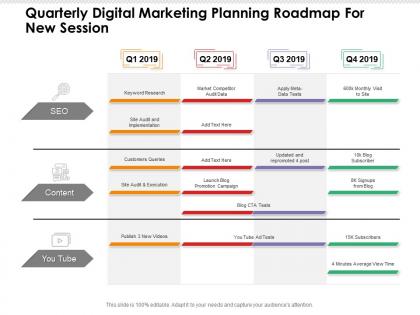
Quarterly digital marketing planning roadmap for new session




Try Before you Buy Download Free Sample Product
 Impress Your
 Audience
 100%
100% Editable
 Save Hours
 of Time


Visualize your work plan and communicate your ideas impactfully with our pre designed Quarterly Digital Marketing Planning Roadmap For New Session. Showcase the detailed overview of the project, the key deliverables, and the milestones to be achieved with the help of our fully customizable PowerPoint layout. You can easily emphasize on the project goals and discuss all the activities involved in an easy to comprehend manner by utilizing our professionally designed PPT theme. This roadmap PowerPoint layout is a perfect strategic planning tool that can help in keeping the project on track. With our attractive PowerPoint theme, you can articulate the workflow, track the work progress, and have a clear vision of the goal to be achieved. Download this versatile Quarterly Digital Marketing Planning Roadmap For New Session and save your hours of work.
People who downloaded this PowerPoint presentation also viewed the following :
Quarterly digital marketing planning roadmap for new session with all 2 slides:
Give your audience a fulfilling experience. They will find our Quarterly Digital Marketing Planning Roadmap For New Session elevating.
FAQs for Quarterly digital marketing planning roadmap
Key components include campaign objectives, target audience analysis, content calendar development, channel strategy optimization, and performance measurement frameworks. These elements work together by aligning marketing activities with business goals, streamlining resource allocation across platforms, and enabling data-driven adjustments, with many organizations finding that structured quarterly planning delivers improved ROI and sustained audience engagement.
Businesses can align quarterly digital marketing goals with overall objectives by establishing clear KPIs, mapping marketing activities to revenue targets, conducting regular cross-departmental reviews, and implementing data-driven feedback loops. Through strategic planning sessions and integrated analytics platforms, organizations streamline their marketing efforts with sales forecasts and growth initiatives, ultimately delivering measurable ROI and enhanced competitive positioning.
Key metrics include conversion rates, customer acquisition cost, return on ad spend, engagement rates, and lifetime customer value. These indicators enable marketing teams to optimize budget allocation, refine targeting strategies, and demonstrate ROI across channels, with many organizations finding that quarterly assessments streamline campaign performance and accelerate strategic pivots.
Seasonal trends significantly influence quarterly digital marketing roadmaps by dictating campaign timing, budget allocation, content themes, promotional strategies, and channel prioritization throughout the year. Retail brands align Q4 campaigns with holiday shopping, while B2B companies leverage Q1 budget cycles and summer networking events, ultimately enabling marketers to maximize engagement and ROI by synchronizing strategies with predictable consumer behavior patterns.
Audience segmentation enables precise targeting by dividing customers into distinct groups based on demographics, behaviors, purchase history, and engagement patterns, allowing marketers to tailor messaging and channels strategically. This approach streamlines resource allocation across quarters, with retail brands and SaaS companies finding that segmented campaigns deliver significantly higher conversion rates, reduced acquisition costs, and enhanced customer lifetime value.
Data analytics enables businesses to refine quarterly marketing efforts by analyzing customer behavior patterns, campaign performance metrics, conversion rates, and channel effectiveness across previous quarters. Through predictive analytics and real-time tracking, companies optimize budget allocation, personalize messaging strategies, and identify high-performing segments, with many organizations finding that data-driven quarterly adjustments increase ROI significantly while reducing acquisition costs.
Best practices for integrating social media marketing into a quarterly roadmap include aligning content themes with business objectives, establishing consistent posting schedules, coordinating campaigns across platforms, setting measurable KPIs, and planning seasonal promotional activities. These strategic approaches streamline brand messaging while enabling marketing teams to track engagement metrics, optimize content performance, and maintain competitive advantage through coordinated digital presence.
Businesses can ensure quarterly marketing plan flexibility by implementing rolling reviews, maintaining budget reserves for emerging opportunities, establishing agile team structures, and utilizing data-driven decision frameworks. Through regular performance assessments and trend monitoring, companies across retail, technology, and financial services streamline campaign pivots, enhance responsiveness to market shifts, and ultimately deliver sustained competitive advantage while adapting to evolving consumer behaviors.
Digital marketing channels for maximum quarterly ROI include search engine optimization, pay-per-click advertising, email marketing, social media advertising, and content marketing automation. These channels deliver measurable results by targeting qualified leads, enabling precise audience segmentation, and providing real-time performance analytics, with many organizations finding that strategic integration across platforms ultimately accelerates customer acquisition while reducing overall marketing costs.
Businesses should allocate quarterly digital marketing budgets by prioritizing high-ROI channels like search engine marketing, social media advertising, content creation, email campaigns, and performance analytics tools. Strategic allocation typically involves dedicating 40-50% to paid advertising, 25-30% to content development, and 20-25% to analytics and optimization, with many organizations finding that quarterly budget reviews enable rapid pivoting toward the most profitable channels and campaigns.
Tools enhancing quarterly digital marketing roadmaps include analytics platforms like Google Analytics, marketing automation software, CRM systems, social media management tools, and project management platforms. These technologies streamline campaign planning, audience targeting, and performance tracking, with many organizations finding that integrated dashboards and AI-powered insights ultimately deliver faster optimization and measurable ROI improvements.
Balancing short-term campaigns with long-term branding requires strategic resource allocation, typically dedicating 60-70% to immediate conversion-focused initiatives while reserving 30-40% for brand-building activities like content marketing, thought leadership, and awareness campaigns. This approach enables organizations to drive quarterly revenue through targeted promotions and product launches, while simultaneously building brand equity and customer loyalty that delivers sustained competitive advantage.
Content marketing serves as the foundation for quarterly digital marketing strategies by building brand authority, nurturing leads through educational resources, and supporting SEO efforts across multiple channels. Through strategic blog posts, whitepapers, and social content, organizations enhance customer engagement, drive organic traffic, and establish thought leadership, with many companies finding that consistent content creation ultimately delivers higher conversion rates and stronger customer relationships.
Businesses conduct competitive analysis by monitoring competitors' content strategies, social media engagement, SEO rankings, paid advertising campaigns, and customer feedback patterns. Through tools like SEMrush, Ahrefs, and social listening platforms, organizations identify market gaps, benchmark performance metrics, and uncover emerging trends, ultimately enabling more strategic quarterly planning and competitive positioning in increasingly crowded digital landscapes.
Common pitfalls include setting unrealistic goals, neglecting audience research, overlooking competitor analysis, ignoring budget constraints, and failing to establish clear KPIs. These oversights can derail campaigns by misallocating resources, targeting wrong demographics, and lacking measurable outcomes, with many marketing teams finding that balanced planning and realistic timelines ultimately deliver better ROI and sustainable growth.
No Reviews