


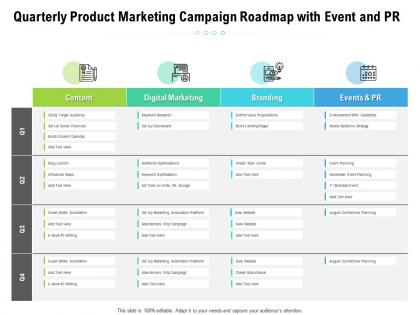
Quarterly product marketing campaign roadmap with event and pr




Try Before you Buy Download Free Sample Product
 Impress Your
 Audience
 100%
100% Editable
 Save Hours
 of Time


A well thought out action plan makes execution easier and increases the possibility of success significantly. Ensure hitting all the milestones within the deadlines by introducing our fully customizable Quarterly Product Marketing Campaign Roadmap With Event And PR. Streamline the work related information, budget, timeframe, key deliverable, landmarks, and major steps involved, all in one place to give an organized overview of the project by utilizing our PowerPoint theme. Minimize time lag and increase work efficiency by providing insight into the process with our comprehensively researched roadmap PowerPoint layout. Color coding helps in highlighting the process and grabs the attention of the audience. Download our handy Quarterly Product Marketing Campaign Roadmap With Event And PR to identify the possible problem areas in a much shorter time and propose solutions. Have a productive brainstorming session with your workforce by utilizing our action plan visualization tool.
People who downloaded this PowerPoint presentation also viewed the following :
Quarterly product marketing campaign roadmap with event and pr with all 2 slides:
Use our Quarterly Product Marketing Campaign Roadmap With Event And PR to effectively help you save your valuable time. They are readymade to fit into any presentation structure.
FAQs for Quarterly product marketing campaign roadmap with
A quarterly marketing roadmap should include target audience analysis, campaign objectives and KPIs, budget allocation across channels, content calendars, product launch timelines, and competitive positioning strategies. These components work together by aligning marketing activities with business goals, optimizing resource distribution, and ensuring consistent messaging, with many organizations finding that structured roadmaps deliver improved campaign performance and measurable ROI.
Businesses align quarterly marketing roadmaps with objectives by establishing clear KPIs, conducting regular strategy reviews, and ensuring marketing initiatives directly support revenue targets and growth goals. Through integrated planning sessions, companies can synchronize marketing campaigns with product launches, seasonal demands, and budget allocations, ultimately delivering measurable outcomes that drive competitive advantage.
Key metrics include conversion rates, customer acquisition cost, return on marketing investment, lead quality scores, and brand awareness levels. These measurements enable organizations to assess campaign effectiveness, optimize resource allocation, and demonstrate tangible business impact, with many marketing teams finding that balanced scorecards ultimately deliver greater strategic alignment and competitive advantage.
Marketing teams should review their quarterly roadmap bi-weekly for tactical adjustments and monthly for strategic pivots, with milestone checkpoints at 30, 60, and 90-day marks. This cadence enables teams to respond to market shifts, campaign performance data, and competitive developments while maintaining strategic focus, with many organizations finding that regular reviews improve ROI by 25-40% through optimized resource allocation.
Tools for creating quarterly marketing roadmaps include Asana, Monday.com, Trello, Smartsheet, and Microsoft Project for project management, alongside HubSpot, Marketo, and Salesforce for campaign integration. These platforms streamline planning by enabling timeline visualization, resource allocation, and cross-team collaboration, with many marketing organizations finding that integrated dashboards ultimately deliver better campaign coordination and measurable ROI tracking.
Customer feedback plays a crucial role in shaping quarterly marketing roadmaps by informing campaign messaging, identifying product positioning opportunities, guiding channel optimization, and revealing emerging market demands. This strategic input enables marketing teams to refine targeting strategies, enhance customer experiences, and allocate resources more effectively, with many organizations finding that feedback-driven roadmaps deliver significantly higher engagement rates and campaign ROI.
A quarterly marketing roadmap incorporates emerging trends through regular trend analysis, flexible campaign structures, experimental budget allocation, and adaptive content strategies. By monitoring social media shifts, consumer behavior changes, and technological advances, marketing teams can pivot campaigns mid-quarter, test new platforms, and ultimately deliver more relevant customer experiences while maintaining competitive advantage.
Cross-departmental collaboration strategies include establishing shared KPIs, creating regular inter-team check-ins, implementing unified project management platforms, forming cross-functional task forces, and developing transparent communication protocols. These approaches streamline alignment by breaking down silos, enhancing information flow, and synchronizing objectives across sales, product, and customer service teams, ultimately delivering coordinated campaigns and improved market responsiveness.
Businesses can effectively prioritize marketing initiatives by evaluating ROI potential, aligning with strategic objectives, assessing resource requirements, analyzing customer impact, and considering competitive positioning. Through data-driven scoring systems and stakeholder input, organizations streamline decision-making while balancing short-term wins with long-term growth, ultimately delivering focused campaigns that maximize budget efficiency and market advantage.
Common pitfalls include setting unrealistic goals, lacking clear metrics, insufficient budget allocation, ignoring market seasonality, and poor cross-team coordination. These challenges often derail campaigns by creating resource conflicts, missed deadlines, and misaligned expectations, with many marketing teams finding that overly ambitious timelines and inadequate stakeholder buy-in ultimately compromise campaign effectiveness and ROI measurement.
A quarterly marketing roadmap adapts to different audiences through segmented content strategies, channel customization, personalized messaging frameworks, and targeted campaign timing adjustments. By leveraging audience analytics and behavioral data, marketers can tailor product positioning, communication frequency, and promotional offers across segments, while maintaining consistent brand messaging that ultimately delivers higher engagement rates and conversion optimization.
Effective communication methods include interactive presentations with visual timelines, regular dashboard updates, collaborative planning sessions, detailed progress reports, and cross-functional workshops. These approaches enhance stakeholder alignment by providing clear visibility into campaign priorities, resource allocation, and performance metrics, with many organizations finding that consistent communication cycles ultimately deliver stronger buy-in and strategic execution.
Content marketing integrates into quarterly roadmaps through strategic content planning, audience segmentation, campaign alignment, performance tracking, and cross-channel coordination. Organizations typically structure quarterly content themes around product launches, seasonal trends, and customer journey stages, with marketing teams finding that consistent content calendars, SEO optimization, and social media integration ultimately deliver enhanced brand visibility and measurable lead generation across multiple touchpoints.
Digital marketing drives quarterly roadmap development by enabling data-driven decision making, real-time campaign optimization, and agile strategy pivots based on performance analytics. Through social media insights, SEO trends, and customer behavior tracking, organizations streamline resource allocation, enhance targeting precision, and accelerate market responsiveness, with many companies finding that digital channels ultimately deliver measurable ROI and competitive advantage.
Businesses can account for seasonal changes by analyzing historical data, monitoring industry trends, incorporating flexible budget allocations, and scheduling campaigns around peak periods. Through strategic planning, retailers adjust inventory messaging for holidays, travel companies promote seasonal destinations, and B2B firms align launches with fiscal calendars, ultimately maximizing engagement while maintaining adaptable strategies for unexpected market shifts.
No Reviews