


Six months customer engagement model development roadmap




Try Before you Buy Download Free Sample Product
 Impress Your
 Audience
 100%
100% Editable
 Save Hours
 of Time


Visualize your work plan and communicate your ideas impactfully with our pre designed Six Months Customer Engagement Model Development Roadmap. Showcase the detailed overview of the project, the key deliverables, and the milestones to be achieved with the help of our fully customizable PowerPoint layout. You can easily emphasize on the project goals and discuss all the activities involved in an easy to comprehend manner by utilizing our professionally designed PPT theme. This roadmap PowerPoint layout is a perfect strategic planning tool that can help in keeping the project on track. With our attractive PowerPoint theme, you can articulate the workflow, track the work progress, and have a clear vision of the goal to be achieved. Download this versatile Six Months Customer Engagement Model Development Roadmap and save your hours of work.
People who downloaded this PowerPoint presentation also viewed the following :
Content of this Powerpoint Presentation
Description:
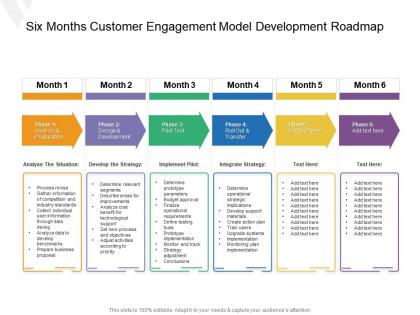
This image depicts a customer engagement model development roadmap spanning six months, divided into different phases for each month. Each phase corresponds to an aspect of the model's development process.
1. Month 1, Phase 1: Analysis & Preparation
a). Process revise: Review and enhance existing processes.
b). Gather information on competition and industry standards: Collect comparative data for benchmarking.
c). Collect individual user information through data mining: Acquire personalized insights from user behavior.
d). Analyze data to develop benchmarks: Use data analysis to establish performance standards.
e). Prepare business proposal: Formulate a proposition to initiate the model development.
2. Month 2, Phase 2: Design & Development
a). Determine relevant segments: Identify sections of the market/customer base to target.
b). Describe areas for improvements: Outline potential enhancements in the engagement strategy.
c). Analyze cost/benefit for technological support: Assess the financial implications of new technology adoption.
d). Set new process and objectives: Establish goals and methods for the new engagement model.
e). Adjust activities according to priority: Prioritize actions based on their urgency and impact.
3. Month 3, Phase 3: Pilot Test
a). Determine prototype parameters: Define the scope and specifications for the trial.
b). Budget approval: Secure financial authorization for the pilot.
c). Finalize operational requirements: Establish detailed plans for the pilot test.
d). Define testing tools: Identify methods and instruments for measuring the pilot's efficiency and success.
e). Prototype implementation and monitor: Execute the pilot and observe its operation.
f). Strategy adjustment and track conclusions: Amend the strategy based on pilot outcomes and deduce findings.
4. Month 4, Phase 4: Roll Out & Transfer
a). Determine operational strategic implications: Understand the operational impact of the new model.
b). Develop support materials: Create resources to assist with the model's implementation.
c). Create action plan: Devise a detailed plan for rollout.
d). Train users: Educate the users on the new model and systems.
e). Upgrade systems: Improve existing systems to support the new model.
f). Monitoring plan implementation: Track the progress and effectiveness of the rollout.
Phases 5 and 6 are placeholders for additional content.
Use Cases:
This roadmap can be utilized by various industries to strategize and implement customer engagement models.
1. Retail:
Use: Customer experience enhancement
Presenter: Marketing Manager
Audience: Retail Operations and Sales Team
2. Banking:
Use: Implementation of customer relationship management (CRM) systems
Presenter: CRM Project Lead
Audience: Stakeholders & Banking Executives
3. Telecommunications:
Use: Subscriber retention programs
Presenter: Customer Engagement Strategist
Audience: Product Managers and Customer Service Leaders
4. Healthcare:
Use: Patient engagement improvement initiatives
Presenter: Healthcare Administrator
Audience: Medical Professionals and Administrative Staff
5. Technology:
Use: Rollout of user engagement tools
Presenter: Product Development Lead
Audience: Investors and Technical Teams
6. Education:
Use: Student engagement and retention strategies
Presenter: Academic Affairs Director
Audience: Faculty and Institutional Planners
7. Hospitality:
Use: Guest loyalty and retention programs
Presenter: Director of Guest Experience
Audience: Hotel Management and Staff
Six months customer engagement model development roadmap with all 2 slides:
Give your audience a fulfilling experience. They will find our Six Months Customer Engagement Model Development Roadmap elevating.
FAQs for Six months customer engagement
Honestly, start by mapping out where you're losing people - that's where the real money is. Your customers need different approaches, so ditch the generic messaging. Track everything across all your channels because people jump between your app, website, and support constantly. They expect it to feel seamless, which is harder than it sounds but totally worth it. Data-driven personalization is clutch here - use what you know about them to make interactions actually relevant. Oh, and build in feedback loops so you're not just guessing what's working. The whole omnichannel thing sounds buzzy but it's genuinely what separates good companies from meh ones.
Track the big stuff first - engagement rates, customer lifetime value, retention, and NPS scores. Email opens and how long people actually stay on your site matter too. But honestly? Half the analytics dashboards I see are just ego-boosting numbers that don't mean anything for revenue. The real gold is in customer feedback and what people are actually saying in support tickets. I'd set up a monthly review mixing the hard data with actual user conversations - that's where you'll catch problems before they tank your business.
Honestly, think of tech as your secret weapon for scaling personal connections. CRM systems track what customers actually want (not what you think they want). Chatbots handle the basic stuff so you don't go crazy answering the same questions all day. Social media tools help you build genuine relationships, while analytics show you when you're totally missing the mark - happens to everyone, trust me. Mobile apps and email automation keep touchpoints smooth across platforms. Just pick tools that solve real problems for your customers, not whatever looks coolest in the sales pitch.
Honestly, personalization works because it makes people feel like you actually understand them instead of just blasting generic stuff at everyone. I mean, you're way more likely to click something that feels relevant to you specifically, right? Use your customer data to segment people properly and customize things across email, web, social - whatever you're using. Product recommendations work really well, or even just personalized subject lines. The whole point is creating experiences people actually want to engage with rather than ignore. Start small though - don't try to personalize everything at once or you'll go crazy.
Honestly, the biggest mistake I see is teams trying to do everything at once - total recipe for disaster. You'll just stress everyone out, including your customers. Pick one or two things and actually get good at them first. Oh, and don't build your whole strategy on assumptions about what customers want. Ask them! I've watched so many companies create these fancy systems that completely flopped because they never bothered checking if customers actually cared. Training your team properly is huge too - otherwise you get wildly inconsistent experiences. Get your leadership on board early and figure out what metrics actually matter.
Honestly, just pick one platform first and actually engage with people there. Reply to comments fast - like, people can tell when you're ignoring them. Ask questions in your posts, throw up some polls, maybe do a contest or whatever. The behind-the-scenes stuff always does well too. I swear, brands that just post promotional garbage all day wonder why nobody cares. Treat it like you're actually talking to people, not shouting into the void. Once you've got that one platform working, then think about expanding. But seriously, focus beats being everywhere at once.
Focus on engagement stuff first - how often people actually use your product, time spent in sessions, which features they adopt. Support tickets are a dead giveaway too. Customer satisfaction and NPS scores matter, but honestly don't spam people with surveys constantly. Watch for the warning signs like usage dropping off or people not renewing. I learned this the hard way - you can't track everything or you'll go crazy with data. Pick maybe 4-5 things that actually connect to keeping customers and making money. That's really all you need to start.
So it really comes down to what keeps your customers up at night, you know? Retail goes all-in on omnichannel stuff because people are constantly switching between shopping online and in stores. Healthcare? They're all about building trust and educating people - makes sense when you're dealing with someone's actual health. Financial companies focus on security and personal advice since everyone's financial situation is totally different. Tech companies are obsessed with community building and getting users to create content. Honestly, once you figure out what stresses your customers out most, that's where you build your whole strategy around.
Customer feedback is like your GPS for engagement - shows you what's broken and what's actually hitting. Can't just wing it anymore based on hunches (trust me on this one). Their comments reshape everything from which channels you focus on to how you craft messages. Honestly, the patterns you'll spot in their complaints and preferences will totally flip your whole approach. Without feedback, you're basically just throwing stuff at people randomly. My advice? Set up feedback collection everywhere - every interaction point - then actually review it quarterly to adjust your game plan. Makes such a difference.
Map out where your customers usually bail - that's your starting point. We totally screwed this up and watched people vanish after demos because we weren't paying attention. Create specific content for those danger zones. Set up automated messages but don't make them sound robotic - nobody wants to feel like they're talking to a bot. Send setup guides after onboarding, special deals to loyal customers, that kind of thing. Track what's actually working, not what you assume works. Oh, and don't be annoying about it - relevance beats frequency every time.
Honestly, skip the boring PowerPoint stuff - nobody remembers that anyway. Get your team doing role-plays with actual customer scenarios. That's where they'll learn to really listen and show empathy. Have them practice asking open-ended questions and mirroring how customers feel. Oh, and make sure they always follow through on what they promise! Watch them interact with real customers afterward and give specific feedback. I'm telling you, ongoing coaching beats one massive training session every time. Practice beats theory.
Dude, analytics will show you stuff about your customers you'd never notice otherwise. Like which touchpoints actually make people buy vs. just create busy work. Track your email opens, website clicks, purchase patterns - that's where I'd start honestly. The data gets crazy overwhelming fast (learned that the hard way). But once you see when people usually bounce or what messages work for different groups, you can fix those high-impact spots first. Way better than trying to optimize everything at once and burning out.
Honestly, engagement and loyalty go hand in hand - can't really have one without the other. Engagement is all your customer touchpoints, loyalty is what happens when those interactions actually matter to people. But here's what I've noticed - tons of companies just create pointless "engagement" that's basically spam. Quality over quantity, always. When customers feel genuinely engaged (like you're solving real problems), they'll stick around longer and spend more. Oh, and they'll tell their friends too, which is huge. I'd start by looking at your current touchpoints and being brutally honest: does this add value or just annoy people?
Dude, this is huge - I've watched companies totally crash because they ignored cultural stuff. Germany loves direct marketing, but try that in Japan and you'll seem super pushy since they're all about building relationships first. The timing, colors, communication style... everything changes. Some places want formal emails while others prefer casual social posts. Honestly, the decision-making processes are completely different too. My advice? Do your homework on communication norms before you launch anything, or you might blow your whole market entry.
Honestly, video content is crushing it right now - behind-the-scenes stuff, live Q&As, all that. AI personalization is getting really good too. Interactive posts like polls work great, and I've seen companies build solid communities with private groups. Oh, gamification is pretty cool - you know, giving people points or badges for engaging. My cousin's startup tried like five strategies at once and it was a mess lol. I'd pick whatever matches where your audience actually hangs out, test one thing first, then expand from there if it works.
No Reviews