

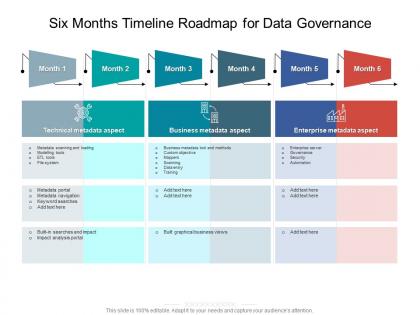
Six months timeline roadmap for data governance




Try Before you Buy Download Free Sample Product
 Impress Your
 Audience
 100%
100% Editable
 Save Hours
 of Time


The success rate of business plans is hugely dependent on the plan of action, and this editable Six Months Timeline Roadmap For Data Governance rightly serves the purpose. Encapsulate all the information related to the project in a well structured manner to obtain maximum efficiency by incorporating our stunning PowerPoint theme. State the critical deliverable, steps involved, time frame, workforce allocation, and lots more in an easy to understand manner by utilizing this pre designed roadmap PowerPoint layout. You can also prioritize your tasks and discuss the problem areas with your colleagues by incorporating this tailor made PPT layout. Empower your work plan by employing this professionally designed PPT theme. Entrepreneurs can download Six Months Timeline Roadmap For Data Governance as a beneficial communication tool that facilitates in collaborating with different tasks and achieve targets.
People who downloaded this PowerPoint presentation also viewed the following :
Six months timeline roadmap for data governance with all 2 slides:
Use our Six Months Timeline Roadmap For Data Governance to effectively help you save your valuable time. They are readymade to fit into any presentation structure.

FAQs for Six months timeline roadmap
So you need data ownership roles and clear policies first. Quality monitoring and compliance stuff comes next. Honestly, finding good data stewards is a nightmare - like trying to organize a group chat where nobody responds. Get some tech tools for cataloging and tracking where your data comes from. Training is huge too, otherwise people just wing it. Oh, and set up metrics to actually see if this is working. My take? Start small with your most important datasets. Don't try to fix everything at once - I've seen that blow up spectacularly. Maybe run a pilot first and see how it goes.
First thing you need to do is figure out where you actually stand right now. Run a data maturity assessment - check your data quality, governance, tech setup, all that stuff. DAMA-DMBOK is pretty solid, or just make your own scorecard. Look at how you handle data lineage, security, who can access what. And honestly? Most companies think they follow their data policies way better than they actually do. Get people from IT, business teams, and compliance to help with this - you'll miss blind spots otherwise. Once you see the gaps clearly, prioritizing your next steps becomes way easier.
Dude, you absolutely need leadership backing or you're screwed. Get a C-level sponsor who'll actually fight for you when people start whining about the new rules. Without that executive support, your whole plan just becomes another forgotten presentation nobody cares about. Here's the thing though - leaders have to walk the walk too. If they're asking for reports that break their own data rules, the program's dead in the water. Honestly, I've seen this tank so many projects. They need to give you budget, resources, and actually hold teams accountable. Otherwise you're just spinning your wheels.
Here's the thing - don't get caught up in all the technical stuff. Start with what actually matters to your business: revenue, costs, customer happiness. Figure out which data problems are genuinely blocking you from hitting goals. I've seen way too many teams build these elaborate roadmaps that sound impressive but don't move the needle. Connect every single milestone to real results - faster reports, better customer insights, whatever. And honestly? Present it all in language your leadership gets excited about. Money saved, competitive edge gained, time freed up. That's what gets budgets approved.
Track your data quality scores first - accuracy, completeness, that stuff. Compliance metrics matter too, like how fast you're fixing issues and hitting regulatory deadlines. Honestly, user adoption is probably the biggest one though - are people actually using your data catalogs? Business impact KPIs help show real value, like faster insights or fewer violations. I always tell people to stick with maybe 5-7 metrics tops. Monthly reviews with stakeholders keep everyone on the same page. Oh, and don't get too fancy with the dashboard - simple charts work better than you'd think.
DAMA-DMBOK is your best bet if you want something comprehensive - covers data architecture, quality management, the whole nine yards. COBIT works well too, especially if you're already using it for IT stuff since it has decent data governance built in. But honestly? Don't stress too much about finding the "perfect" framework. Lots of companies just go agile and tackle their roadmap in sprints by business area or data domain. Start by figuring out where you are now and what your biggest pain points are. Then just pick whatever framework actually fits your situation and run with it.
Look, data quality is literally everything when it comes to governance. Without solid data, you're basically building your whole strategy on a house of cards. People won't follow your policies if the underlying data is trash - why would they? I've seen this happen so many times. Clean data gets stakeholder buy-in and actually proves your governance framework works. Messy, inconsistent data just makes everyone lose faith and work around your system instead. My advice? Figure out your worst data quality problems first, then design your governance around fixing those specific issues.
Honestly, people just hate changing their routines - that's the biggest pain. Plus executives never want to fund it properly since it's not flashy like other tech stuff. Your data's probably a mess too, scattered across systems that weren't built to work together. Nobody wants to own the cleanup either, which I totally get because it's thankless work. Most companies also try doing everything at once instead of being smart about it. Just pick one small thing first, prove it works, then expand from there. Way less headache that way.
Look, first thing - get your leadership actually using data instead of just talking about it. Everyone copies what the boss does, right? Set up dashboards so teams can grab their own numbers without bugging IT constantly (seriously, waiting weeks for a simple report is soul-crushing). Train people on basic data stuff and make a big deal when someone makes a smart data-driven call. Someone needs to own data quality or it'll be garbage in, garbage out. Oh, and definitely connect data usage to performance reviews - people care about what affects their paycheck. Start with teams who already get it, then spread those wins around.
Start with a good data catalog - Collibra, Alation, or Apache Atlas work well for tracking your stuff. Most people hate this step but trust me, it's necessary. Then grab data quality tools like Talend or Great Expectations for monitoring. You'll also want lineage tracking to see how data moves around, plus access control (Okta or whatever IAM your cloud has). Oh and dashboards for keeping an eye on things ongoing. Honestly I'd focus on catalog + quality tools first since they'll make the biggest difference right away. The rest can come later once you've got those basics down.
Honestly, I'd check it every quarter and do big updates once a year. Those quarterly check-ins help you spot problems early and shift priorities based on what's actually working. The annual deep dive is where the real work happens - I've watched too many teams create these elaborate roadmaps then basically ignore them for months. Keep notes between reviews about what's bombing and what's crushing it. Business moves crazy fast these days, plus regulations change and new tech pops up constantly. Oh, and actually put those review dates in your calendar now or you'll definitely forget.
First thing - figure out who actually matters for this project. Business users, IT folks, legal team, executives, compliance people. Skip those giant meetings where everyone just stares at each other. Run small workshops instead, way more productive. Don't use fancy governance speak that puts people to sleep. Talk about how this stuff affects their actual job, not some abstract concept. I learned this the hard way - people tune out if you can't connect it to their daily headaches. Keep notes on everything and check in regularly so nobody gets surprised later.
Track cost savings and revenue boosts - that's your best bet for measuring ROI. Compliance fines going down? Great. Less time wasted hunting for decent data? Even better, honestly. I've watched teams burn hours daily on this stuff. Revenue-wise, look at faster decisions, better customer insights, maybe quicker product launches. Here's the thing though - you gotta set baseline metrics first or you can't prove anything actually improved. Don't overcomplicate it. Pick 3-4 metrics your leadership actually cares about and track those consistently.
Look, compliance is gonna drive your whole roadmap whether you like it or not. Map out GDPR, CCPA, whatever applies to your data first - those become your must-haves. I know it sounds boring but it actually helps you focus instead of building random stuff. Your phases need to match compliance deadlines, which is honestly kind of annoying but whatever. Build audit trails from the start or you'll hate yourself later. Figure out which regulations hit your data types and use those as your baseline governance framework. It's like doing homework before Netflix, but it works.
Start by figuring out who owns what data - customer stuff, financials, product info, whatever makes sense for your company. Give each steward real power to fix quality issues and set access rules in their area. The key is weaving them into your governance without making it a total bureaucracy nightmare (trust me, people will just bypass everything if it's too rigid). Monthly meetings work well for escalating problems and coordinating when domains overlap. Just make sure these aren't just glorified status updates - stewards need actual authority to make decisions and enforce standards, or the whole thing falls apart.
-
Designs have enough space to add content.
-
The Designed Graphic are very professional and classic.