


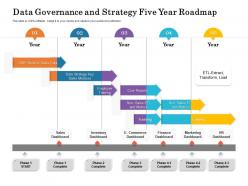
Data governance and strategy five year roadmap





Try Before you Buy Download Free Sample Product
 Impress Your
 Audience
 100%
100% Editable
 Save Hours
 of Time


Visualize your work plan and communicate your ideas impactfully with our pre designed Data Governance And Strategy Five Year Roadmap. Showcase the detailed overview of the project, the key deliverables, and the milestones to be achieved with the help of our fully customizable PowerPoint layout. You can easily emphasize on the project goals and discuss all the activities involved in an easy to comprehend manner by utilizing our professionally designed PPT theme. This roadmap PowerPoint layout is a perfect strategic planning tool that can help in keeping the project on track. With our attractive PowerPoint theme, you can articulate the workflow, track the work progress, and have a clear vision of the goal to be achieved. Download this versatile Data Governance And Strategy Five Year Roadmap and save your hours of work.
People who downloaded this PowerPoint presentation also viewed the following :
Data governance and strategy five year roadmap with all 2 slides:
Use our Data Governance And Strategy Five Year Roadmap to effectively help you save your valuable time. They are readymade to fit into any presentation structure.
FAQs for Data governance and strategy
Honestly, just start with data stewardship - get clear owners for your datasets. Most companies try to do everything at once and it's a mess. You'll need some basic policies and processes that people actually follow (good luck with that part lol). Data classification and security stuff matters too, but don't overthink it initially. Figure out your data lineage first so you know where things come from. Set up clear roles so someone's accountable when stuff breaks. My advice? Pick one business area that's super critical, nail that down, then expand. Way better than trying to govern your entire data warehouse from day one.
Honestly, start by talking to like 5-10 people from different teams - not just IT folks. Ask about their biggest data headaches. Map out how your data actually flows (trust me, it's messier than you think). Then dig into three things: who owns what data, how decisions happen, and which tools you're using vs the ones collecting digital dust. Oh, and check your data quality and any compliance gaps. I learned this the hard way but you can't fix data governance without understanding what's broken first. Skip the fancy frameworks initially - just get the real story from your stakeholders.
Data stewardship is your day-to-day data management crew - they're handling quality control and actually living with the data. These folks know where everything is, what it means, and catch problems early. Honestly, they're what makes governance policies work instead of just collecting dust on a shelf. Short sentences work. Your governance framework becomes useless paperwork without them maintaining standards and following through on rules. Look around your team first - you probably already have people doing steward work without the official title. They're your best starting point.
Map your data stuff straight to business goals first - like if you're fixing customer experience, focus on data quality for those teams. Most companies mess this up by building frameworks nobody asked for. Get business people involved from day one and show them how cleaner data helps them hit their numbers. Your governance metrics should match their KPIs too. Honestly, I've watched so many teams fail because they got too technical too fast. Every decision needs to scream "this makes us money" instead of just being some IT project.
Track the obvious stuff first - data quality scores, how fast issues get fixed, policy compliance rates. But honestly? The soft metrics are where you'll see real impact. Are people still bugging you with "where's this data" questions all the time? Teams actually working together on projects now? Time-to-insight improving for your analysts? Business-wise, check if your data catalog's getting used and whether people can find what they need faster. I'd say pick maybe 3-4 metrics tied to your biggest headaches right now. You can always add more later once you get a baseline going.
Look, regulations are basically what set your whole timeline and priorities when you're building data governance. First thing - figure out what actually applies to you. GDPR? CCPA? SOX? Map those out because they'll drive everything from how you classify data to your retention policies and who gets access to what. Honestly, doing a regulatory assessment upfront is clutch - helps you separate the absolute must-dos from the stuff that'd be nice but isn't urgent. Yeah it's tedious work, but trust me, way better than scrambling later when auditors show up.
Start with a data catalog like Collibra or Alation - that's your home base for metadata and lineage stuff. Then grab data quality tools (Great Expectations is solid) and something for access control like Privacera. The whole tool landscape is honestly a mess to navigate at first, but those three buckets will get you going. Oh, and you'll need workflow management for approvals plus some dashboard to track your metrics. My advice? Pick one tool per category instead of trying to do everything at once. Trust me on that one - I've seen too many teams get buried trying to implement five tools simultaneously.
First thing - get your leadership actually excited about this, not just nodding along in meetings. Make the data easy for regular people to access, and honestly? Most folks are just scared of looking dumb around spreadsheets. Train them on the basics so dashboards don't feel intimidating. When someone uses data to nail a decision, make a big deal about it. Share those wins everywhere. Here's the thing though - connect it to stuff they actually care about, not some random KPI nobody understands. Pick one team to start with and let it spread naturally from there.
Honestly, the hardest part is getting executives to care when they can't see immediate returns. Data silos are brutal too - every department hoards their info like it's gold or something. Nobody wants to share, which makes working together a nightmare. Then there's the whole "who's fault is it when stuff breaks" problem because ownership gets super murky. Oh, and don't even get me started on trying to change how people actually work day-to-day. Cultural shifts take forever. Best bet? Pick one thing that'll make a real difference, prove it works, then slowly expand. Way easier than trying to boil the ocean from day one.
Data quality starts with having clear owners for different pieces of your data - someone's gotta be responsible when things go wrong. Set up automated checks at entry points so bad data gets caught before it messes up everything downstream. I'd also run regular data profiling to catch weird patterns early. Documentation is super boring but you'll thank yourself later when you need to trace where a problem started. Oh, and definitely standardize how people collect and update data - otherwise it's chaos. Start with your most important datasets first, get those locked down, then work outward from there.
So you'll want different training for different people - data stewards need the heavy technical stuff on quality tools and lineage, but regular business users just need basics like data classification and how to actually access things. Honestly, the soft skills part is probably more important than people think because everyone hates new processes. Change management training is key. Oh, and definitely build some kind of central knowledge base with all your workflows and who to bug when stuff breaks. I'd test it with a small group first, fix whatever's broken, then roll it out to everyone else in phases.
So basically, data governance gives you the foundation for security and compliance stuff. You'll want to map out who owns what data and set up proper access controls. Once you know what you've got and where it sits, most regulatory requirements become way more manageable. Audits are still a pain but at least you're not scrambling around looking for everything - been there, not fun. Set up policies for classifying data, retention periods, and what to do when things go wrong. I'd start by figuring out your current data flows and tackle the biggest compliance gaps first.
Honestly, get the executives on board first because you'll need them when people start getting territorial. Figure out what's actually broken in your data setup - like what's costing real money or making teams waste time. Don't go crazy trying to fix everything at once though. Pick maybe 2-3 things that'll make the biggest difference. And please, talk to the people who actually touch the data every day, not just their managers who have opinions but don't know the reality. Set up some quick wins every few months so you can show progress. Oh, and make sure someone owns each piece - otherwise nothing gets done.
Start with standardizing your governance policies across all platforms - that's your base layer. Then get a unified data catalog that can find and classify stuff no matter where it sits. Trust me, managing each cloud separately will drive you insane. Map out all your current data flows first though - you need that visibility before building anything on top. Cross-platform monitoring tools are clutch here, plus consistent access controls with identity federation. The whole thing works way better when you treat it as one big ecosystem instead of separate pieces.
So data lineage is basically tracking where your data comes from and where it goes - like following breadcrumbs through your systems. Super helpful when something breaks and you need to figure out what went wrong. You can trace issues back to the source instead of playing detective for hours (been there, trust me). Plus auditors love seeing clear data trails when compliance season rolls around. It shows dependencies between systems too, so you know what might break if you change something upstream. Honestly, just start with your most important data flows first - trying to map everything at once is a nightmare.
No Reviews