

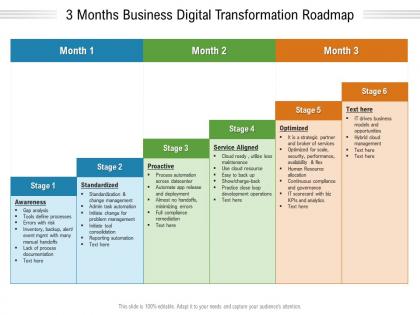
3 months business digital transformation roadmap




Try Before you Buy Download Free Sample Product
 Impress Your
 Audience
 100%
100% Editable
 Save Hours
 of Time


Visualize your work plan and communicate your ideas impactfully with our pre designed 3 Months Business Digital Transformation Roadmap. Showcase the detailed overview of the project, the key deliverables, and the milestones to be achieved with the help of our fully customizable PowerPoint layout. You can easily emphasize on the project goals and discuss all the activities involved in an easy to comprehend manner by utilizing our professionally designed PPT theme. This roadmap PowerPoint layout is a perfect strategic planning tool that can help in keeping the project on track. With our attractive PowerPoint theme, you can articulate the workflow, track the work progress, and have a clear vision of the goal to be achieved. Download this versatile 3 Months Business Digital Transformation Roadmap and save your hours of work.
People who downloaded this PowerPoint presentation also viewed the following :
3 months business digital transformation roadmap with all 2 slides:
Use our 3 Months Business Digital Transformation Roadmap to effectively help you save your valuable time. They are readymade to fit into any presentation structure.
FAQs for 3 months business
Look, you need five main things for your digital roadmap: figure out where you are now (most companies totally blow this off), decide where you're going, spot the gaps, prioritize what to tackle first, and set up ways to measure success. Map your current processes before you get distracted by flashy new tools - trust me on this one. Quick wins are your friend because they build momentum while you work on bigger changes. Don't forget timelines, budget, and honestly? Your people matter more than the tech. They'll either make it work or tank the whole thing.
So you'll need to check four main things: your tech setup, how you handle data, what skills your team actually has, and customer experience stuff. Most people use something like the Digital Maturity Model - or just make their own scorecard rating everything 1-5. Survey your people, take a hard look at your current tech, see if you're actually using data to make real decisions. Companies always think they're further along than they really are, which is annoying but totally normal. The trick is being honest about what sucks instead of patting yourself on the back for the good parts.
Honestly, stakeholders are like your GPS for this whole thing. They'll tell you what actually needs fixing vs what just sounds cool. Talk to customers, employees, leadership - everyone sees different problems. Your IT team might be drooling over some new tech stack, but if sales can't close deals because the CRM sucks, guess what takes priority? Each group knows where the real gaps are. I'd map out everyone who's gonna be affected and interview them first - trust me, it beats spending months building something nobody wants. Their input basically becomes your roadmap for what success looks like.
Honestly, I'd say every quarter with a bigger deep-dive once a year. Tech changes so damn fast - like, plans from six months ago already feel ancient sometimes. Quarterly reviews are perfect for tweaking timelines and fixing what's not working. Then annually you can look at new tech, budget stuff, all the big picture changes. Oh and set those calendar reminders right now! I always forget to do roadmap updates when I'm buried in actually doing the work. You want to stay flexible but not flip-flopping every month, you know?
Pick metrics that actually matter to your business goals. Customer stuff like NPS scores and how fast people adopt your digital tools. Operational things - automation rates, how quickly you ship products. Financial impact from digital channels and cost savings. Honestly, I've watched too many teams get obsessed with pointless numbers like "apps deployed" while completely missing what actually moves the needle. Choose 3-5 metrics max that tie directly to real outcomes. Figure out where you're starting from today, then set targets for the next 6-12 months. Keep it simple and track consistently.
Honestly, just map everything against business impact vs how hard it'll be to pull off. Quick wins are your best friend here - they buy you credibility for the bigger stuff later. Don't try doing everything at once (learned that the hard way). Pick things that actually move the needle on your main goals first. The fancy extras can wait. Get your executives on board early or you'll be fighting uphill battles. A simple scoring system works great - doesn't need to be complicated. Oh, and revisit your priorities every quarter because things change fast.
Honestly, the hardest part is dealing with people who hate change - your team will push back hard if they don't get why you're doing this. Budget's always tight too, and the payoff takes forever to actually show up. Oh, and legacy systems? Total nightmare trying to make old stuff play nice with new tech. Half your team probably doesn't have the skills you need either. Leadership support is make-or-break - without executives backing you, you're screwed. Don't try transforming everything at once though. Start with small wins, explain the reasoning constantly, and lock down that C-suite buy-in before you do anything else.
Honestly, you've gotta get people involved from the start - don't just dump changes on them. Have them actually help figure out what this looks like for their jobs. Keep explaining the why behind everything because people hate change when it feels random. The worst thing leadership does? Assuming everyone will magically be excited about it. Make sure there's real training during the transition, not just a PowerPoint. Oh, and find those naturally enthusiastic people in each team who can get others pumped up. Celebrate the small stuff too - it actually matters more than you'd think.
So honestly, cloud stuff and data analytics are kinda non-negotiable now regardless of what you do. If you're in manufacturing, IoT sensors are huge - plus automation tools obviously. Retail? You need solid e-commerce and ways to actually track customer data. Healthcare has to have secure patient portals and telemedicine (learned that one the hard way during COVID). Financial services - man, the AI fraud detection alone is worth it, plus everyone expects mobile banking now. Fintech moves crazy fast though. But real talk? Just tackle your biggest headache first, then expand.
Honestly, start with what your customers are actually complaining about - that's your best guide for digital transformation. I'd dig into support tickets, run some surveys, maybe even call a few customers directly (I know, terrifying lol). Look at their user data too. The stuff they keep bringing up over and over? That's gold. Companies waste so much money building fancy tech that sits there unused because they never asked what people actually wanted. Map those pain points to real projects you can tackle. Rank them by impact. Don't overthink it - just fix what's broken first, then get fancy later.
Map your digital stuff to what actually moves the needle - revenue, cutting costs, happier customers. Whatever your boss's boss cares about. Get department heads involved early so they feel ownership (trust me on this one). I've seen too many projects die because someone decided to chase the latest trendy tech without thinking it through. Build KPIs that connect to metrics executives already watch. Short check-ins are crucial since priorities shift constantly. You'll want room to pivot when - not if - things change direction.
Honestly, start by figuring out where you actually stand right now - analyze your current processes and what's bugging customers. Don't just guess at problems like most companies do (it's such a waste). Use that data to prioritize which changes will give you the biggest bang for your buck. Then track everything as you go - performance metrics, adoption rates, the works. Dashboards are your friend here. Set them up early so you're making real decisions instead of going with your gut. Course-correct fast when something isn't working. Sounds obvious but you'd be surprised how many people skip this part.
Dude, culture beats tech every single time. I've watched companies blow crazy money on shiny new systems while their people just... ignore them completely. Wild, right? Your team has to actually want change, or you're screwed from day one. Get people excited about trying new stuff and failing fast. Find those few employees who love change - they exist, I promise - and let them spread the excitement naturally. Skip the formal announcements and corporate BS. Just make experimenting feel normal and safe. That's honestly where the magic happens.
Honestly? Just pick ONE thing that's driving you crazy right now and fix that first. Don't go nuts trying to digitize everything - that's how projects die. Map out whatever process is eating up your time, then find some basic cloud tools that play nice with your current setup. Quick wins build momentum way better than those massive overhauls that take forever. Getting your team on board early is huge too, otherwise you'll be fighting resistance the whole way. Set a timeline that won't make everyone miserable. The whole point is making work suck less, not just buying shiny new software.
Dude, AI and IoT are completely changing how companies think about tech strategy. It's not optional anymore - this stuff is becoming essential infrastructure. Companies need to start planning for data way earlier since both technologies eat through massive amounts of it. The shift happened crazy fast, honestly caught a lot of people off guard. I'd say build in some pilot programs within your first 18 months, and definitely budget for training your team (most don't have these skills yet). Pick one real business problem first, then design your whole roadmap around proving that actually works.
No Reviews