


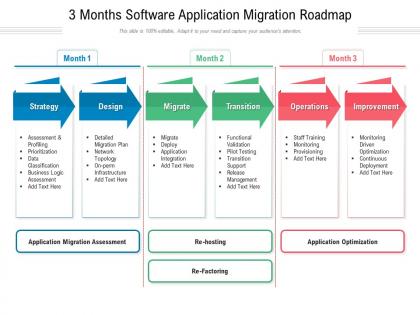
3 months software application migration roadmap




Try Before you Buy Download Free Sample Product
 Impress Your
 Audience
 100%
100% Editable
 Save Hours
 of Time


A cohesive work plan is essential for achieving the desired target. Communicate your vision and lay a firm ground in front of your audience with our PowerPoint layout. Align your project milestones, budgets, deliverables, deadlines, and all the requisite information for a dynamic presentation by employing this amazingly designed 3 Months Software Application Migration Roadmap. Maximize team efficiency and streamline a work plan efficiently by introducing our ready made roadmap PowerPoint theme. You can quickly establish coordination between different activities across the organization and present an insight to your colleagues by utilizing this useful business tool. Color code specific tasks, prioritize, and keep a close eye on the deadlines with the help of our eye catchy PowerPoint template. Download our 3 Months Software Application Migration Roadmap for excelling at productive management.
People who downloaded this PowerPoint presentation also viewed the following :
3 months software application migration roadmap with all 2 slides:
Use our 3 Months Software Application Migration Roadmap to effectively help you save your valuable time. They are readymade to fit into any presentation structure.
FAQs for 3 months software
Key software migration objectives include minimizing downtime, ensuring data integrity, maintaining system functionality, controlling costs, and preserving user experience throughout the transition. These priorities enable organizations to streamline operations while reducing risks, with many enterprises finding that strategic planning delivers faster deployment, enhanced performance, and sustained competitive advantage in increasingly complex digital environments.
Organizations assess migration readiness by conducting comprehensive system audits, evaluating technical dependencies, analyzing performance metrics, reviewing security compliance, and assessing user requirements. Through systematic assessment tools, businesses identify legacy bottlenecks, integration challenges, and resource allocation needs, while mapping current workflows and data structures, ultimately enabling strategic migration planning that minimizes disruption and maximizes operational efficiency.
Migration strategy selection depends on budget constraints, timeline requirements, technical complexity, business continuity needs, and long-term scalability goals. Organizations with tight deadlines often choose lift-and-shift for speed, while companies seeking competitive advantage prefer refactoring, with many finding that re-platforming offers the optimal balance between cost efficiency and modernization benefits.
Data integrity and security serve as foundational pillars throughout software migration, ensuring accurate data transfer, maintaining regulatory compliance, and protecting sensitive information during system transitions. These critical elements enable organizations to preserve customer trust, meet industry standards like HIPAA or GDPR, and minimize operational disruptions, with many enterprises finding that robust security frameworks ultimately deliver seamless migrations and sustained competitive advantage.
Organizations ensure minimal downtime during software migration through phased rollouts, comprehensive testing environments, and parallel system operations before full cutover. Strategic approaches like blue-green deployments enable banks and hospitals to maintain critical services while transitioning, with many finding that automated rollback procedures and real-time monitoring ultimately deliver seamless migrations and enhanced operational continuity.
Data migration best practices include thorough data assessment, comprehensive backup creation, phased migration approach, rigorous testing protocols, and detailed rollback planning. These strategies streamline transitions by minimizing downtime, ensuring data integrity, and reducing operational risks, with many organizations finding that careful pre-migration validation and stakeholder communication ultimately deliver seamless platform transitions and enhanced system performance.
Teams can effectively communicate migration changes through regular status updates, stakeholder-specific dashboards, structured feedback sessions, and transparent timeline documentation. These communication strategies streamline decision-making by providing real-time visibility into progress, addressing concerns proactively, and maintaining stakeholder alignment, with many organizations finding that consistent communication reduces migration risks and accelerates user adoption.
Essential software migration tools include automated migration platforms, data mapping software, dependency analyzers, performance monitoring systems, and rollback mechanisms. These technologies streamline the process by minimizing manual errors, ensuring data integrity, and providing real-time insights, with many organizations finding that strategic tool selection reduces migration timelines by up to 40% while maintaining operational continuity.
Organizations evaluate post-migration total cost of ownership by analyzing operational expenses, maintenance costs, licensing fees, training requirements, and infrastructure updates. Through comprehensive cost tracking across departments, businesses can measure reduced IT overhead, improved system efficiency, and enhanced productivity gains, with many finding that strategic migration delivers significant long-term savings despite initial investment.
Post-migration training mechanisms include role-based workshops, interactive tutorials, comprehensive documentation, peer mentoring programs, and dedicated help desk support. These approaches streamline user adoption by addressing specific workflow changes, providing hands-on practice opportunities, and ensuring continuous assistance, with many organizations finding that combining formal training with ongoing peer support ultimately delivers faster productivity recovery and enhanced system utilization.
Organizations should prioritize system migration based on business criticality, technical complexity, interdependencies, and potential ROI, starting with less complex applications that deliver quick wins. Many companies find success migrating customer-facing applications first, followed by core business systems, while considering factors like compliance requirements, data sensitivity, and operational risk, ultimately building momentum through early successes before tackling mission-critical infrastructure.
Common software migration challenges include data integrity issues, system compatibility conflicts, user resistance, downtime concerns, and budget overruns. These obstacles can be mitigated by conducting thorough pre-migration assessments, implementing phased rollout strategies, and providing comprehensive staff training, with many organizations finding that detailed planning and stakeholder engagement ultimately deliver smoother transitions and reduced operational disruption.
Organizations measure software migration success through performance metrics like system uptime, response times, and user adoption rates, alongside cost analysis comparing pre and post-migration operational expenses. Key indicators include reduced downtime, improved processing speeds, enhanced security compliance, and user satisfaction scores, with many enterprises finding that successful migrations deliver 20-30% operational efficiency gains and measurable competitive advantages.
Cloud adoption fundamentally transforms software migration strategies by enabling phased migrations, reducing infrastructure dependencies, and providing scalable testing environments for risk mitigation. This shift allows organizations to leverage containerization, microservices architectures, and automated deployment pipelines, with many enterprises finding that cloud-first approaches significantly accelerate migration timelines while minimizing operational disruptions.
Organizations ensure regulatory compliance during migration through comprehensive audit trails, data encryption protocols, access controls, and validation testing at each phase. Financial services and healthcare institutions particularly benefit from phased migration approaches that maintain continuous compliance monitoring, enabling seamless regulatory adherence while minimizing operational disruptions and audit risks.
-
Informative design.
-
Editable templates with innovative design and color combination.
-
It saves your time and decrease your efforts in half.
-
Graphics are very appealing to eyes.