

3 months employee training and mentoring roadmap




Try Before you Buy Download Free Sample Product
 Impress Your
 Audience
 100%
100% Editable
 Save Hours
 of Time


Utilize our pre build 3 Months Employee Training And Mentoring Roadmap to present your plan of action in the most effective way. Reduce the paperwork and showcase how different activities are linked to each other by incorporating this attention grabbing PowerPoint theme. This completely editable roadmap PPT layout is suitable to fit all your needs and to have a structured outline of the entire process flow using color coding. Provide guidelines to your teammates about the progression process by employing our PPT theme. Team members can easily be designated into teams by accessing the work milestones to be accomplished within the timeframe. You can easily modify the PowerPoint slide according to real time situations. Download our stunning 3 Months Employee Training And Mentoring Roadmap, and you are good to go to prove your expertise in strategic planning.
People who downloaded this PowerPoint presentation also viewed the following :
Content of this Powerpoint Presentation
Employee training and mentoring can be so easily overlooked in an organization that most businesses end up giving them very little attention. Yet, this has adverse consequences that threaten the very existence of business. This happens because without being given training as soon as they join, employees tend to become jaded, lazy, and stop thinking.
Hence, training on joining must be a mandatory exercise for all businesses. It must be carefully recorded and results monitored. The numbers and the good results will surprise.
Solve your training problems in the minutest of details with this employee training timeline with task and session details.
In this blog, we talk about a template that provides users and businesses with a content-ready presentation on 3-month employee training.
With this in their library, businesses do not have to refer to another resource on the internet as a solution for drawing up a roadmap and mentoring plan for new employees.
This wonderfully-designed, clutter-free design also saves businesses the headache of drawing and designing a PPT or any software. Our USP is our content and the ready-made training roadmap.
This workforce training playbook roadmap is a must for your library.
Each of the templates is also 100% customizable and editable, giving you both structure and a starting point.
Let’s explore!
Template 1 Three-Month Employee Training and Mentoring Roadmap
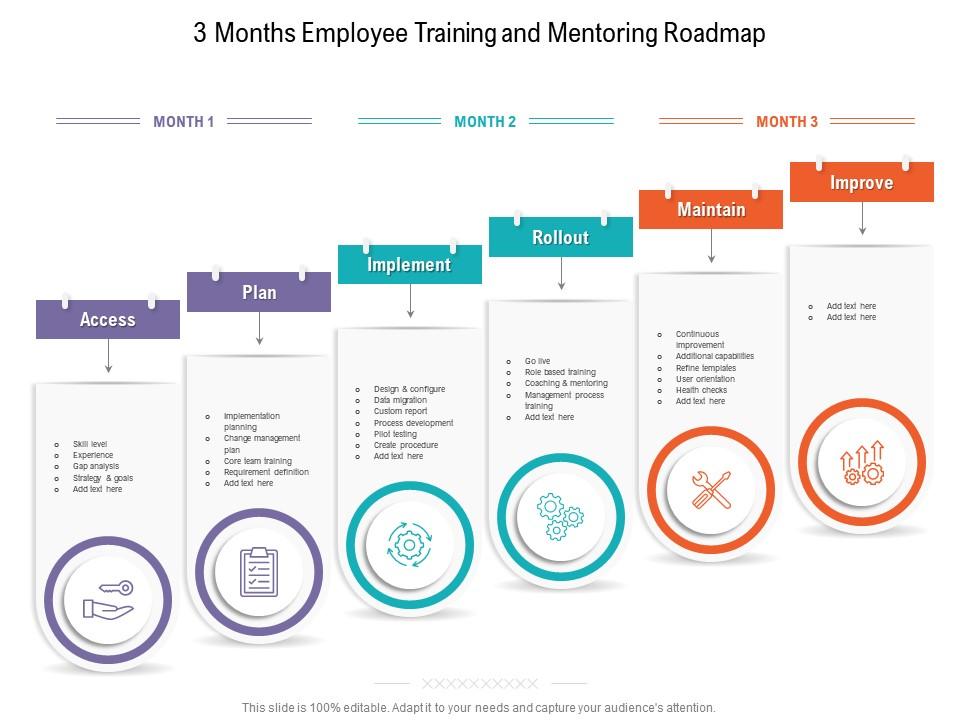
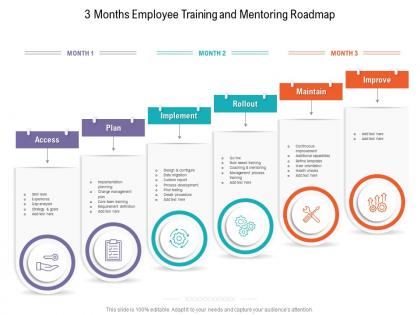
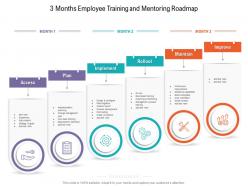
In six segments of 15 days each, this PPT Template outlines the perfect employee training and mentoring roadmap that businesses can ask for. This is a ready-made slide to help you streamline your employee training. Incorporate this professional and appealing PPT Slide to monitor activities involved in managing and training an organization’s employees in their first three months of the job. The steps an employee must take to join are access, plan, implement, rollout, maintain, and improve. Deploy this ready-made PowerPoint Template and simplify your training and mentoring of employees to ensure their bonding is deep and they enjoy working with you over the first three months of your opening. You can use this PowerPoint Template to outline tasks involved in the training steps as well. For instance, in the access stage, the focus is on understanding the employees’ skill level and experience. In the plan, you take verifiable steps and action to see how to reduce or limit these, and so on. The icons with each of the stages add to the appeal of the process and give us a clear idea of what the process entails. Get this template now!
TRAINING MATTERS MOST, ESPECIALLY FOR NEW HIRES
In any business, the quality of training determines the quality and efficacy of the goods and services produced. This is even more critical when employees have just joined and wait for instructions with energy and verve. The first three months of training, or the lack of it, determines the status of the employees and orients them to a fruitful career. Hence, download this template to train them well.
PS Get the best world-class employee training plans with a click here.
3 months employee training and mentoring roadmap with all 2 slides:
Use our 3 Months Employee Training And Mentoring Roadmap to effectively help you save your valuable time. They are readymade to fit into any presentation structure.
FAQs for 3 months employee training
Honestly, 360-degree feedback works really well - gets you the full picture. Skills assessments are solid too, plus performance reviews that dig into actual competencies instead of just results. Mix manager observations with self-assessments because we're all pretty terrible at spotting our own weak points. Those regular one-on-ones? Gold mine if you ask the right questions about what's tripping people up. Oh, and definitely look at your business goals first and figure out what gaps you need to fill. Just pick one method to start though - nobody wants to get bombarded with assessments right off the bat.
Honestly, just survey people first about how they like to learn. Some are super visual and need videos. Others want podcasts they can listen to while commuting. Then you've got the hands-on people who need workshops or simulations - they can't just sit through a lecture, you know? Don't make my old company's mistake of doing boring one-size-fits-all sessions that nobody retained. Mix it up with self-paced options too since introverts hate being put on the spot in groups. I'd start small though - pick one training topic and try three different formats to see what actually works before going crazy with it.
Honestly, mentorship is huge for career growth. You get real advice from someone who's been there, not just cookie-cutter training stuff. Your mentor actually knows the office drama and can help you navigate all that weird unspoken politics - which is half the battle, honestly. The feedback is way more honest too. Plus they'll point out career paths you probably never even thought about. I've seen people's confidence totally transform when they have someone genuinely invested in their success. If you're thinking about starting something like this, don't overthink it. Just match up a few people who want to participate and see what happens.
Honestly, tech can make your training way less painful. Start with an LMS to track everyone's progress - way better than spreadsheets, trust me. VR simulations are actually getting decent for technical stuff, though still pricey. Mobile apps work great since people can squeeze in lessons during lunch or whatever. AI platforms will spot skill gaps and suggest courses automatically, which is pretty neat. Video calls mean you can get expert trainers without flying them in. My advice? Pick whatever part of your current training sucks the most and try one tech solution there first.
So basically you want to compare what you spent on training against real business results. Track stuff like retention rates, how productive people got, promotion numbers - that kind of thing. Customer satisfaction too if it was customer-focused training. The annoying part? You can't always tell what improved because of your program vs other random factors happening at work. It gets messy. But honestly, even ballpark numbers beat having zero clue if it worked. I'd just pick 2-3 metrics that actually match your goals and track them before/after. Way better than nothing.
Honestly, AI-powered personalized learning is huge right now. Companies are ditching those old role-based training programs for skills-focused stuff instead. Micro-learning's where it's at too - nobody has time for day-long seminars anymore (thank god). Remote platforms aren't going anywhere, obviously. Peer-to-peer learning is getting big because it's way cheaper than hiring new people. Oh, and mental health support? That's basically mandatory now. You should probably take a look at what you're doing currently and see where you can squeeze these things in.
Be the example first - talk about what you're learning, books you're reading, whatever. I messed this up early on because my team was scared to admit they didn't know stuff. Set up regular sessions where people share cool things they've discovered. Actually give them real time to learn, not just "when you're free" (spoiler: they're never free). Celebrate the attempts, even when things go sideways. Oh, and ask each person what they want to learn this quarter - sounds obvious but most managers skip this step. The psychological safety thing is huge though.
Show them how training connects to where they actually want their careers to go - that's huge. Flexible timing is everything since everyone's swamped. Lunch sessions work surprisingly well (free food is basically magic). Your managers need to be the cheerleaders here, not just sending calendar invites and disappearing. When someone finishes a program or uses what they learned? Make noise about it. Public recognition motivates way more people than you'd think. Oh, and keep sessions short - nobody has time for day-long workshops anymore. Make it feel worth their time, not like homework.
Honestly, most companies totally screw this up by doing generic leadership workshops that don't connect to anything real. Start with your big goals for the next few years first. Expanding internationally? Focus on language skills or cultural training. Going digital? Tech skills obviously. Then create individual development plans that actually tie each person's growth to specific business results - like revenue targets or market share. I learned this the hard way at my last job. Track both employee progress AND how it's moving your key metrics. Otherwise you're just throwing money at feel-good training that doesn't matter.
Honestly, investing in your people is like the cheat code for retention. When employees see you care about their growth - through training, mentorship, whatever - they stick around way longer. It's pretty obvious when you think about it. Nobody wants to feel stuck in a dead-end job. Development keeps people mentally engaged too, which is half the battle. You don't need some fancy program either. Just sit down with folks, figure out what they want career-wise, and help them get there. Even basic development plans make people feel way more connected to the company.
Skip the yearly review thing - it's basically useless by then. Monthly or quarterly check-ins work way better. Get feedback from all directions too - managers, coworkers, people they manage if applicable. Honestly, most companies mess this up by waiting until performance reviews to say anything meaningful. Oh, and tie it to specific goals they're actually working on, not just vague "how's it going" chats. The whole point is catching stuff early so they can actually fix it. Makes such a huge difference when people aren't blindsided months later.
Ugh, budget issues are the worst - you're always fighting for money. Getting the higher-ups to care about stuff that won't pay off immediately? Good luck with that. Managers hate letting people step away from their regular work too, even for an hour. Honestly, the hardest part might be that everyone learns differently but you're expected to create these blanket programs. Measuring if anything actually worked is nearly impossible btw. My suggestion? Try small pilot programs first. Focus on obvious skill gaps and track whatever numbers your executives obsess over. Way easier to expand something that's already working.
Here's the thing - frontline employees care way more about development than their bosses do. For leadership, training programs are just retention tools or something to check off a list. But your frontline staff? They see it as their ticket out. Skills training and mentorship aren't nice extras - they're how these workers get better pay and actually move up. Without development opportunities, they're basically trapped in the same job forever. That's why any program you build needs clear paths to promotion, not just generic training. Make it about real advancement opportunities they can use right away.
Honestly, start with digital literacy - your team has to get comfortable with basic tech and data stuff. Critical thinking matters more than ever since robots are doing all the boring tasks now. Adaptability is huge too because everything changes ridiculously fast these days. Don't sleep on communication skills, especially with remote work being everywhere. Creativity and emotional intelligence? Those are our superpowers that AI can't touch. Oh, and definitely do a skills assessment first - no point building training programs if you don't know where people actually struggle.
Honestly, mixing departments for training is way better than keeping teams stuck in their own bubbles. Your marketing people can pick up project management tricks from IT, while the tech folks learn how to actually explain things clearly. It's just more interesting than the usual boring workshops - plus people start building real connections across the company. The best part? Everyone suddenly gets how their piece fits into the whole puzzle. I'd try pairing up different teams for joint sessions or maybe tackle some cross-functional projects together. Way more engaging than the standard training stuff.
-
Informative presentations that are easily editable.