


3 months business planning timeline




Try Before you Buy Download Free Sample Product
 Impress Your
 Audience
 100%
100% Editable
 Save Hours
 of Time


A business plan is a set of actions or process that describe how an organization run and business plan consists of describing the organization products and services. You can explain different types of business plan that is essential for an organization to accomplish its goal or to complete any project by taking help of 3 Months Business Planning Timeline presentation slide. Business marketing strategy PPT is an effective way to discuss all the strategies and tips to do any business. The strategic business plans template helps in discussing the different techniques, tools, and process with your team to achieve any target. You can guide your team about detailed theories and methods of sales planning and selling by taking help of the business planning process template. You can share the vision and mission of your organization with your team or stakeholders. With the help of business marketing planning slide, you can give an overview of the specific market segments which your organization is targeting. You can share the threats with your team which may affect your organization's business planning by taking help of 90 days business planning presentation template. An air of harmony develops due to our 3 Months Business Planning Timeline. Friendly feelings begin to flow.
People who downloaded this PowerPoint presentation also viewed the following :
Content of this Powerpoint Presentation
Description:
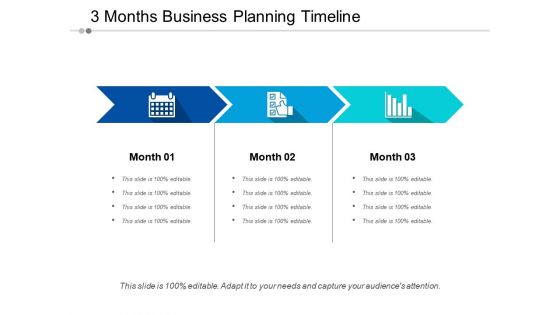
The image shows a PowerPoint slide titled "3 Months Business Planning Timeline," structured to outline a quarterly business plan. The slide is segmented into three main columns, each representing a month with a unique icon at the top: a calendar for Month 01, a thumbs-up for Month 02, and a bar chart for Month 03. Below each icon is space for adding text, indicating that the slide is meant to be customized with specific actions or milestones for each month of the quarter.
Use Cases:
This slide can be effectively utilized in various industries for strategic planning, project management, and reporting:
1. Software Development:
Use: Outlining product development phases.
Presenter: Project Manager.
Audience: Development team, stakeholders.
2. Marketing:
Use: Scheduling marketing campaigns and activities.
Presenter: Marketing Director.
Audience: Marketing team, sales representatives.
3. Construction:
Use: Planning project milestones and deliverables.
Presenter: Construction Manager.
Audience: Contractors, clients, architects.
4. Education:
Use: Mapping out academic and administrative timelines.
Presenter: Academic Coordinator.
Audience: Faculty, administrative staff.
5. Financial Services:
Use: Detailing financial close processes or compliance deadlines.
Presenter: Compliance Officer.
Audience: Finance department, auditors.
6. Retail:
Use: Planning for product launches, sales, or inventory cycles.
Presenter: Retail Operations Manager.
Audience: Store managers, merchandising teams.
7. Event Management:
Use: Tracking preparation stages for upcoming events.
Presenter: Event Planner.
Audience: Vendors, event staff, clients.
3 months business planning timeline with all 5 slides:
Correct the injudicious with our 3 Months Business Planning Timeline. Deter them from hurried decisions.
FAQs for 3 months
So there are basically four phases you'll want to hit: research and analysis (market stuff, checking out competitors), then strategy development where you nail down your business model and goals. Financial planning comes next - projections, figuring out funding needs, all that fun stuff. Finally implementation planning with your operational details and timelines. Here's the thing though - most people totally skip over the research phase properly, but honestly that's what makes or breaks everything. Each phase usually takes 2-4 weeks depending on how complex your business is. You're looking at 2-3 months total for something solid. Just start with research first - can't build anything decent without knowing your market inside out.
Honestly? Most businesses do best with 1-3 years - gives you enough runway without being totally unrealistic. Tech moves so crazy fast though, so maybe 12-18 months max if that's your world. Manufacturing can probably stretch longer since things don't shift as much. I'd start with annual planning and check in quarterly. Those 5-year plans usually just end up in a drawer somewhere collecting dust anyway! The sweet spot is whatever timeframe you can actually predict without just making stuff up. Market conditions change, your data gets stale - you know how it goes.
Dude, break it down into chunks or you'll go crazy. Months 1-2: market research and validation - boring but necessary. Then tackle your financial stuff and funding strategy around months 3-4. Most people skip ahead here and totally regret it. Months 5-6 should be operational planning - hiring, systems, legal headaches, all that fun stuff. Save launch goals and marketing for months 7-8. Honestly everything's gonna take way longer than you expect, so don't be too ambitious with timing. Write down specific targets for each phase and check in weekly. Sounds obvious but it actually helps keep you from spiraling.
Honestly, you gotta do market research FIRST - before you get attached to any business idea. Spend like 2-4 weeks digging into your competitors, target customers, industry stuff. I know it sounds boring but trust me, skipping this is how people end up with products nobody wants. Make a simple template so you don't get overwhelmed by all the data. Everything else builds off this - your pricing, marketing plan, even your financial projections. Way better than realizing six months in that you totally misread the market.
Honestly, put most of your time into market research first - like 60% of it. Way more valuable than getting lost in business plan details. Set aside some money for basic stuff like surveys or quick prototypes to test if people actually want what you're building. The relationship building part is huge too - start talking to potential customers now, not later. I probably sound like a broken record about this, but don't stress too much about getting the perfect resource split. You'll figure out what works as you go and can shift things around.
Quarterly reviews are the bare minimum, but monthly check-ins work way better if you can manage it. Things change so damn fast now - what looked solid three months back could be totally irrelevant today. Monthly meetings are just quick status updates on progress and any issues. Save the quarterly ones for big picture stuff like shifting major deadlines or budget changes. Honestly, if you're in startup mode or some crazy volatile industry, bi-weekly isn't overkill. Just throw a recurring meeting on your calendar now before you forget.
Look, forecasting is just putting real numbers on your business ideas so you're not flying blind. Map out when revenue should start flowing and when you'll need more cash - trust me, those scary dips will happen. Conservative estimates are your friend here. The cool thing? These become your measuring stick for whether you're actually on track or need to pivot. Set up quarterly check-ins because your projections will definitely be wrong somehow. But that's fine - better to plan with numbers than just wing it and hope for the best.
Seriously, visuals are a game changer for timelines. Gantt charts and flowcharts help people actually get what you're talking about instead of just staring at walls of text. I learned this the hard way after watching too many eyes glaze over during presentations lol. Color coding works great for showing priority phases. You can throw in icons for different departments and progress bars to track where things stand. If you're presenting on a screen, interactive stuff is pretty cool too. Just pick one format and stick with it - people hate when slides are all over the place visually.
Honestly, the worst thing people do is being way too optimistic about timing. Market research drags on forever, your designer gets the flu for a week, or some "quick" financial model becomes this massive Excel headache. Plus you can't predict everything upfront anyway - nobody's that good! Start with your main assumptions and adjust as you go. I always tell people to add like 20-30% buffer time to every big milestone. Sounds excessive but trust me, you'll need it. Oh and definitely do regular check-ins to see if your timeline still makes sense once you actually know what you're doing.
Honestly, dive into market research first - you can't wing business decisions without knowing what you're up against. Financial projections come next since they'll basically dictate your entire plan. Do the brutal stuff while you're still caffeinated! Marketing strategy and operations follow after that. Here's the weird part: write your executive summary dead last, even though it goes at the front of the document. Company description and those easier sections? Perfect for when your brain's fried later. Oh, and actually set deadlines for each chunk or you'll procrastinate forever.
Honestly, Gantt charts are where it's at for business timelines. Asana and Monday.com are my go-tos - super visual and intuitive. Smartsheet's solid too. Microsoft Project is powerful but kinda overkill unless you're managing huge projects. Trello's perfect if you want something dead simple with those card things. My cousin actually swears by just using Google Sheets, which sounds insane but somehow works for her team. The real trick? Pick whatever your people will actually stick with. Download a few free trials and test drive them. Most of these tools look great in demos but feel totally different when you're actually using them day-to-day.
Dude, legal stuff will mess up your timeline if you don't plan for it. I'm talking business registration, permits, licenses - all that boring paperwork takes forever. Our food truck permit? Six weeks instead of two, which was super annoying. Contracts and partnerships are even worse since there's back-and-forth negotiations. Start everything legal way early, like right when you begin planning. Don't wait until the end or you'll be screwed. Also get a decent business lawyer involved from day one - they'll tell you exactly what hoops you need to jump through.
Look, getting stakeholders involved from the start is a total game-changer. They actually care about making things happen when they've had a say in building the plan. Short sentences work. But here's what really matters - these people know stuff you don't about realistic timelines and potential roadblocks, especially the ones doing the actual work. I learned this the hard way on a project last year. You'll avoid those nasty surprises that derail everything. Figure out who your key players are early, then create real moments for input. Not just "here's what we're doing" presentations, but actual collaboration where you're listening.
Honestly, you've gotta bake this stuff into your planning right from day one. Get those industry reports, follow the big names on LinkedIn, set up Google alerts - the usual suspects. I carve out like an hour monthly just to scroll through what's happening (mind-numbing but whatever, it works). Watch what competitors are doing too. Seasonal stuff can totally mess with your timeline if you're not paying attention. Here's the thing though - update your plan every quarter based on what you're actually seeing. Don't just write it once and call it done. Start with maybe 3-5 solid sources you'll actually check regularly.
Track different stuff for each phase since they're doing totally different jobs. Research phase? Focus on data quality and market validation - customer interviews, competitor deep-dives, that kind of thing. Planning gets more about hitting milestones and keeping stakeholders happy. Execution's where the real numbers matter - revenue, customer acquisition costs, team productivity. Ugh, I've seen so many founders get obsessed with metrics that look good in presentations instead of ones that actually teach you something. My old boss did this constantly. Start simple, track what moves the needle, add complexity later when you're not drowning.
No Reviews