


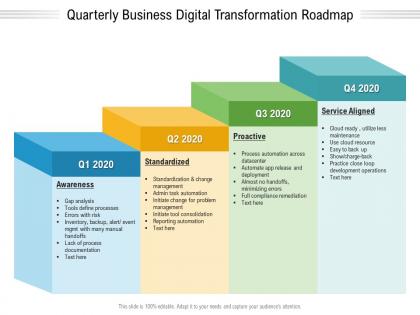
Quarterly business digital transformation roadmap




Try Before you Buy Download Free Sample Product
 Impress Your
 Audience
 100%
100% Editable
 Save Hours
 of Time


Visualize your work plan and communicate your ideas impactfully with our pre designed Quarterly Business Digital Transformation Roadmap. Showcase the detailed overview of the project, the key deliverables, and the milestones to be achieved with the help of our fully customizable PowerPoint layout. You can easily emphasize on the project goals and discuss all the activities involved in an easy to comprehend manner by utilizing our professionally designed PPT theme. This roadmap PowerPoint layout is a perfect strategic planning tool that can help in keeping the project on track. With our attractive PowerPoint theme, you can articulate the workflow, track the work progress, and have a clear vision of the goal to be achieved. Download this versatile Quarterly Business Digital Transformation Roadmap and save your hours of work.
People who downloaded this PowerPoint presentation also viewed the following :
Quarterly business digital transformation roadmap with all 2 slides:
Use our Quarterly Business Digital Transformation Roadmap to effectively help you save your valuable time. They are readymade to fit into any presentation structure.

FAQs for Quarterly business
Key components include strategic vision alignment, technology infrastructure assessment, change management frameworks, employee training programs, and performance measurement systems. These elements work together by establishing clear objectives, identifying capability gaps, and ensuring organizational readiness, with many companies finding that integrated approaches deliver faster implementation, reduced resistance, and ultimately sustainable competitive advantage in increasingly digital markets.
Organizations assess digital maturity through comprehensive audits evaluating technology infrastructure, data capabilities, workforce skills, customer engagement channels, and operational processes. These assessments typically involve stakeholder interviews, system inventories, and benchmarking against industry standards, with many companies finding that structured maturity frameworks help identify gaps, prioritize investments, and create phased transformation strategies that deliver measurable competitive advantages.
Stakeholder engagement ensures digital transformation roadmaps align with diverse organizational needs, secure necessary buy-in, and identify potential implementation challenges early. Through collaborative workshops, feedback sessions, and cross-departmental input, organizations streamline adoption processes, minimize resistance, and ultimately deliver solutions that enhance operational efficiency across departments, with many finding that engaged stakeholders become transformation champions.
Businesses can prioritize digital transformation initiatives by assessing impact potential, implementation complexity, resource requirements, and alignment with strategic objectives. Organizations typically focus on customer-facing improvements first, such as e-commerce platforms or mobile applications, followed by operational enhancements like automation and data analytics, ultimately delivering competitive advantage and measurable ROI.
Digital transformation success metrics include customer satisfaction scores, operational efficiency ratios, revenue growth from digital channels, employee productivity measures, and time-to-market improvements. These indicators enable organizations to track progress across multiple dimensions, with many companies finding that combining financial performance data with user experience analytics delivers the most comprehensive view of transformation impact.
Organizations ensure alignment by establishing clear governance frameworks, conducting regular strategy reviews, and creating cross-functional teams that include both IT and business stakeholders. Through integrated planning processes, companies can prioritize digital investments based on ROI potential, customer impact, and competitive advantage, with many enterprises finding that quarterly alignment sessions and shared KPIs ultimately deliver measurable business outcomes.
Critical technologies for digital transformation roadmaps include cloud computing, artificial intelligence, data analytics, automation platforms, and customer relationship management systems. These technologies work together by streamlining operations, enhancing decision-making capabilities, and improving customer experiences, with many organizations finding that strategic integration of these elements delivers competitive advantage and measurable operational efficiency across all business functions.
Change management practices support digital transformation execution by addressing employee resistance, facilitating skills development, ensuring clear communication, and creating structured adoption processes. Through strategic training programs, stakeholder engagement, and phased implementation approaches, organizations streamline technology integration while maintaining productivity, with many companies finding that proactive change management reduces transformation timelines by 40% and significantly enhances employee buy-in.
Organizations should avoid rushing implementation without proper change management, underestimating employee training needs, neglecting data security protocols, and failing to align initiatives with business objectives. Many companies find that inadequate stakeholder communication, insufficient budget planning, and attempting too many changes simultaneously ultimately derail progress, making phased approaches with clear success metrics essential for sustainable transformation.
Customer experience significantly shapes digital transformation priorities by identifying pain points, defining technology investments, and establishing success metrics that align with user expectations. Organizations increasingly find that customer feedback drives their adoption of omnichannel platforms, AI-powered personalization, and self-service portals, ultimately delivering faster response times and seamless interactions while maintaining competitive advantage in experience-driven markets.
Digital transformation frameworks include McKinsey's Digital Quotient, MIT's Digital Transformation Framework, Gartner's Digital Business Transformation Model, Deloitte's Digital Maturity Model, and design thinking methodologies. These approaches streamline transformation by assessing current capabilities, identifying strategic priorities, and establishing clear implementation phases, with many organizations finding that structured frameworks accelerate their digital initiatives while minimizing risks.
Organizations can leverage data analytics to inform digital transformation by identifying process inefficiencies, predicting customer behaviors, measuring technology ROI, and uncovering automation opportunities through comprehensive data analysis. Through advanced analytics platforms, companies in sectors like retail and manufacturing streamline operations, enhance customer experiences, and accelerate decision-making processes, ultimately delivering competitive advantages and measurable business outcomes.
Employee training and skill development serve as the foundation for successful digital transformation, encompassing technical competencies, change management capabilities, digital literacy, and collaborative workflows. These investments enable organizations to maximize technology adoption, reduce resistance to change, and accelerate implementation timelines, with many companies finding that comprehensive training programs deliver significantly higher ROI and sustained competitive advantage.
SMEs can approach digital transformation more strategically by focusing on scalable, cost-effective solutions like cloud-based platforms, automated workflows, and customer relationship management systems, rather than enterprise-wide overhauls. While larger corporations implement comprehensive transformations across multiple departments simultaneously, SMEs benefit from phased approaches, starting with core operations like accounting or customer service, ultimately delivering faster implementation and measurable ROI with greater operational agility.
Organizational culture significantly impacts digital transformation success by influencing employee adoption, change resistance, and innovation willingness throughout the implementation process. Companies with collaborative, adaptive cultures see faster technology integration and smoother workflows, while rigid cultures often struggle with new processes, ultimately determining whether digital initiatives deliver competitive advantage and operational efficiency.
No Reviews