


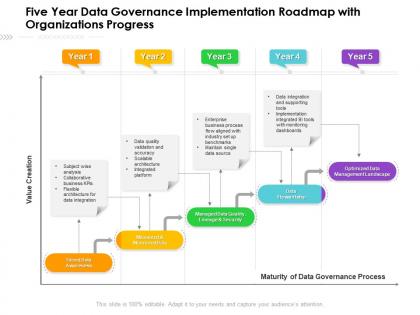
Five year data governance implementation roadmap with organizations progress




Try Before you Buy Download Free Sample Product
 Impress Your
 Audience
 100%
100% Editable
 Save Hours
 of Time


Utilize our pre build Five Year Data Governance Implementation Roadmap With Organizations Progress to present your plan of action in the most effective way. Reduce the paperwork and showcase how different activities are linked to each other by incorporating this attention grabbing PowerPoint theme. This completely editable roadmap PPT layout is suitable to fit all your needs and to have a structured outline of the entire process flow using color coding. Provide guidelines to your teammates about the progression process by employing our PPT theme. Team members can easily be designated into teams by accessing the work milestones to be accomplished within the timeframe. You can easily modify the PowerPoint slide according to real time situations. Download our stunning Five Year Data Governance Implementation Roadmap With Organizations Progress, and you are good to go to prove your expertise in strategic planning.
People who downloaded this PowerPoint presentation also viewed the following :
Five year data governance implementation roadmap with organizations progress with all 2 slides:
Use our Five Year Data Governance Implementation Roadmap With Organizations Progress to effectively help you save your valuable time. They are readymade to fit into any presentation structure.
FAQs for Five year data governance implementation roadmap
Four things you need: data stewardship (someone owns it), clear policies everyone follows, quality management, and actual processes. Technology tools are huge too - honestly, most frameworks crash because they're just fancy presentations nobody uses. Roles need to be super clear, and you'll want metrics to track if it's working. My advice? Pick one small area first, show it works, then grow from there. The whole thing falls apart if people find workarounds easier than following your system.
So there's this thing called a data governance maturity assessment - sounds fancy but it's basically just rating yourself on stuff like data quality, policies, who does what, and your tech setup. DAMA-DMBOK is pretty solid, or honestly just find a template online because who has time to build one from scratch? Rate everything 1-5 based on how formal your processes actually are. Here's the thing though - you gotta be real about where you suck, not where you wish you were. I've seen too many teams lie to themselves here. Once you've got those scores, tackle the worst areas first.
Data stewards are your go-to people who actually make governance happen day-to-day. They know the data inside and out, spot problems early, and make sure those fancy policies don't just collect dust. Honestly, they're probably already doing this stuff informally - you just need to find them and give them the official title. Without these folks, your beautiful roadmap becomes another forgotten presentation. They're what connects your big-picture strategy to reality. I'd say identify them early because they're the ones who'll save your butt when data quality goes sideways.
Just take whatever compliance stuff you're already doing (GDPR, HIPAA, whatever) and make that the backbone of your data governance. Way smarter than building from zero. First, list out all the regulations you're stuck with anyway, then wrap your governance around those existing rules. Your compliance team should be in the room from the start - trust me, you don't want them showing up later saying "uh, that won't work." Most of these frameworks already cover data classification and access controls. Pro tip: document how each control maps to specific regulations. Makes audits way less painful and you can actually show this thing pays for itself.
Honestly, you need to watch both the technical stuff and business side to know if it's actually working. Data quality scores are your bread and butter - accuracy, completeness, whether things match up across systems. Track adoption rates too, like who's using your data catalog (hint: probably fewer people than you think at first). Time saved on data prep and faster decisions show real business impact. User satisfaction surveys matter because nobody follows governance they hate. Pick maybe 3-5 metrics tops and check monthly. Start simple - you can always get fancy later.
Ok so first thing - get your main people involved from day one. Data owners, business folks, IT, executives. Don't just do boring PowerPoint meetings though. Actually let them talk and share what's bugging them about data right now. I swear, most governance projects crash because they feel like some consultant's pet project instead of solving real problems. Show them how this fixes their headaches - like actually finding data they can trust or dealing with compliance stuff. Quick wins are huge for keeping people interested. Oh and speak normal English, not corporate jargon. Treat them like partners, not obstacles.
Honestly, start small or you'll go crazy. Get a data catalog first - Alation or Collibra work well for mapping what you actually have (spoiler: it's way more scattered than you think). Data lineage tools help track where everything flows, which is super handy when things break. Great Expectations or Talend are solid for quality monitoring. Oh, and you definitely need access controls so random people aren't poking around sensitive stuff. The metadata management part can't be skipped either. But seriously, don't try tackling everything at once. Pick one messy area and show it actually works before expanding.
So basically you're drowning in bad data and need a game plan, right? A roadmap helps you figure out where all your data mess actually comes from instead of just scrambling to fix random problems. Map out your current data flows first - trust me, you'll be shocked at how tangled everything is. Then tackle the stuff that's making your team want to quit daily. The key thing is getting people to actually own their data instead of everyone pointing fingers when something breaks. It's like cleaning your house room by room rather than just shoving everything in closets.
Honestly, getting leadership on board is the worst part - they hear "data governance" and immediately think red tape. departments hoard their data like it's gold or something. Breaking down those silos takes forever because everyone's protective of their turf and doesn't want to follow new rules. Legacy systems make it even messier since they weren't designed for this stuff. Cultural pushback is brutal too. My take? Don't go big right away. Pick one department for a pilot, show some wins, then expand from there. Way less painful than trying to overhaul everything at once.
Yeah, totally doable - actually works better when you tackle both at once. Build privacy right into your governance setup from day one so it's just automatic. Classify your data by how sensitive it is, then set access controls accordingly. Trust me, trying to add privacy stuff later is such a pain in the ass. Regular privacy assessments should be baked into your policies. Set clear schedules for how long you keep different data types. The trick is making privacy a must-have, not something that gets in the way of good governance.
Honestly, three things worked for us: get leadership to actually walk the walk first. If your execs keep making gut decisions while preaching "data-driven," you're screwed from the start. Make sure people can easily grab the data they need - invest in decent self-service tools and maybe some quick training sessions. The biggest thing though? Celebrate wins publicly when someone makes a smart data call, even tiny ones. People notice what gets rewarded. Oh, and don't try to flip the whole company at once - pick one team as your guinea pig first to show it actually works.
Honestly, I'd check monthly for the first year - data stuff moves way too fast to wait longer. After that, quarterly works fine. Your roadmap will be wrong within weeks if you're not staying on top of new regulations and business changes. Monthly feels like overkill once you hit your stride, but early on? Trust me, those assumptions get stale quick. Just track your KPIs and be ready to pivot without going crazy with constant direction changes. Oh, and actually put those reviews on your calendar right now or you'll forget.
Honestly, the trick is making docs that don't suck to read. Use simple templates covering who does what and when - skip the corporate jargon nobody understands anyway. Real examples help way more than abstract explanations. Version control everything since policies change all the time (learned that one the hard way). Quick cheat sheets work better than dense formal documents for day-to-day stuff. People need something they'll actually pull up when confused, not another PDF collecting digital dust. Oh, and scenarios from actual work situations? Game changer.
Look, build data lineage right into your governance policies from day one - don't tack it on later. Map your most critical assets first, obviously. Then make lineage docs mandatory for any new pipelines or transforms. Trust me, it'll save you when stuff inevitably breaks. Data stewards need lineage tools to track flow and check impact before changing anything. Oh, and automate the capture wherever you can so it stays current without someone manually updating spreadsheets all day. The whole point is making it visible through dashboards so everyone can actually use it.
Honestly, good data governance is a game changer for your BI stuff. You'll stop having those annoying meetings where nobody knows which dataset to trust. Clean, consistent data means your dashboards actually show what's really happening instead of random nonsense. Plus everyone starts using the same definitions for things like "active customer" - sounds boring but it's huge. Compliance gets handled automatically too, which your legal team will love. I'd start simple though: just document what data you're currently using and get your stakeholders to agree on how you define your key metrics.
No Reviews