


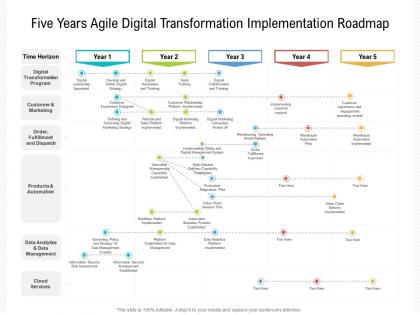
Five years agile digital transformation implementation roadmap





Try Before you Buy Download Free Sample Product
 Impress Your
 Audience
 100%
100% Editable
 Save Hours
 of Time


The success rate of business plans is hugely dependent on the plan of action, and this editable Five Years Agile Digital Transformation Implementation Roadmap rightly serves the purpose. Encapsulate all the information related to the project in a well structured manner to obtain maximum efficiency by incorporating our stunning PowerPoint theme. State the critical deliverable, steps involved, time frame, workforce allocation, and lots more in an easy to understand manner by utilizing this pre designed roadmap PowerPoint layout. You can also prioritize your tasks and discuss the problem areas with your colleagues by incorporating this tailor made PPT layout. Empower your work plan by employing this professionally designed PPT theme. Entrepreneurs can download Five Years Agile Digital Transformation Implementation Roadmap as a beneficial communication tool that facilitates in collaborating with different tasks and achieve targets.
People who downloaded this PowerPoint presentation also viewed the following :
Five years agile digital transformation implementation roadmap with all 2 slides:
Use our Five Years Agile Digital Transformation Implementation Roadmap to effectively help you save your valuable time. They are readymade to fit into any presentation structure.
FAQs for Five years agile digital
Agile principles driving digital transformation include iterative development, customer collaboration, cross-functional teams, continuous feedback loops, and adaptive planning. These methodologies streamline organizational change by reducing project risks, accelerating time-to-market, and enhancing customer experiences, with many enterprises finding that Agile frameworks ultimately deliver greater operational flexibility and competitive advantage in increasingly dynamic markets.
Organizations measure Agile digital transformation impact through key performance indicators like delivery velocity, time-to-market reduction, customer satisfaction scores, employee engagement metrics, and operational efficiency gains. These measurements enable tracking of sprint completion rates, feature deployment frequency, and user adoption levels, with many enterprises finding that regular retrospectives and data-driven assessments ultimately deliver enhanced business agility and competitive advantage.
Cross-functional collaboration serves as the cornerstone of Agile digital transformation, breaking down organizational silos, accelerating decision-making, fostering innovation, and ensuring seamless integration across departments. This collaborative approach enables organizations to respond rapidly to market changes, streamline processes, and deliver enhanced customer experiences, with many companies finding that diverse team perspectives ultimately drive more comprehensive and successful transformation outcomes.
Companies overcome resistance by establishing clear communication about transformation benefits, involving employees in decision-making processes, providing comprehensive training programs, and celebrating early wins to build momentum. Through gradual implementation and strong leadership support, organizations create psychological safety, address concerns transparently, and demonstrate tangible improvements in workflow efficiency, ultimately fostering a culture that embraces continuous improvement and innovation.
Essential tools include cloud platforms, DevOps automation, collaborative project management software, API integration platforms, and analytics dashboards for real-time monitoring. These technologies streamline development cycles, enhance cross-functional collaboration, and enable rapid iteration, with organizations like financial services and retail finding that integrated toolchains accelerate deployment timelines while maintaining quality standards.
Agile methodologies enhance customer feedback loops by implementing iterative sprints, continuous user testing, and rapid prototyping cycles that capture real-time insights. Through short development cycles and regular stakeholder reviews, organizations streamline feedback integration, accelerate product improvements, and deliver customer-centric solutions, with many companies finding that this approach significantly reduces time-to-market while enhancing user satisfaction.
Common pitfalls include resistance to cultural change, insufficient leadership buy-in, inadequate training, siloed thinking, and rushing implementation without proper planning. These challenges often emerge when organizations underestimate the behavioral shifts required, with many enterprises finding that successful integration demands consistent communication, cross-functional collaboration, and phased adoption strategies that ultimately deliver sustainable transformation outcomes.
Agile project management differs from traditional approaches by emphasizing iterative development, continuous feedback, and adaptive planning rather than rigid, sequential phases with fixed requirements. In digital transformation initiatives, Agile enables organizations to respond quickly to changing market conditions, incorporate user feedback throughout development, and deliver incremental value, while traditional methods often struggle with the uncertainty and rapid evolution typical of digital projects, ultimately providing greater flexibility and faster time-to-market.
Critical skills include cross-functional collaboration, adaptive problem-solving, data analytics, user experience design, and continuous learning mindsets. These competencies enable teams to iterate quickly, respond to market changes, and deliver customer-centric solutions, with many organizations finding that combining technical expertise with agile methodologies accelerates innovation and enhances competitive advantage.
Agile digital transformation accelerates time-to-market by enabling iterative development cycles, cross-functional collaboration, automated testing processes, and continuous feedback integration. Through rapid prototyping and sprint-based methodologies, organizations streamline product launches, reduce development bottlenecks, and respond quickly to market demands, ultimately delivering competitive advantages and faster customer value realization.
Best practices for aligning Agile teams with business goals include establishing clear OKRs, implementing regular cross-functional stakeholder reviews, creating shared roadmaps, and maintaining transparent communication channels between teams and leadership. These approaches streamline alignment by connecting sprint outcomes to strategic objectives, facilitating continuous feedback loops, and ensuring product increments deliver measurable business value, with many organizations finding that consistent goal cascading and milestone tracking ultimately enhance both team autonomy and organizational coherence.
Organizations ensure continuous improvement in Agile digital transformation through regular retrospectives, iterative feedback loops, cross-functional collaboration, data-driven decision making, and embedding learning cultures across teams. These practices enable companies to adapt quickly to market changes, optimize processes based on real-time insights, and foster innovation, with many enterprises finding that systematic learning cycles accelerate transformation outcomes and competitive advantage.
Culture and mindset are foundational to Agile digital transformation success, as they drive employee adaptability, cross-functional collaboration, continuous learning, and customer-centricity required for rapid change. Organizations with strong Agile cultures, particularly in technology and financial services sectors, demonstrate faster innovation cycles, improved responsiveness to market demands, and enhanced operational efficiency, ultimately delivering sustainable competitive advantage through engaged, empowered teams.
Leadership can support Agile digital transformation by fostering cross-functional collaboration, investing in employee training and development, establishing clear communication channels, and implementing flexible resource allocation strategies. Through regular stakeholder engagement and adaptive planning frameworks, organizations streamline decision-making processes, enhance operational efficiency, and accelerate innovation cycles, with many enterprises finding that executive commitment ultimately delivers sustained competitive advantage and improved customer experiences.
Organizations should track velocity metrics, sprint completion rates, customer satisfaction scores, time-to-market improvements, and employee engagement levels to assess Agile transformation success. These measurements enable companies to monitor operational efficiency, delivery speed, and stakeholder value simultaneously, with many financial services and healthcare organizations finding that combining quantitative performance data with qualitative feedback delivers comprehensive insights into transformation ROI.
No Reviews