


Five stages of digital transformation




Try Before you Buy Download Free Sample Product
 Impress Your
 Audience
 100%
100% Editable
 Save Hours
 of Time


Our Five Stages Of Digital Transformation are excellent comrades-in-arms. Always ready to come to your defence.
People who downloaded this PowerPoint presentation also viewed the following :
Content of this Powerpoint Presentation
Description:
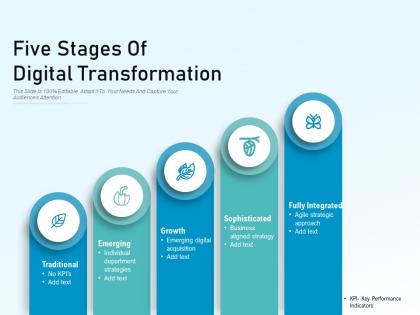
The image is a PowerPoint slide titled "Five Stages Of Digital Transformation," which represents the different phases a business might go through as it integrates digital technology into all areas of its operations, fundamentally changing how it operates and delivers value to customers.
The slide features five vertical bars of increasing height, signifying the progression through the stages. Each bar is associated with a particular stage of digital transformation and has a unique icon and text elements:
1. Traditional:
Characterized by no KPIs (Key Performance Indicators). Additional details can be added as needed.
2. Emerging:
Focuses on individual department strategies. Space is provided for further customization.
3. Growth:
Involves emerging digital acquisition strategies. Additional text can be appended.
4. Sophisticated:
Defined by business-aligned strategy. Extra details can be incorporated.
5. Fully Integrated:
Marked by an agile strategic approach. More information can be included.
Use Cases:
This digital transformation framework is applicable across a broad range of industries:
1. Technology:
Use: Guiding tech companies through digital product innovation.
Presenter: Chief Information Officer
Audience: Stakeholders, IT staff
2. Retail:
Use: Transforming retail businesses from brick-and-mortar to e-commerce models.
Presenter: Digital Transformation Lead
Audience: Retail executives, marketing teams
3. Healthcare:
Use: Implementing digital health records and telemedicine services.
Presenter: Healthcare Administrator
Audience: Medical professionals, administrative staff
4. Banking:
Use: Transitioning to online banking services and digital customer interfaces.
Presenter: Digital Strategy Manager
Audience: Banking executives, operational teams
5. Education:
Use: Shifting from traditional teaching to digital and remote learning platforms.
Presenter: Educational Technologist
Audience: Educators, institutional leaders
6. Manufacturing:
Use: Integrating Industry 4.0 technologies into manufacturing processes.
Presenter: Operations Director
Audience: Engineers, production managers
7. Logistics:
Use: Adopting digital tracking and automation for supply chain optimization.
Presenter: Logistics Coordinator
Audience: Supply chain partners, logistics teams
Five stages of digital transformation with all 2 slides:
Move from the fringes to the centre with our Five Stages Of Digital Transformation. They allow you to stake your claim.
FAQs for Five stages
Honestly, it comes down to three big things. Customers expect everything to work like Amazon now - super smooth and instant. Meanwhile your competitors are probably already doing this stuff, so you're falling behind if you don't. COVID definitely sped things up too, suddenly everyone had to go remote and figure out digital processes overnight. But here's the thing - digital tools actually do make life easier once you get past the initial headache of setting them up. They automate boring tasks, give you better data, fewer mistakes. My advice? Don't try to overhaul everything at once. Pick one thing and start there.
Honestly, you gotta measure both the numbers and the fuzzy stuff to really know what's happening. Start with the obvious business metrics - revenue, customer satisfaction, how much more efficient things are getting. Employee productivity too, obviously. But here's the thing - just tracking if people are using the new tech is pretty useless by itself. You need to actually ask employees and customers how they feel about the changes. Get a baseline before you start anything, then check progress monthly. Maybe set up some kind of dashboard so you can pivot fast if things go sideways.
Dude, culture will absolutely make or break your digital transformation. I've watched companies with solid tech plans crash and burn because nobody wanted to change how they worked. Your people have to feel comfortable experimenting with new stuff - even when they screw up at first, which they will. Leadership needs to actually USE the digital tools they're pushing, not just talk about them. Honestly? Figure out what's blocking your culture before you spend a dime on fancy technology. Celebrate the small wins too - that momentum really adds up over time.
Don't try to fix everything at once - that's a recipe for disaster. Pick your biggest headache and tackle that first. There are tons of free tools that'll handle the boring stuff automatically. CRM systems, cloud storage, social media posting - most have decent free versions. I'd focus on anything that either makes you money or gives you time back. Those savings? Put them toward your next upgrade. Quick wins build momentum way better than dropping a fortune on some fancy enterprise thing that takes forever to figure out. Get good at one thing, then move to the next.
Cloud computing and AI/ML are the big ones right now. IoT's massive for manufacturing and retail too. Everyone's doing cloud migration - it's basically expected at this point. Automation tools like RPA are cleaning up all the tedious back-office stuff. Honestly though, every vendor just throws "AI-powered" on everything now (kind of annoying). But the tech actually works when done right. AI's getting built into customer service, supply chains, you name it. I'd figure out what's actually broken in your business first, then see which of these fits.
Honestly, the worst part is people just hate change - your team will fight you on everything. Budget issues come out of nowhere too. Then you've got these ancient systems that refuse to work with anything modern, which is beyond frustrating. Nobody has time to actually learn the new tools either, so skill gaps become this massive problem. Data gets trapped in silos and makes integration hell. Plus if your executives aren't aligned on the vision, you're basically screwed from day one. I'd say start with small pilot projects first - way easier to show results and get buy-in before going big.
Look, build security right into your transformation from the start - don't just slap it on later. Zero-trust is the way to go... verify literally everything trying to access your systems. I know it sounds like a lot, but trust me, way better than dealing with a breach. Encrypt your data when it's moving and when it's sitting still. Keep updating those protocols and actually train your team on the new risks. Oh, and do a solid risk assessment before rolling out any new tech. Honestly saved my butt more times than I can count.
Honestly, get your leadership team on the same page first or you're screwed from day one. Figure out what your customers actually need, then work backwards - most companies think they need to transform everything when really it's like 30% of their processes. I'd start with small pilots that show quick wins while building toward the bigger stuff. Oh, and don't cheap out on training your people. Shiny new systems are useless if nobody knows how to use them properly. This isn't a sprint either - think of it more like remodeling your house while you're still living in it.
Look, training really is everything here. I've seen companies blow massive budgets on fancy software that just sits there collecting digital dust because nobody knows how to use it. Your team needs to actually understand these new tools - and more importantly, they need to buy into the whole process. Start by figuring out where your biggest skill gaps are. Then build learning programs that connect to what people actually do every day. Don't just dump them in generic workshops either. You'll want ongoing support and maybe some change management stuff too. Otherwise you're just setting money on fire, honestly.
Honestly, digital transformation is a game-changer for customer experience. Your customers can finally get quick responses and actually personalized service instead of generic BS. Most people live on their phones anyway, so you're meeting them there rather than making them jump through hoops. The cool part? You can use data to predict what they want before they even realize it themselves. Self-service becomes way smoother. People feel understood. Start by looking at your current customer journey - I'd bet there are some obvious pain points you can fix pretty easily for some quick wins.
Honestly, just start collecting data from everywhere - customer stuff, sales, operations, all of it. That's how you'll actually see where the real problems are instead of just guessing (companies get this wrong constantly). Pick your worst pain point first and digitize that process. Set up some basic dashboards so you can see what's happening in real time. Oh, and definitely start with just one department - prove it works there before you try to roll it out everywhere else. Way less messy that way. Once you've got solid results, scaling becomes much easier.
Job displacement is the obvious one - automation's gonna affect your workforce whether you like it or not. Then there's data privacy, which honestly most companies handle terribly even though they're collecting tons more info now. Algorithmic bias is another biggie since your AI might treat different groups unfairly without you realizing it. People also deserve to understand how automated systems make decisions about them - transparency matters. Oh, and here's the thing everyone gets wrong: you can't just add ethics discussions at the end. Build them into your planning from the start or you'll regret it later.
Honestly, the smartest thing is to start small and test stuff out before going all-in. Pick one area to pilot your new tech - don't try to flip everything at once because that's how companies totally screw themselves over. Run the new system alongside your old one until you're dead certain it actually works. Think of it like renovating while you're still living there, you know? You do one room at a time so you don't end up sleeping on the floor. Once you've proven it works in that test environment, then you can roll it out everywhere else. Way less risky that way.
Honestly, partnerships are a game-changer for digital transformation. You can't do everything in-house - it's just not realistic. Cloud providers and tech specialists bring expertise you'd take years to build yourself. Think of it as borrowing superpowers instead of trying to develop them from scratch. The trick is finding partners who actually get your industry, not just generic consultants. I'd start by figuring out your biggest skill gaps first. Then hunt for companies who've already solved these exact problems for businesses similar to yours. Way faster than reinventing the wheel.
Dude, COVID was insane for tech stuff. Companies that had these slow 3-year digital plans? Yeah, they threw those out and did everything in like 3 months. Remote work, online stores, contactless everything - it all happened so fast it made your head spin. Restaurants suddenly became delivery experts, schools figured out Zoom real quick. Even boring industries like manufacturing started using smart sensors they could check remotely. Healthcare though - that was the crazy one. Telemedicine went from barely existing to everywhere overnight. My advice? Don't wait around for another crisis to hit. Build cloud systems now that can actually handle growth when things get weird again.
No Reviews