


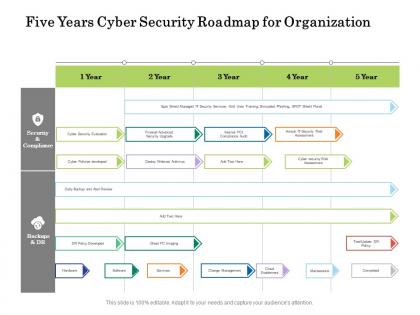
Five years cyber security roadmap for organization




Try Before you Buy Download Free Sample Product
 Impress Your
 Audience
 100%
100% Editable
 Save Hours
 of Time


Utilize our pre build Five Years Cyber Security Roadmap For Organization to present your plan of action in the most effective way. Reduce the paperwork and showcase how different activities are linked to each other by incorporating this attention grabbing PowerPoint theme. This completely editable roadmap PPT layout is suitable to fit all your needs and to have a structured outline of the entire process flow using color coding. Provide guidelines to your teammates about the progression process by employing our PPT theme. Team members can easily be designated into teams by accessing the work milestones to be accomplished within the timeframe. You can easily modify the PowerPoint slide according to real time situations. Download our stunning Five Years Cyber Security Roadmap For Organization, and you are good to go to prove your expertise in strategic planning.
People who downloaded this PowerPoint presentation also viewed the following :
Five years cyber security roadmap for organization with all 2 slides:
Use our Five Years Cyber Security Roadmap For Organization to effectively help you save your valuable time. They are readymade to fit into any presentation structure.

FAQs for Five years cyber security
So you'll want to start with figuring out what security stuff you actually have vs what you need - that gap analysis part is huge. Most companies I've seen are genuinely surprised by how many holes they find, honestly. Map out your biggest risks and vulnerabilities first. Then build a realistic timeline (like 1-3 years) with clear owners for each piece and actual budget numbers. Don't forget the boring compliance stuff and incident response planning. Oh, and get your executives on board early or this whole thing just becomes another dusty document nobody looks at. Quarterly check-ins help too.
Honestly, just do a full security audit first. Inventory everything you've got, test your defenses with vulnerability scans and pen testing. Think of it like a doctor visit for your network - yeah it sucks but you need to know what's broken. Check if your team actually knows security basics too. Review who has access to what, look for compliance gaps, test your incident response. Document it all (I know, boring but necessary). The whole point is getting a real picture of where you're vulnerable. Otherwise you're just guessing at what needs fixing, and that never ends well.
Honestly, you can't skip the risk assessment part - it's what shows you where you're actually vulnerable instead of just guessing. I learned this the hard way when we were buying random security stuff without knowing what we even needed to protect. Figure out your most critical assets first, then map how attackers might go after them. The whole point is prioritizing where to spend your time and money, because let's be real, you can't secure everything at once. Once you know your biggest risks, building the rest of your security plan becomes way more focused. Don't overthink it initially though.
Go with NIST first - it's free, pretty straightforward, and most companies actually use it. The risk-based thing makes sense too. ISO 27001 works if you need that official certification (though honestly it's kind of a paperwork nightmare). CIS Controls are solid for the more technical stuff. My take? Don't overwhelm yourself trying to do everything at once. NIST gives you a good foundation, then you can always add other pieces later depending on what your company needs. Way better than jumping into three different frameworks and getting nowhere.
Quarterly reviews are the sweet spot, but honestly? Most places I know are doing monthly check-ins now because threats evolve so damn fast. Big overhauls happen yearly or when something major hits - new regulations, business changes, or god forbid an actual breach. The quarterly thing works well though. Catches emerging stuff, lets you see if your current projects are actually doing anything useful, and you can shift priorities around. Set those calendar reminders right now - I'm serious about this one. It's always the first thing that gets pushed aside when everyone's busy.
Track both technical stuff and business impact to see what's actually working. Technical metrics like incident detection time, how fast you patch vulnerabilities, training completion rates - that kind of thing. But honestly? Sometimes the soft stuff matters more than spreadsheet numbers. Are people actually changing their security habits? Look at compliance results, downtime costs, incident expenses too. Here's the thing though - you need baselines first or you're just guessing if things improved. I'd say pick maybe 5-7 metrics that match your goals and check them every quarter. Don't go overboard with tracking everything.
Honestly, start with what your business actually needs. Expanding into Europe? Then GDPR compliance is your priority. Going all-in on digital? Cloud security and access controls come first. Most companies treat cybersecurity like this annoying expense that just drains budget. Wrong approach. Frame it as business protection instead - "this keeps our customer data safe, which builds trust and drives revenue." Way easier to get buy-in that way. Oh, and drop the tech jargon when you're pitching this stuff. Speak their language, not yours.
Honestly, most companies just try to tackle everything at once instead of focusing on what actually matters risk-wise. Big mistake. They also think it's just an IT thing when really the whole business needs to be involved. Scope creep kills these projects too - I've watched roadmaps turn into these crazy impossible lists. Leadership always underestimates how long training takes (and changing how people work is harder than they think). Oh, and tons of teams create these gorgeous roadmaps then never check if they're actually making progress. Start small though, get the executives on board early, and schedule regular check-ins to pivot when needed.
Don't treat training like some separate project you'll get to later. Weave it right into each phase - start with basic security awareness, then add role-specific stuff as you roll out new tools. Most companies totally blow this part by doing one training session and calling it done. Big mistake. You need ongoing quarterly refreshers, phishing sims, scenario exercises that actually match what's happening in the real world right now. The trick is timing it with when you're implementing new security measures. That's when people actually pay attention and it sticks.
Honestly, start with the basics - endpoint protection, a decent firewall, and multi-factor auth. Those are must-haves. SIEM tools catch threats as they happen, which is pretty clutch. Vulnerability scanners help you find weak spots before hackers do. Backup solutions are huge right now because ransomware attacks are everywhere (learned that one the hard way at my last job). Identity management keeps random people out of your systems. The whole thing works best when you layer everything together - if something breaks through one defense, another one catches it. Just build up gradually based on what risks you're actually facing.
Don't treat incident response like a one-and-done project - it's gotta be ongoing. Map your current detection stuff first, then build out response procedures and team training. Most teams totally skip the "lessons learned" phase, which is honestly the best part. Run tabletop exercises regularly and update your protocols when new threats pop up. Budget for tools AND training all year long - I learned that one the hard way at my last job. Think of it like going to the gym. You can't just work out once and expect to stay in shape, right? Same deal here.
Look, compliance basically makes your security roadmap for you - GDPR, HIPAA, whatever applies to your company becomes the starting point instead of just suggestions. Honestly not terrible since those frameworks cover most of the basics anyway. You'll need to prioritize their requirements first, budget for audits (ugh), and leave extra time because regulations change randomly and mess up your timeline. But here's the silver lining - getting budget approval becomes way easier when you can tell execs "this isn't optional, we're legally required to do this." That argument works every time.
Honestly, I'd start with a risk assessment to figure out where you're most exposed. Focus on the boring stuff first - strong passwords, keeping software updated, training your team. That foundation matters way more than some shiny expensive tool. Free open-source security options can work great when you're bootstrapping. Maybe roll things out in phases so you're not dropping huge money upfront? Oh, and definitely document what you're doing. Makes it easier to prove it's working when you need more budget later.
Figure out who you need on board first - execs, IT, compliance, actual users, the whole gang. Skip the boring presentation route and get them into real working sessions where they can actually shape things. Oh, and talk money/business impact with leadership, not tech specs - learned that one the hard way. Check in regularly so nobody's shocked when you roll things out. The trick that really works? Give people ownership over pieces of the roadmap. When they feel responsible for parts of it, they actually care about making it succeed instead of just complaining later.
Break it down into phases - quick wins first, then bigger picture stuff. Patch those critical vulnerabilities and fix access controls right away. Meanwhile, start planning the heavy hitters like zero-trust or automation. I've watched way too many teams get trapped just putting out fires constantly. Split your resources maybe 70% immediate problems, 30% building for the future. Then flip that ratio over time as things stabilize. Oh, and set up quarterly check-ins to see what new threats are popping up - this stuff changes fast.
-
Design layout is very impressive.