


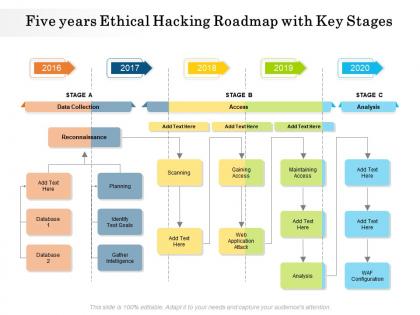
Five years ethical hacking roadmap with key stages




Try Before you Buy Download Free Sample Product
 Impress Your
 Audience
 100%
100% Editable
 Save Hours
 of Time


Utilize our pre build Five Years Ethical Hacking Roadmap With Key Stages to present your plan of action in the most effective way. Reduce the paperwork and showcase how different activities are linked to each other by incorporating this attention grabbing PowerPoint theme. This completely editable roadmap PPT layout is suitable to fit all your needs and to have a structured outline of the entire process flow using color coding. Provide guidelines to your teammates about the progression process by employing our PPT theme. Team members can easily be designated into teams by accessing the work milestones to be accomplished within the timeframe. You can easily modify the PowerPoint slide according to real time situations. Download our stunning Five Years Ethical Hacking Roadmap With Key Stages, and you are good to go to prove your expertise in strategic planning.
People who downloaded this PowerPoint presentation also viewed the following :
Five years ethical hacking roadmap with key stages with all 2 slides:
Use our Five Years Ethical Hacking Roadmap With Key Stages to effectively help you save your valuable time. They are readymade to fit into any presentation structure.

FAQs for Five years ethical hacking roadmap
Honestly, start with networking basics and get comfortable with Linux - you'll be living in command lines. Python's probably your best bet for scripting, though JavaScript and C++ are solid too. Before you can hack anything, you gotta understand how systems actually work, which sounds boring but trust me on this. Learn pentesting methods and tools like Nmap, Metasploit, Burp Suite. The technical stuff is only half of it though - you'll spend way more time than you'd think explaining vulnerabilities to people who don't get tech. Try some CTF competitions to practice. They're addictive once you get into them.
Honestly, you gotta just dive into the hands-on stuff. TryHackMe and Hack The Box are perfect for starting out - they walk you through everything so you won't be totally clueless. VulnHub's cool too since you can download VMs and mess around offline. Build yourself a little home lab with vulnerable apps like DVWA or Metasploitable. CTFs are where it gets really fun though - they'll teach you to actually think like a hacker instead of just following tutorials. Oh, and don't skip the boring repetition part. That's what actually sticks.
Python's your best bet to start with - tons of libraries for network stuff and web scraping. You'll also want bash scripting since you're gonna be in the terminal constantly anyway. JavaScript helps a lot when you're poking around web apps and figuring out client-side bugs. C/C++ is useful for understanding buffer overflows but honestly that's more advanced territory. Oh and SQL is pretty much required for database attacks and injection stuff. I'd just focus on Python and bash first though - they'll handle most of what you need for basic pentesting. The other languages can wait until you're more comfortable.
Dude, certs are honestly game-changers for breaking into pentesting. CEH is solid for getting your foot in the door - shows you've got the basics down. But OSCP? That's where the magic happens. It's brutal hands-on testing that actually proves you can hack stuff, not just memorize theory. Clients and hiring managers see these on your resume and immediately know you're legit. Way better than trying to explain "yeah I learned everything from random tutorials and CTFs" - though that's totally valid too, just harder to sell yourself. I'd go CEH first for foundation, then grind toward OSCP when you're ready to hate your life for a few months.
Start with CVE and NVD databases - they're your go-to for vulnerability tracking. Twitter's honestly where I get most of my real-time intel if you follow the right security researchers. Krebs on Security is solid for blogs. Set up Google Alerts for "zero-day" and stuff in your field. Security conferences are worth it, even virtual ones (way cheaper anyway). Communities like r/netsec are pretty active too. If your company has threat intel feeds, definitely use those. Just don't go crazy at first - pick maybe 2-3 sources or you'll drown in notifications.
Dude, you absolutely need written permission before touching anything - verbal doesn't cut it when you're literally breaking into systems. Scope creep is real too, so stick to what's agreed on. The disclosure thing gets tricky because timing matters a ton (you don't want to hand bad actors a how-to guide). Your skills could get weaponized if you're sloppy about who you work with. I've seen people get burned by not documenting properly. Get authorization first, define clear boundaries, and have solid reporting protocols ready. Trust me on this one.
Start with the basics - Nmap, Wireshark, and Metasploit are your bread and butter. Burp Suite is a must for web testing, honestly can't imagine working without it. Grab either Nessus or OpenVAS for vulnerability scans. John the Ripper handles password cracking pretty well too. Kali Linux packages most of this stuff together which saves you tons of setup time. Oh, and learn some Python or Bash scripting - you'll thank me later when you're automating everything. Master these first, then branch out based on what actually interests you. No point collecting tools you'll never touch.
Dude, get everything in writing first - that's what saves your ass legally. Make sure the contract spells out exactly which systems you can test and what methods are cool to use. I've literally seen people get sued even with "permission" because the scope was too vague. Document what you're doing as you go, and don't sit on critical stuff - report vulnerabilities right away. Oh, and if it's payment systems, you'll need to follow PCI DSS rules too. Honestly though, clear contracts plus keeping them in the loop constantly? That's your best protection.
So basically, it's all about permission and what you're trying to accomplish. White-hat hackers are the good ones - they get permission first and help companies patch security holes. Black-hats? Total criminals who steal data or mess stuff up for money. Gray-hats are weird because they'll find bugs without asking but actually report them instead of being jerks about it. Honestly, if you're getting into this stuff, stick to white-hat only. Get some certs, practice on legit sites like HackTheBox, and never touch systems you don't own. Trust me on that last part.
Yeah dude, you absolutely can't skip network security - it's like fundamental stuff. Gotta understand how networks actually function before you can break into them properly. TCP/IP, subnetting, firewalls, VPNs, all that jazz. Some of the worst breaches I've read about? They started with super basic network screwups that should've been obvious. It's like trying to pick a lock when you don't even know how doors work, you know? I'd start with Network+ materials or maybe CCNA to get your foundation solid, then branch out into the more security-focused networking stuff later.
Ditch the technical jargon completely - executives don't care about SQL injections. Focus on what actually matters to them: "Hackers could steal customer credit cards" or "Your site goes down, you lose money." Risk matrices and screenshots help too. Honestly, they're way more worried about getting sued than understanding buffer overflows. Always throw in remediation steps with realistic timelines and costs. I learned this the hard way after watching too many eyes glaze over during presentations. End every finding with "Here's your next move" - keeps it simple and actionable.
So first thing - they need written permission or you're basically screwed legally. Then they'll hit you with the usual stuff: fake phishing emails, sketchy phone calls pretending to be IT, maybe even try walking into your building. Honestly the documentation part is kind of tedious but super necessary. What they're really looking for is who on your team might get fooled and where your security training sucks. You'll want to give everyone a heads up that testing's coming, but don't spoil the surprise by telling them exactly what or when. The final report will show you exactly where you're vulnerable.
OWASP has amazing free resources - start there for solid methodologies. PTES framework is worth checking out too. CEH study materials are pretty decent even without taking the actual cert. YouTube saved my life learning this stuff honestly - NetworkChuck and John Hammond break things down way better than boring textbooks. HackTheBox and TryHackMe are clutch for hands-on practice since they teach you real methodologies through actual scenarios you'll encounter. Mix structured learning (OWASP's your friend here) with tons of lab work. That's how concepts actually stick instead of just memorizing theory.
Honestly, home labs are perfect for this stuff - you get to mess around with attacks and defenses without worrying about legal issues or breaking anything important. I started with VirtualBox (free!) and threw some vulnerable VMs on there like Metasploitable. Way cheaper than those cloud lab subscriptions once you get past the initial setup headache. You can actually break things and learn from it, which is huge. The freedom to experiment at your own speed makes all the difference. DVWA's another good one to start with if you're just getting comfortable with the basics.
Trust me, you'll forget everything way faster than you think. I learned this the hard way after spending hours redoing work I'd already figured out months earlier. Taking notes on what worked and what bombed creates this personal cheat sheet that saves crazy amounts of time later. You can copy successful attacks, skip the stuff that failed, and actually build on past work instead of reinventing the wheel. Client reports need solid documentation too - honestly, it's part of staying ethical. Start basic though. Even messy notes about tools and findings will save your future self major headaches.
-
Excellent products for quick understanding.