


Quarterly ethical hacking roadmap with key stages




Try Before you Buy Download Free Sample Product
 Impress Your
 Audience
 100%
100% Editable
 Save Hours
 of Time


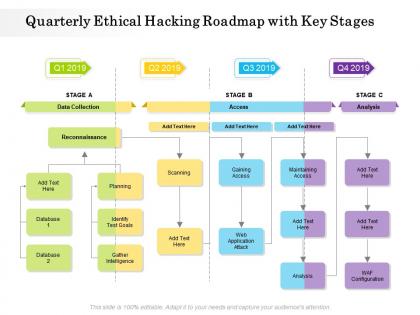
Utilize our pre build Quarterly Ethical Hacking Roadmap With Key Stages to present your plan of action in the most effective way. Reduce the paperwork and showcase how different activities are linked to each other by incorporating this attention grabbing PowerPoint theme. This completely editable roadmap PPT layout is suitable to fit all your needs and to have a structured outline of the entire process flow using color coding. Provide guidelines to your teammates about the progression process by employing our PPT theme. Team members can easily be designated into teams by accessing the work milestones to be accomplished within the timeframe. You can easily modify the PowerPoint slide according to real time situations. Download our stunning Quarterly Ethical Hacking Roadmap With Key Stages, and you are good to go to prove your expertise in strategic planning.
People who downloaded this PowerPoint presentation also viewed the following :
Quarterly ethical hacking roadmap with key stages with all 2 slides:
Use our Quarterly Ethical Hacking Roadmap With Key Stages to effectively help you save your valuable time. They are readymade to fit into any presentation structure.

FAQs for Quarterly ethical hacking roadmap
Focus on three big things this quarter: CEH or OSCP prep, building your home lab, and knocking out 3-4 CTF challenges. The lab setup's honestly gonna eat up most of your time - you'll need Kali, some Windows targets, plus vulnerable apps like DVWA. CTFs are fun though, way better than just reading theory all day. Don't sleep on the report writing practice either. That's where tons of people mess up later. I'd block out maybe 10-15 hours each week and just track everything in a basic spreadsheet. Keeps you honest about actually putting in the work.
Your ethical hacking approach should change every quarter based on what's actually happening out there. I'd start by watching threat feeds and breach reports - figure out what attackers are doing right now, not last year's stuff. Map your pen testing to mirror those real attack patterns. Ransomware crews using new social engineering tricks? Your red team better test those same methods on your systems. Build regular feedback between your security team and ethical hackers - honestly, most companies forget this part. Make it a quarterly thing you actually stick to, not something that gets pushed off indefinitely.
Dude, cloud security is where it's at right now. AWS, Azure, GCP pentesting - companies are throwing money at this stuff since everyone's moving everything to the cloud. API security testing is blowing up too, especially with GraphQL and REST vulnerabilities. Container security with Docker and Kubernetes is massive. Literally every startup I know is going full container mode. Oh, and AI/ML security is getting weird - prompt injection and model poisoning attacks are wild but nobody really knows how to defend against them yet. Honestly? Pick two of these and just start messing around with some labs this month. You'll learn way more doing it than reading about it.
Track your wins with both hard numbers and the softer stuff that actually matters day-to-day. Vulnerability rates dropping? Good. Time to fix critical issues shrinking? Even better. Audit scores make the compliance team happy, but honestly the real gold is when you see developers naturally writing cleaner code and your incident response getting tighter. I always forget how much leadership loves seeing ROI until review time hits - so maybe do a quarterly scorecard thing? Mix your technical wins with business impact. That way when budget season rolls around, you've got solid proof your ethical hacking program isn't just burning money.
Dude, you've gotta try Nuclei first - the community templates are insane and you'll get wins immediately. CodeQL is crushing it for semantic analysis right now. For C2 stuff, Sliver's been solid, and Metasploit dropped some neat evasion modules recently. Everyone's obsessing over ChatGPT for recon automation but honestly? Results are pretty mixed in my experience. Cloud-wise, ScoutSuite and Prowler are must-haves if you're not using them yet. Container security is moving fast - Trivy and Grype will save your ass there. Actually, now that I think about it, start with Nuclei since it integrates well with most workflows.
Start with NIST Cybersecurity Framework as your base - it's solid. OWASP handles web app testing, and PTES gives you good methodology structure. MITRE ATT&CK is huge right now for threat modeling, everyone's using it. ISO 27001 covers compliance stuff if you need it. Here's the thing though - don't try to do everything at once. Pick maybe 2-3 frameworks per quarter, otherwise you'll burn out on all the documentation. Map your quarterly goals to specific parts of each framework so you're not just randomly hitting targets. OSSTMM's worth looking at too for comprehensive coverage, but honestly it can get pretty dense. Rotate based on what's actually risky for your org.
Stop being the security cop who swoops in at the end with a problem list. Get into their sprint planning, use their ticket system, actually sit with devs during code reviews - that's where the real learning happens, not in some PowerPoint deck. Weekly 15-minute chats work great for quick questions or sharing threat intel. Oh, and always explain WHY something's a risk instead of just "fix this vulnerability." I know it sounds obvious but most security people skip that part. Bottom line: become their teammate who helps build secure stuff upfront rather than the person they dread hearing from.
First things first - get your authorization docs sorted out. Written permission from asset owners, clear scope boundaries, the whole deal. Your Rules of Engagement need updating too if you're testing new systems this quarter. Check that your liability insurance actually covers pentest activities (trust me, you don't want to find out it doesn't after something breaks). Data handling gets tricky with PCI or HIPAA stuff. Honestly? Just grab 30 minutes with legal before you start - way easier than dealing with angry lawyers later.
Honestly, just mash CVSS scores together with what actually matters to your business. Ask yourself "what's the absolute worst case if someone exploits this?" - that question alone cuts through so much BS. Hit your external stuff first, obviously, then dig into the internal systems based on how sensitive the data is. Create some basic buckets: Critical means drop everything and patch now, High gets 30 days, Medium can wait 90. Your team will thank you for the clarity. Don't get too caught up in the technical severity numbers though - a "medium" vuln on your payment system is way scarier than a "high" one on some random dev box.
Scope creep will destroy you - you'll start testing one thing and end up three networks deep without permission. Document everything obsessively because I've watched teams find critical vulns then lose them forever due to crappy notes. Don't chase fancy exploits when basic misconfigs are staring you in the face (honestly, some of the worst breaches come from stupid simple stuff). Keep stakeholders in the loop constantly, not just at the end. They get antsy without updates. Set boundaries early and actually stick to them, or you'll burn bridges fast.
Honestly, Friday afternoons work great for skill building since I'm usually too brain-dead for real technical stuff anyway. Try dedicating like 20% of each quarter to learning new attack vectors or whatever tools are trending. Monthly learning sprints where everyone rotates through different areas - web app security, network pen testing, social engineering - keep things fresh. Oh and definitely track what certs people want and line up quarterly goals with exam dates. Makes the whole thing feel less like homework. The goal is staying sharp for actual engagements, not just checking boxes.
Think of threat intel as your cheat sheet for pentesting priorities. You're not just poking around randomly anymore - you're hitting the stuff that hackers are actually exploiting right now. Check out recent CVE databases and threat reports to see what's hot this quarter. Industry-specific attacks are huge too, so focus there first. It's honestly like having a preview of their playbook before the game starts. Your testing schedule should mirror what threat actors are using in the wild - that's where you'll catch the nastiest vulnerabilities before they do.
So here's what works for me - ditch the tech speak completely when talking to executives. I always use the "testing your defenses before the bad guys do" line because honestly, it clicks every single time. Think of it like hiring someone to check if your house locks actually work, you know? Show them numbers they care about: money saved, risks gone, compliance boxes checked. Those vulnerability reports? Turn them into simple dashboards showing "problems fixed" and "security got better." Skip all the exploit details - they don't need that headache. Just connect everything back to what keeps them up at night: protecting customer info and avoiding those nightmare headlines.
Dude, AI attack tools are getting insanely sophisticated - they're automating vuln discovery and social engineering like crazy. Cloud misconfigs are still everywhere (seriously, how do people keep screwing this up?). Supply chain attacks aren't just hitting dependencies anymore - now they're going after CI/CD pipelines and container stuff. Oh, and API security is a mess, especially with GraphQL. Set up some alerts for new AI security tools and maybe audit your cloud configs when you get a chance. Everything's moving stupid fast right now, honestly.
Look, make it everyone's problem, not just IT's headache. Run training with actual examples from your pen testing - real stories stick way better than boring policies. Get volunteers from different departments to be your "security champions" and spread the word. Gamification actually works (sounds cheesy but whatever) - do phishing sims and celebrate wins instead of shaming people. Share your quarterly results so teams get why this stuff matters. Oh, and keep it collaborative. Nobody likes being lectured at. You'll get way more buy-in that way.
-
Helpful product design for delivering presentation.
-
Illustrative design with editable content. Exceptional value for money. Highly pleased with the product.
-
Informative design.
-
Illustrative design with editable content. Exceptional value for money. Highly pleased with the product.
-
Designs have enough space to add content.