

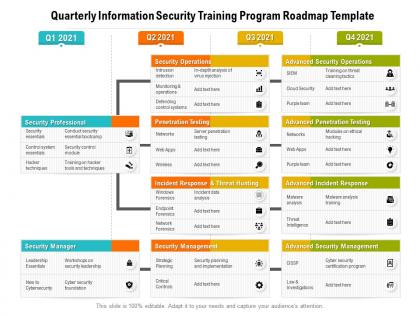
Quarterly information security training program roadmap template




Try Before you Buy Download Free Sample Product
 Impress Your
Audience
 100%
Editable
 Save Hours
of Time


A cohesive work plan is essential for achieving the desired target. Communicate your vision and lay a firm ground in front of your audience with our PowerPoint layout. Align your project milestones, budgets, deliverables, deadlines, and all the requisite information for a dynamic presentation by employing this amazingly designed Quarterly Information Security Training Program Roadmap Template. Maximize team efficiency and streamline a work plan efficiently by introducing our ready made roadmap PowerPoint theme. You can quickly establish coordination between different activities across the organization and present an insight to your colleagues by utilizing this useful business tool. Color code specific tasks, prioritize, and keep a close eye on the deadlines with the help of our eye catchy PowerPoint template. Download our Quarterly Information Security Training Program Roadmap Template for excelling at productive management.
People who downloaded this PowerPoint presentation also viewed the following :
Quarterly information security training program roadmap template with all 2 slides:
Give your audience a fulfilling experience. They will find our Quarterly Information Security Training Program Roadmap Template elevating.


FAQs for Quarterly information security training
Alright, so you'll want four key things: basic security training for everyone, then specialized stuff for different teams, plus hands-on practice like fake phishing emails, and regular refreshers. The basic training covers password stuff and spotting sketchy emails - honestly wild that people still fall for obvious scams, but whatever. Different departments need targeted training since what finance deals with is totally different from what IT faces. Practice scenarios are clutch because people learn better when they can mess up safely. Oh, and track how well it's actually working through tests and incident reports, not just who clicked "complete."
So basically you've gotta match the training to what people actually do at work. Group everyone by role first - executives get the governance stuff, IT gets the hardcore technical training, finance focuses on fraud prevention. HR handles tons of personal data so they need solid training too (people always forget about them). General employees just need the phishing basics. Here's the thing though - make the scenarios realistic for each group. If someone never touches customer data, why waste their time on data classification? Create different learning paths with varying levels of detail. Keep it relevant instead of boring everyone with generic content they'll never use.
Start with phishing simulations - they're honestly the best way to see if people actually get it. Before/after tests show knowledge gains, but watching real behavior matters more. Do people lock their screens now? Check incident reports to see if breaches dropped after training. Surveys help too, especially for spotting confidence issues. Honestly, combining a few methods works better than relying on just one metric. I'd run baseline phishing tests first, then add knowledge quizzes and track your security incidents over the next couple months. It's kinda tedious but you'll get a clearer picture.
Honestly, once a year is the absolute minimum but don't just stick to that. Big changes in threats or new regulations? Update immediately. I swear some companies are still worried about USB drives while employees are getting ransomware emails daily lol. Quarterly refreshers work great, especially for phishing since scammers get creative fast. Also update after any actual incidents - that's when people actually pay attention. Set a reminder every six months and just ask yourself: "would this help my coworkers today?" If you're teaching outdated stuff, you're wasting everyone's time.
Honestly, the hardest part is just getting people to care - everyone thinks security training is this mind-numbing waste of time. Budget's always tight too since execs want some magic one-time fix instead of ongoing investment. Oh, and your materials get stale super fast because hackers are constantly switching up their tactics. Start small though. Skip the boring company-wide stuff and make it specific to what each team actually does. Like, give the finance folks scenarios about invoice scams, not generic phishing examples. Make it feel relevant to their real work instead of just another compliance thing to check off.
Honestly, the usual stuff like completion rates and quiz scores barely scratch the surface. What you really want to see is if people actually change their behavior - run fake phishing tests and track how many fall for them. Survey folks about whether the content felt relevant (this part's huge). Space out follow-up assessments over 30, 60, 90 days because people forget everything ridiculously fast. Also track your security incidents before and after training rollouts. Oh, and ask employees how confident they feel handling sketchy emails - that confidence metric tells you way more than you'd expect. Just make sure you've got solid baseline numbers first, otherwise you're shooting blind.
Oh man, you're so right to ask about this! Leadership buy-in makes or breaks everything. I've watched training programs just... die when execs don't care. But when they're actually participating and talking about it? Night and day difference. People pay attention because they see it matters to the boss. Plus you'll actually get budget and time to do it properly instead of rushing through some half-baked modules. Honestly the politics part is almost more important than the content sometimes. Get at least one C-level person on your side before you launch anything big - trust me on this one.
Honestly, gamification works super well for this stuff. Add points, badges, maybe a leaderboard - suddenly people actually care about finishing those boring compliance modules. We did phishing competitions at my last job where teams tried to get the lowest click rates, which was way more fun than expected. Escape rooms work too - employees solve security puzzles to unlock the next level. Some companies do trivia nights or even scavenger hunts around the office. The trick is showing progress right away and rewarding people immediately when they do something right. I'd start with just a basic point system and see how it goes from there.
Focus on the big three first: phishing, password managers, and spotting social engineering tricks. Honestly, that covers most of how companies actually get hacked. After that, get specific - teach data handling to anyone touching sensitive stuff, secure coding for your developers. Mobile security's huge now too since we're all working from random coffee shops half the time. Break it into small pieces over a few months rather than one massive training dump. People's brains can only take so much cybersecurity lecture at once, you know? Make sure it connects to what they're doing day-to-day, not just generic "don't click bad links" stuff.
Oh man, culture stuff is huge for security training. Some groups want all the context and relationship-building first, others just want the bullet points. I've watched amazing programs totally bomb because they ignored this. Power dynamics matter too - certain cultures expect training from higher-ups, while others prefer learning from peers. Then you've got communication styles, hierarchy attitudes, how people like feedback... it's a lot. Honestly? Survey your teams first. Figure out what works for them, then adapt your examples, delivery style, even who's doing the training. Makes such a difference.
Honestly, running incident response simulations is like the best investment you can make. Your team gets to practice dealing with security breaches without the actual panic and chaos. Fire drills but for hackers, basically. You'll spot holes in your procedures super fast, plus see how everyone communicates when stuff hits the fan. Some people freeze, others surprise you by taking charge - good to know beforehand! Start small with tabletop exercises where you just talk through scenarios. Once everyone's comfortable, move to full technical simulations. Trust me, that muscle memory saves you when real incidents happen.
Honestly, mobile-first is everything here. Remote people are checking stuff on their phones constantly, so if your training doesn't work on mobile, you're screwed. Break everything into short chunks - nobody's sitting through hour-long sessions anymore. Mix recorded modules they can do whenever with some live Q&A sessions for the social aspect. Oh, and definitely track who's actually finishing this stuff by team or location. I swear half the companies I know just blast out PDFs and then act shocked when engagement is trash. The bite-sized approach works way better than those marathon training dumps everyone hates.
Start with monitoring baked right into your training plan. I grab threat intel from SANS newsletters and vendor alerts - honestly the daily emails are clutch for catching new attack patterns early. Build your training content in chunks so you can swap pieces out instead of redoing everything. Your SOC team is gold here since they're dealing with actual attacks happening to you right now. Do quarterly check-ins to see what's stale, then focus updates on whatever threats are hitting your industry hardest. Way more efficient than scrambling to catch up later.
Honestly, bake the feedback stuff right into your design from day one. After each module, send quick surveys and watch your completion rates like a hawk. Quiz scores tell you a lot too. Create some way for people to actually speak up about what sucks and what doesn't. Too many companies just dump training out there and walk away - drives me crazy. Use all that data to tweak your content and timing. Oh, and run focus groups with different departments since they deal with totally different security headaches. Main thing is making feedback dead simple to give, then actually doing something with it.
NIST and SANS have really good frameworks to start with - they're basically your foundation. OWASP Top 10 is absolutely essential for web security stuff. Cybrary and SANS have templates you can steal and modify, which saves tons of time. For the hands-on part, DVWA and WebGoat are perfect since people can break things without, you know, actually breaking anything important. Your internal security folks are probably sitting on knowledge that's way more relevant than generic training though. Pick one framework first, then build practical exercises around whatever tech you're actually using. Oh, and honestly? Don't overthink it - something decent that people will actually complete beats a perfect program nobody finishes.
No Reviews